
September 17, 2026
For users of SWIFT Accounting and Procurement modules and those who use SWIFT data in the EPM Data Warehouse.
Contents
- Punchout Error Workaround
- SWIFT Data is Available to the Public on TransparencyMN
- Add Comments to Purchase Orders
- SWIFT Hot Topic: “Hold” in the Interagency Voucher Netting Field
- SWIFT Module Training
- EPM Data Warehouse for SWIFT Training
Punchout Error Workaround
If you continue to receive a “First Operand of NULL” error when trying to complete a Punchout order, it means your browser is still unable to submit the request. Until the issue is resolved, users can successfully submit Punchout orders using the Firefox browser. Our technical team is actively working on a solution for Chrome and Edge. We will notify you as soon as the issue is fixed.
SWIFT Data is Available to the Public on TransparencyMN
Did you know that SWIFT budget, payment, contract, grant, and purchase order information is available to the public on the TransparencyMN website? TransparencyMN uses citizen-friendly public reports from the EPM Data Warehouse.
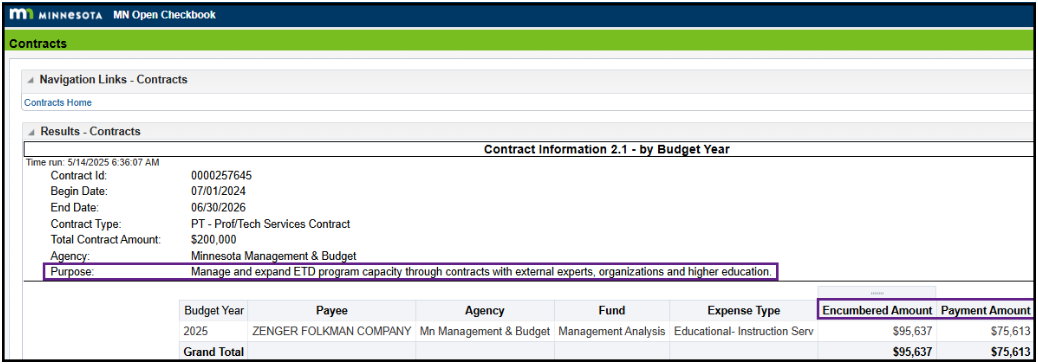
For example, if you create contract shells in the Supplier Contracts module, you are familiar with the required Statement of Purpose field. This field is visible to the public in the Contracts Open Checkbook on the TransparencyMN website. Remember to write a clear, concise, and easy to understand Statement of Purpose of the contract.
Here’s an example of a Statement of Purpose in the MN Open Checkbook, available to the public:
See the TransparencyMN website for more examples and details.
Add Comments to Purchase Orders
You can add comments and/or attachments to a purchase order. You can add comments to the header, lines, or schedules sections. See below for detailed steps for each section.
Header Comments
1. On the purchase order header, select the Add Comments or Add ShipTo Comments.
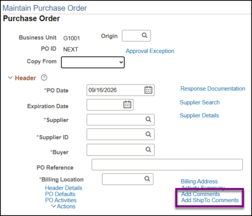
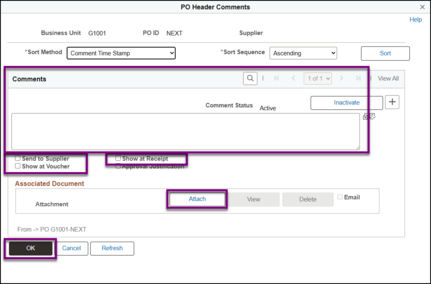
2. SWIFT opens the PO Header Comments or ShipTo Comments page. Enter text in the Comments section.
- Optionally, select any applicable boxes for Send to Supplier, Show at Voucher, and/or Show at Receipt, and select the Attach link to attach any documents as needed.
3. Select OK when you are done.
Lines Comments
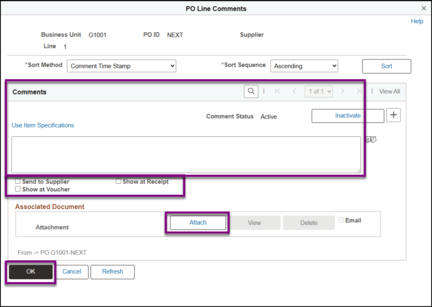
1. On the PO Lines section, select the Comment icon.

2. SWIFT opens the PO Line Comments page. Enter text in the Comments section.
- Optionally, select any applicable boxes for Send to Supplier, Show at Voucher, and/or Show at Receipt, and select the Attach link to attach any documents as needed.
3. Select OK when you are done.
Schedules Comments
1. On the PO Lines section, select the Schedules icon.

2. Select the Add ShipTo Comments link.
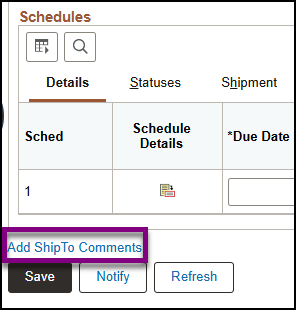
3. SWIFT opens the PO ShipTo Comments page. Enter text in the Comments section.
- Optionally, select any applicable boxes for Send to Supplier, Show at Voucher, and/or Show at Receipt, and select the Attach link to attach any documents as needed.
4. Select OK when you are done.
SWIFT Hot Topic: “Hold” in the Interagency Voucher Netting Field
Help Desk Hot Topics feature Frequently Asked Questions (FAQs) answered by the SWIFT Help Desk. Use these as a friendly reminder of a process or as an opportunity to learn something new!
Q. Why does my interagency voucher say “Hold” on the Netting field? Should I change this?
A. On the Payments tab, SWIFT automatically sets the Netting field to “Hold” for interagency vouchers. The “Hold” must be on the Netting field of interagency vouchers because it allows the bilateral netting process to identify and process the interagency payment.
Do not change this field. Once the payment is completed, SWIFT updates the Netting field to “Selected.”
For troubleshooting any issues with bilateral netting, view the Troubleshooting Payments on Interagency Vouchers Quick Reference Guide.
SWIFT Module Training
The SWIFT Training team offers SWIFT module training through a variety of methods at no additional cost to the agency. There are SWIFT training guides and training videos, webinars, eLearning, and individual sessions (by request through the SWIFT Help Desk).
Find current SWIFT training in Learning Management. Enter "SWIFT" in the Find Learning text entry box.
Module |
SWIFT Webinars & eLearning
|
Dates |
|
Intro |
Introduction to SWIFT Navigation webinar |
10/7/26; 11/4/26 |
|
Intro |
Introduction to SWIFT Navigation eLearning |
Anytime |
|
Intro |
Overview of SWIFT Reporting webinar |
9/24/26; 10/22/26 |
|
AP |
SWIFT Vouchers and Accounts Payable Overview webinar |
11/10/26 |
|
PO |
SWIFT Purchase Orders Overview webinar |
10/6/26 |
|
SS |
SWIFT Strategic Sourcing eLearning |
Anytime |
EPM Data Warehouse for SWIFT Training
The SWIFT Training team offers EPM Data Warehouse training for SWIFT data through a variety of methods at no additional cost to the agency. There are EPM training guides, videos, labs, and individual sessions (by request through the SWIFT Help Desk).
Find current EPM Data Warehouse training in Learning Management. Enter "EPM" in the Find Learning text entry box.
EPM Data Warehouse Labs
|
Dates |
|
SWIFT EPM Use Standard Reports and Understand the Data |
9/23/26 |