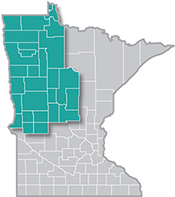
 The presence of such industry powerhouses as Polaris, Arctic Cat and New Flyer make Northwest Minnesota a hub of transportation equipment manufacturing.
From wheat and potatoes to soybeans and sugar beets, the region is a major producer and processor of food staples and specialty agricultural products.
Want the freshest data delivered by email? Subscribe to our regional newsletters.
In-demand health care occupations offer accessible entry points and opportunities to advance with education and support.
10/26/2026 1:32:47 PM
Anthony Schaffhauser
November is Celebrate Caring Careers Month, an opportunity to recognize the people who help older Minnesotans and people with disabilities and behavioral health needs live with dignity and independence. It is also a good time to consider what these careers offer the people doing that work. The Celebrate Caring Careers page on the CareerForce website features workers' stories, career exploration resources and ways employers and communities can participate in the celebration.
For Northwest Minnesota, the opportunity deserves a closer look. Nursing Assistants rank first among the region's Occupations in Demand. Together with Home Health & Personal Care Aides and Registered Nurses, they account for three of the four highest-ranked occupations. These are not obscure career options with a handful of openings, they are large occupations with thousands of workers and with substantial regional demand.
But demand alone is not enough to make a career attractive. Can these jobs support workers and their families? And can an accessible first job become the starting point for a financially rewarding career?
I served on the Governor's Workforce Development Board's Caring Careers Committee, which brought industry and state agency partners together to focus on the workforce serving people with long-term care needs. That includes aging services, disability services and behavioral health services that are delivered in facilities, people's homes and community settings.
The committee's framework connects two perspectives: the industries providing long-term care, and the direct care and direct support professionals working in them (Figure 1). This is broader than nursing facilities alone. It also includes home health care, assisted living, residential disability and behavioral health services, and services for older adults and people with disabilities.
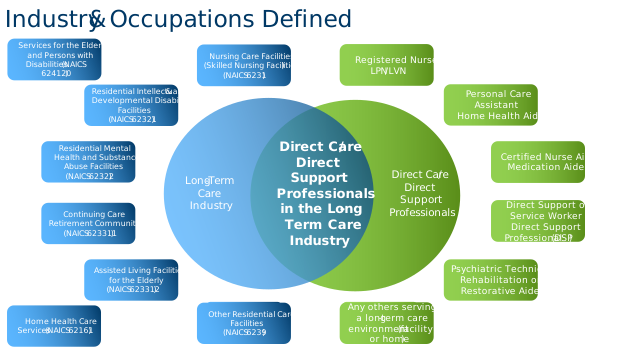
For this article, we narrowed the occupational list to careers with published Northwest Minnesota employment and wage estimates, education requirements of an associate's degree or less, and inclusion in the region's Occupations in Demand list. Eleven occupations meet those criteria.
DEED's Cost of Living study provides a useful starting point. In 2025, a single working adult with no children needed $14.97 per hour to cover basic needs in Northwest Minnesota.
For our standard three-person household, which includes two partnered adults, one working full time and one half time, with one child, the required wage was $19.88 per hour for each worker. Together, those earnings cover an estimated annual household budget of $62,016.
These are basic-needs budgets, not measures of a comfortable middle-class lifestyle. They nevertheless provide a concrete benchmark for assessing career opportunities.
| Occupation | Employment | Demand Rating | Education Requirement1 | Median Hourly Wage | Basic-needs Benchmarks Met2 |
|---|---|---|---|---|---|
| Nursing Assistants | 3,590 | ★★★★★5 stars | Certificate | $22.53 | Both |
| Home Health and Personal Care Aides | 7,380 | ★★★★★5 stars | High school | $18.36 | Single adult |
| Registered Nurses | 5,030 | ★★★★★5 stars | Associate's degree | $47.21 | Both |
| Licensed Practical and Licensed Vocational Nurses | 1,690 | ★★★★★5 stars | Certificate | $30.24 | Both |
| Pharmacy Technicians | 670 | ★★★★★5 stars | Certificate | $22.64 | Both |
| Medical Assistants | 660 | ★★★★★5 stars | Certificate | $22.83 | Both |
| Respiratory Therapists | 70 | ★★★3 stars | Associate's degree | $44.40 | Both |
| Medical Records Specialists | 220 | ★★★3 stars | Certificate | $28.71 | Both |
| Psychiatric Technicians | 300 | ★★★3 stars | Certificate | $22.28 | Both |
| Physical Therapist Assistants | 110 | ★★★3 stars | Associate's degree | $32.04 | Both |
| Massage Therapists | 70 | ★★★3 stars | Certificate | $16.82 | Single adult |
|
Sources: DEED Occupational Employment and Wage Statistics, first quarter 2026; Northwest Minnesota Occupations in Demand; and 2025 Cost of Living. Note: Employment and wages cover these occupations across all industries, not solely long-term care. 1 "Certificate" abbreviates the OID category "postsecondary non-degree award." Requirements vary by occupation and program. 2 "Both" means the median exceeds both the single-adult and standard three-person household hourly benchmarks. |
|||||
According to Occupational Employment and Wage Statistics, median wages in all 11 occupations exceed the single-adult benchmark, and nine exceed both benchmarks. Home Health and Personal Care Aides and Massage Therapists fall between the two thresholds.
The differences also reveal why advancement matters. Nursing Assistants earn a median of $22.53 per hour, compared with $30.24 for LPNs and $47.21 for RNs. Other career advancement directions offer substantial earnings as well: Physical Therapist Assistants earn a median of $32.04, while Respiratory Therapists earn $44.40.
These are median wages, not starting offers or guaranteed earnings. Still, they establish that this group contains both accessible entry points and occupations paying well above basic-needs costs.
Statewide comparisons add useful context. Northwest's median wage for Nursing Assistants is nearly 98% of Minnesota's median; for Home Health and Personal Care Aides, it is 97%. LPN and RN medians are approximately 96% and 94% of their statewide counterparts.
Meanwhile, Northwest's $19.88 basic-needs hourly benchmark for the standard household is about 83% of Minnesota's $23.92 benchmark.
In other words, the regional wage difference in these occupations is considerably smaller than the difference in basic-needs costs. That strengthens their relative financial appeal in Northwest Minnesota, even though individual household circumstances will vary.
The wage estimates also predate new nursing home wage floors. Effective September 10, 2026, Minnesota established minimum hourly wages of $19 for general nursing home workers, $22.50 for Certified Nursing Assistants, $23.50 for Trained Medication Aides and $27 for LPNs. Those minimums increase again on January 1, 2027, to $20.50, $24, $25 and $28.50, respectively.
Covered workers also receive at least time-and-a-half for working on 11 designated holidays under rules effective since January 2025 – see the Department of Labor and Industry's minimum-wage and holiday pay information.
The rules directly cover nursing home employment, but their influence may reach further. Other providers recruiting from the same workforce face a higher competitive bar because of those rules. The extent of that spillover remains to be measured, but the standards strengthen the case for considering these careers.
Moving into a higher-paid licensed clinical occupation generally requires additional formal education and a new credential, not simply more time on the job. That makes education access central to career advancement.
Yet Caring Careers should not be presented as one prescribed ladder. The familiar progression from personal care or home health work to nursing assistant, LPN and RN is one direction, but not the only one. Job seekers can explore therapy careers or, over a longer educational pathway, nursing home administration. The important question is which direction fits the worker's interests and circumstances.
Financial assistance can help. Minnesota's Nursing Facility Employee Scholarship Program provides funding for Medicaid-certified nursing facilities to offer employee scholarships for higher education. Depending on the facility's program, assistance can include tuition, books, fees and other allowable expenses, including childcare and transportation. Employees should ask their human resources department about participation and coverage.
However, paying tuition does not solve the need to support oneself and a family while completing a demanding program. That's where the DEED Drive for 5 Grant program stepped in to fund the Center for Nursing Equity and Excellence's Pre-Licensure Nurse Apprenticeship Model. It addresses that challenge for eligible students in participating nursing programs with an earn-while-you-learn design. Apprentices receive a full-time wage and benefits, clinical learning with a preceptor, and individualized support. In return, they commit to a year of employment with their sponsoring employer after graduation and licensure.
Regional workforce partners can also help workers take the next step. Rural Minnesota CEP's training programs funded through DEED's Drive for 5 competitive grants support training in caring professions, combining education assistance with practical support. In another example featured by CareerForce, Otter Tail County and RMCEP in turn helped a client prepare for work as a nursing assistant and pursue becoming a registered nurse by covering tuition and assisting with textbooks, scrubs, nursing shoes, and transportation. These supports can help turn a promising career pathway into an attainable one.
For workforce development leaders, the opportunity is not simply to publicize vacancies. It is to help people understand their options, get inspired to make a difference in the lives of others and connect them with the education, financial assistance, and employment arrangements that make advancement achievable.
Celebrating Caring Careers should include recognizing what workers contribute today and helping them build the careers they want for tomorrow.

