

The Experience of Somali Youth in Minnesota: Educational Attainment, Workforce Outcomes, and Economic Opportunity

Somalis are a growing segment of high school students in Minnesota, having increased from 0.7% in 2006 to 4% in 20221. The first wave of Somali immigrants in Minnesota arrived in 1992, following the outbreak of civil war in Somalia. This study examines the characteristics of Somali youth and their participation in the Minnesota economy. We define Somalis as Black (in terms of race) students who spoke Somali or other Somali dialects2 at home. This definition likely captures the large majority of students of Somali background in Minnesota, though some individuals of Somali descent who reported a different racial or linguistic identity may not be included in the analysis.
The dataset represents 26,344 Somalis who exited high school from June 2006 to June 2022. This group will be compared with 857,305 students in the same cohorts who reported being white non-Hispanic, with English as the language spoken at home. Non-Hispanic Whites were selected as the comparison group because they represent the largest and most statistically stable reference population in the dataset, providing a consistent baseline for measuring labor market and educational outcomes. It is worth noting that many other communities of color in Minnesota face similar disparities, and this comparison should not be read as the full picture of racial inequity in the state.
Table 1 presents key characteristics for each group. Nearly all (97.2%) Somalis came from a low-income family versus 27.6% of whites. As shown in the Effect of Childhood Poverty on Adult Wages tool, growing up in a low-income family is strongly associated with reduced adult earnings.
| Table 1- Family Income and English Language Proficiency by Race | ||||
|---|---|---|---|---|
| Race/Home Language | Students exiting high school from June 2006 to June 2022 Number | Low family income* Percent | Limited English language proficiency ** Percent | Participated in an Adult Basic Education Program Percent |
| Somalis | 26,344 | 97.2% | 73.5% | 16.6% |
| Non-Hispanic Whites | 857,305 | 27.6% | 0% | 4.8% |
| *Family income is measured by whether a student ever qualified for the Free/Reduced Price Lunch Program. Students are eligible for the program when their family income is at or below 185 percent of the poverty level ($45,510 for a family of four, as measured in 2017).
** Non-Hispanic whites never reported speaking languages other than English at home. Therefore, they had no need for English Language services. Source: Author's calculations from the Statewide Longitudinal Education Data System (SLEDS) |
||||
Three out of four Somalis (73.5%) had limited English proficiency at some point during high school, a characteristic predictive of foreign-born status. Linguistic barriers can hinder learning, as shown by the fact that Somalis were more than three times as likely as whites (16.6% versus 4.8%) to participate in Adult Basic Education, a program targeted at individuals who score below 12th grade level in areas such as math, reading, and English.
The overwhelming majority (76%) of Somali students are resident in the Twin Cities Metro, followed by Central Minnesota (mostly St. Cloud and Willmar) and Southeast Minnesota (Rochester and Faribault).
Postsecondary Educational Attainment
High school experiences are considerably more challenging for Somalis than for whites, leading to large gaps in post-secondary educational attainment (see Figure 1). Forty-two percent of whites completed a credential compared to only 27% of Somalis.
Figure 1. Educational Attainment of Somalis Versus Whites, Cohorts 2006-2020

Not only were Somalis less likely to finish postsecondary education, but also less likely to earn a Bachelor's degree: 15% versus 24% percent among whites.
What do Somalis Study in College?
Figure 2 shows the top 20 most popular majors among Somalis who completed a credential. Healthcare is by far the favorite, making up 30% of the total, followed by Liberal Arts.
Figure 2. Top 20 Majors Among Somali High School Graduates Who Completed a Postsecondary Credential
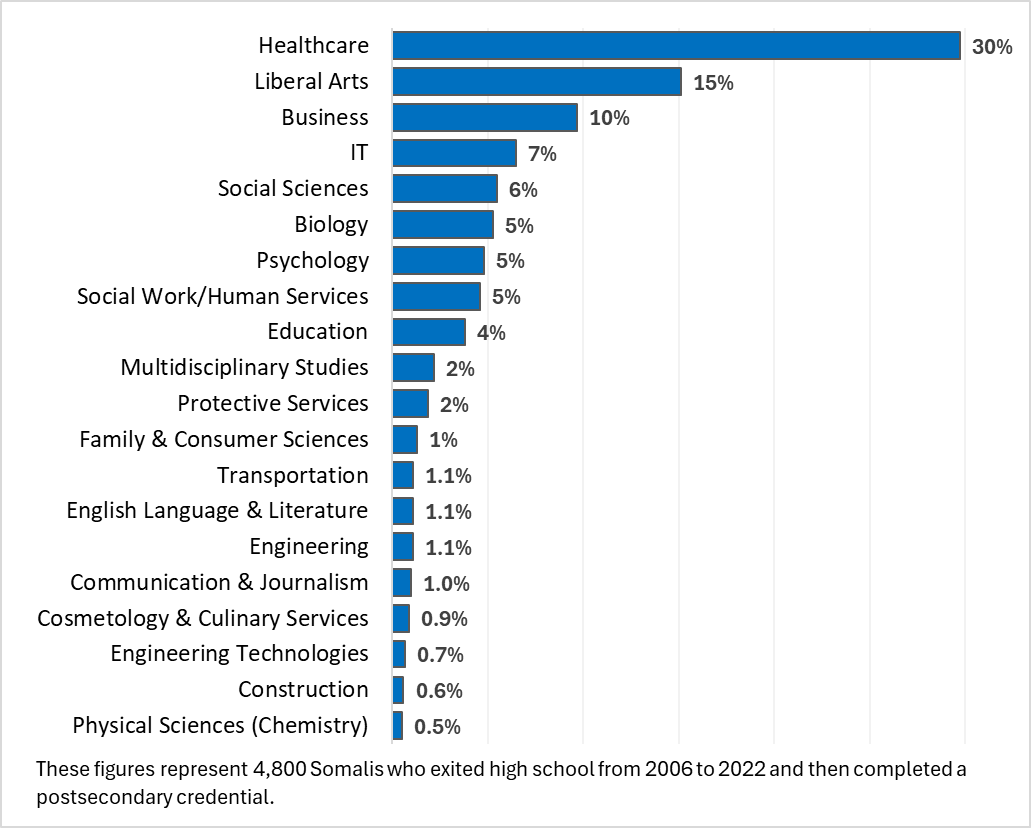
Somalis have a strong presence in programs with a cultural, social, and educational focus such as Social Sciences (especially Political Science), Psychology, Social Work, Human Services and Education. These programs can successfully prepare for jobs focused on serving Somali communities, such as advocacy workers, social workers, community social service specialists, teacher assistants and preschool teachers.
Somalis are severely under-represented in STEM3 majors, especially Engineering, Physical Sciences and Math. They are also under-represented in programs preparing for careers in the trades, such as Construction (0.6%), Mechanical Maintenance & Repair (0.5%), and Welding/Machining (0.1%).
Wages Right Out of High School
As a consequence of their lower educational attainment, Somali youth earn wages that are significantly lower than their Non-Hispanic White peers. As shown in Figure 3, the racial wage gap emerges very early, shortly after exiting high school. Somalis reached a living wage at an average age of 27 (corresponding to nine years after high school graduation), while Whites reached that milestone before age 25.
Figure 3. Wage Growth 1 to 11 Years Post High School, Graduation Cohorts 2007-2016

Disparities in Job Quality
Besides wages, the other consequential gap between young Somalis and whites is in job quality. To demonstrate this, Table 2 focuses on the same individuals shown in Figure 3 and analyzes their employment characteristics from 8 to 11 years post-high school, when they were approximately 25 to 28 years old.
| Table 2 - Employment Patterns from 8 to 11 years from high school exit, Cohorts 2007-2016 | ||||||||
|---|---|---|---|---|---|---|---|---|
| Race/Home Language | Total students | Number employed in MN 8 to 11 years post-high school | Percent employed in MN | Average Years Worked | Percent Worked Fulltime* | Average Hours Worked Per Year | Average Jobs Held Per Quarter | Average Job Changes Per Year |
| Somalis | 8,426 | 7,164 | 85% | 2.6 | 50% | 1,570 | 1.34 | 1.47 |
| Whites | 464,458 | 371,747 | 80% | 3.1 | 65% | 1,640 | 1.17 | 0.81 |
| * Fulltime employment is defined as working 411 hours or more in the quarter. | ||||||||
The key takeaways from this evidence are:
- The percent employed in Minnesota was higher among Somalis, at 85% versus 80% among whites. This suggests that Somalis were more likely to stay in Minnesota for work after high school4.
- Somalis worked on average 2.6 years versus 3.1 years among whites. This shorter duration stems from working in seasonal or temporary jobs.
- Somalis worked fulltime 50% of the time, less often than whites at 65% of the time. Fulltime employment is not just a measure of job quality, but also of the well-being of workers and their families. It indicates a greater likelihood of job security, prospects for obtaining promotions, and access to health care and other benefits.
- Somalis worked fewer hours a year on average compared to whites: 1,570 versus 1,640 hours. This difference is rather small, implying that Somalis participate in the workforce almost as intensely as whites, but their hours are more likely to be divided between multiple part-time or seasonal jobs. This is reflected in the number of jobs held per quarter, which is higher among Somalis: 1.34 jobs per quarter versus 1.17.
- Somalis change jobs much more frequently than whites. On average, for each year worked, Somalis change jobs 1.47 times while whites change jobs 0.81 times. Put it another way, Somalis switch jobs nearly twice as often as whites. Job switches, whether voluntary (quits) or involuntary (layoffs or termination of temporary work), indicate precarious work conditions.
These results demonstrate that, while Somali youth participate in the Minnesota economy just as much as their white peers, the difference between the two groups is in job quality. Finding a stable, fulltime job is challenging for Somalis. They more often need to juggle multiple jobs, working nearly as many hours to attain wages demonstrably lower than whites of the same age (as previously shown in Figure 3).
Somalis in the Economy: Sectors of Employment
Figure 4 compares the top 20 sectors of employment of Somalis who attended high school in Minnesota with those of whites. These results are based on the most recent years of employment payroll records (2023 to 2025).
Figure 4. Industries of Employment in 2023-2025, Somalis Versus Whites Aged 24 and Above

The key takeaways from this comparison are:
- The top sector of employment among Somalis is Health Care, accounting for 30% of the total. Twice as many Somalis were employed in this sector relative to whites. Based on information on wages and fields of study, we know these workers tend to be employed in lower wage healthcare jobs such as Home Health Aides, Nursing Assistants and Medical Assistants.
- The second most common sector is Social Assistance (21% of Somalis versus only 3% of whites), followed by Transportation (9% of Somalis versus 3% of whites). In the transportation sector, Somalis are heavily concentrated in roles such as taxi, bus, and truck driving, occupations that are essential to the regional economy but often characterized by variable income, limited benefits, and constrained advancement pathways.
- The fourth most common sector is Temp Help, characterized by shorter contract durations, limited or no employee benefits, and reduced job security, conditions associated with economic instability for workers and their families.
- Somalis are under-represented in all other sectors, with a particularly lower presence in high wage or unionized industries such as Manufacturing, Professional and Technical Services, Firm Headquarters, Finance and Insurance and Construction. This is a consequence of Somalis' under-representation in Bachelor' level education and STEM programs.
Key Findings
Using 20 years of student records, this study compared Somali with white high school students to identify education and employment disparities and examine how they develop. Here is a summary of findings:
- Ninety-seven percent of Somali high school students come from low-income families versus 27.6% of whites. This disadvantage hurts their chances of entering and completing higher education.
- Three out of four (73%) of Somalis do not attain a postsecondary credential. Those who earn a postsecondary credential are under-represented in high-demand, high-wage majors such as STEM and the trades. As a consequence, Somalis are underrepresented in high wage industries.
- After exiting high school, Somalis take longer to earn a living wage: nine years versus six years for whites.
- Somalis have a higher employment rate than whites, suggesting a higher labor force participation. They are hardworking, holding more jobs in a single year than whites. While Somali youth participate in the economy just as much as their white peers, the difference between the two groups is in wages and job quality.
- More than half of Somalis were employed in Healthcare and Social Assistance, sectors where employers often struggle to fill positions.
Minnesota's economic competitiveness relies, in part, on the contribution of Somalis. Any progress we, as a society, can make toward filling educational achievement and job quality gaps among all population groups, but particularly racial minorities, can help employers diversify their workforce, prevent workforce shortages, and increase the well-being of families and communities. DEED remains committed to advancing strategies that address these disparities, including investing in targeted workforce programs that serve immigrant and refugee communities and deepening partnerships with employers ready to diversify their pipelines.
About the Data
This research uses postsecondary student records and Minnesota wage records from the Statewide Longitudinal Education Data System (SLEDS). The dataset has 883,649 individuals who attended a Minnesota public high school and reported being Black with Somali as their home language or White-Non-Hispanic with English as their home language. Employment and earnings outcomes are only for graduates who work in Minnesota as identified in administrative records of the state's Unemployment Insurance program.
Footnotes
1 These percentages represent high school graduates by year of high school graduation.
2 We included in the analysis students who reported speaking Somali or Maay at home.
3 STEM stands for Science, Technology, Engineering and Math.
4 In contrast, white Non-Hispanics are relatively more likely to leave the state. The higher geographic mobility of whites likely stems from their greater financial resources and/or higher rates of postsecondary credential completion, which can broaden employment options.