

Labor Pains: Central Minnesota’s Economy Pushes Through 2025

By Luke Greiner
Central Minnesota's economy showed mixed signals in 2025. More people entered the labor force, unemployment continued to rise, and employment still grew, though at one of the slowest annual rates outside of recession periods. The result was a regional economy that remained relatively stable, but with signs that workers and employers were not connecting as quickly or evenly as in earlier years of the post-pandemic recovery.
The region's labor market was not defined by a single trend. Labor force growth was relatively strong, job growth was modest, and industry performance varied widely. Some sectors continued to add jobs, especially Health Care & Social Assistance, while others, including Manufacturing and Transportation & Warehousing, lost employment.
Even with these labor market challenges, opportunity is not lost. Many jobs in Central Minnesota still pay above a basic needs cost of living for a single person, and those opportunities are spread across multiple education and training pathways. For the next generation of workers, the data show the importance of understanding how education choices, wages and regional job opportunities fit together.
Labor Force Continued to Grow
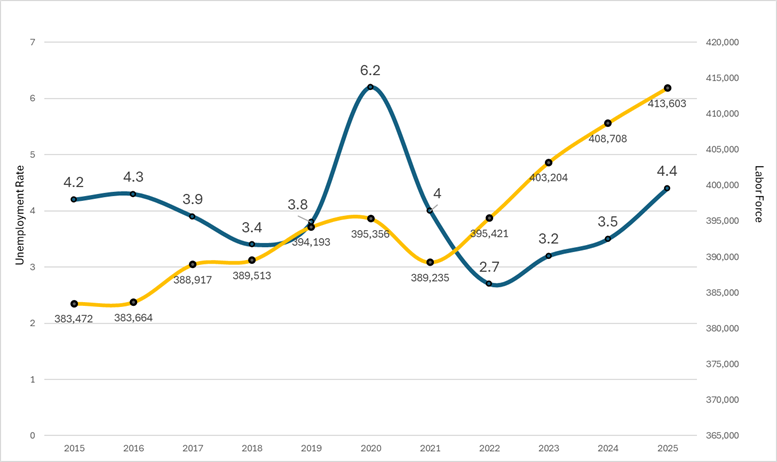
While employment growth slowed, Central Minnesota's labor force continued to expand at a relatively fast pace in 2025. After falling in 2021, the region's labor force increased each year from 2022 through 2025, surpassing 413,500 people. A growing labor force means more people are either working or actively looking for work, which is an important measure of the region's workforce capacity. The labor growth over the year in 2025 was 1.2%, which was twice as fast as the annual average for the past 15 years (0.6%). Labor force growth in the region slightly outpaced Minnesota's 1.1% increase.
At the same time, unemployment also increased by nearly a full percentage point to 4.4% in 2025, up from a post-recession low of 2.7% in 2022. By historical standards, a 4.4% rate is slightly lower than the long-term average from 2010-2025, which was 4.7%. In comparison, Minnesota had a 3.9% rate of unemployment in 2025 (Figure 1).
Figure 1. Labor Force and Unemployment Rates in Central Minnesota, 2015-2025
Source: DEED, LAUS
The combination of a larger labor force and a higher unemployment rate suggests that more people were available for work in 2025, but not all were immediately connecting with jobs. This could reflect a number of factors, including changes in employer demand, skills or experience mismatches, location and transportation barriers, wage expectations, or shifts in the types of jobs being created.
Slow Employment Growth
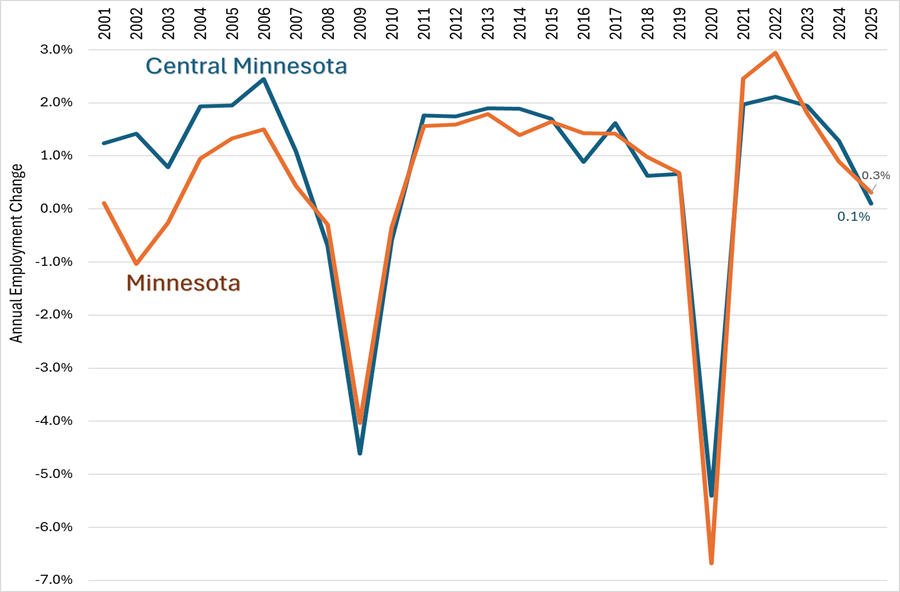
The longer-term employment trend shows that Central Minnesota and Minnesota often move in the same general direction, though not always at the same pace. Both experienced major job losses during the Great Recession and again in 2020, followed by employment rebounds in the years that followed (Figure 2).
Figure 2. Year-Over-Year Employment Change, 2000-2025
Source: DEED QCEW
Employment growth slowed sharply in 2025. Central Minnesota added just 300 jobs from 2024 to 2025, a 0.1% increase, reaching 283,510 jobs. Statewide, Minnesota added 9,159 jobs, a 0.3% increase. For both the region and the state, this marked one of the slowest years of employment growth outside of recession periods.
Though slow, this does not mean the regional economy contracted. Central Minnesota still added jobs, and employment remained well above 2020 levels. From 2020 to 2025, the region added 20,083 jobs, a 7.6% increase. However, the 2025 data show that the pace of growth has slowed considerably compared with the stronger rebound years immediately following the Pandemic Recession.
The unusually slow employment growth in 2025 likely reflects a mix of factors that vary by business and industry. Changes in state and federal policies, less recovery growth following the pandemic recovery and increased use of Artificial Intelligence or other technologies to optimize current workforce talent may all be influencing hiring decisions.
Industry Performance Was Uneven
Central Minnesota's small overall job gain in 2025 was the result of growth in some industries offset by losses in others. Health Care & Social Assistance had the largest numeric increase, adding 1,177 jobs, a 2.3% gain. The industry reached 52,226 jobs in 2025, making it the largest industry in the region.
Several smaller industries posted faster percentage growth. Management of Companies and Arts, Entertainment & Recreation each grew by 4.4%. Real Estate and Rental & Leasing increased by 1.6%, Agriculture, Forestry, Fishing & Hunting grew by 1.5%, and Mining increased by 1.3%.
However, not all industries grew. Manufacturing had the largest numeric decline, losing 638 jobs, a 1.5% decrease. Despite that loss, Manufacturing remained one of the region's largest industries, with 40,751 jobs in 2025. Transportation & Warehousing lost 288 jobs, Professional & Technical Services lost 216 jobs, and Administrative Support & Waste Management Services lost 152 jobs (Figure 3).
Figure 3. Central Minnesota Employment Change by Industry, 2024-2025

Source: DEED QCEW
These industry differences are important because a small overall employment increase can hide large shifts beneath the surface. Health Care & Social Assistance alone added far more jobs than the region gained overall, meaning losses in other industries offset much of that growth.
The five-year picture also varies widely by industry. From 2020 to 2025, Central Minnesota added 20,083 jobs across all industries, a 7.6% increase. Accommodation & Food Services regained 4,744 jobs over that period, Health Care & Social Assistance welcomed 3,766 jobs, Construction added 2,620 jobs, and Educational Services gained 1,571 jobs. In contrast, Administrative Support & Waste Management Services lost 1,149 jobs, Information lost 209 jobs, and Mining cut 34 jobs over the five-year period.
Wages Also Varied Widely by Industry
The average annual wage across all industries in Central Minnesota was $59,332 in 2025. However, wages varied substantially by industry.
Utilities had the highest average annual wage at $133,588, followed by Management of Companies at $107,692, Finance & Insurance at $92,560, Construction at $85,072, and Professional & Technical Services at $83,148. On the lower end, Arts, Entertainment & Recreation had an average annual wage of $19,448, Accommodation & Food Services averaged $23,920, Retail Trade averaged $37,492, and Other Services averaged $38,688.
These differences matter because employment growth does not have the same impact across all industries. Job gains in higher-wage industries can affect regional payroll and household income differently than job gains in lower-wage industries. Likewise, job losses in large industries such as Manufacturing can have a broader effect even when the percentage decline appears modest.
Many Jobs Paying Above the Cost of Living Do Not Require a Four-Year Degree
In 2025, the basic needs cost of living for a single person in Central Minnesota was $37,332, which includes housing, food, insurance, transportation, taxes and other costs. When employment is grouped by typical education requirements, the data show that many jobs paying above that threshold are available through multiple education and training pathways.
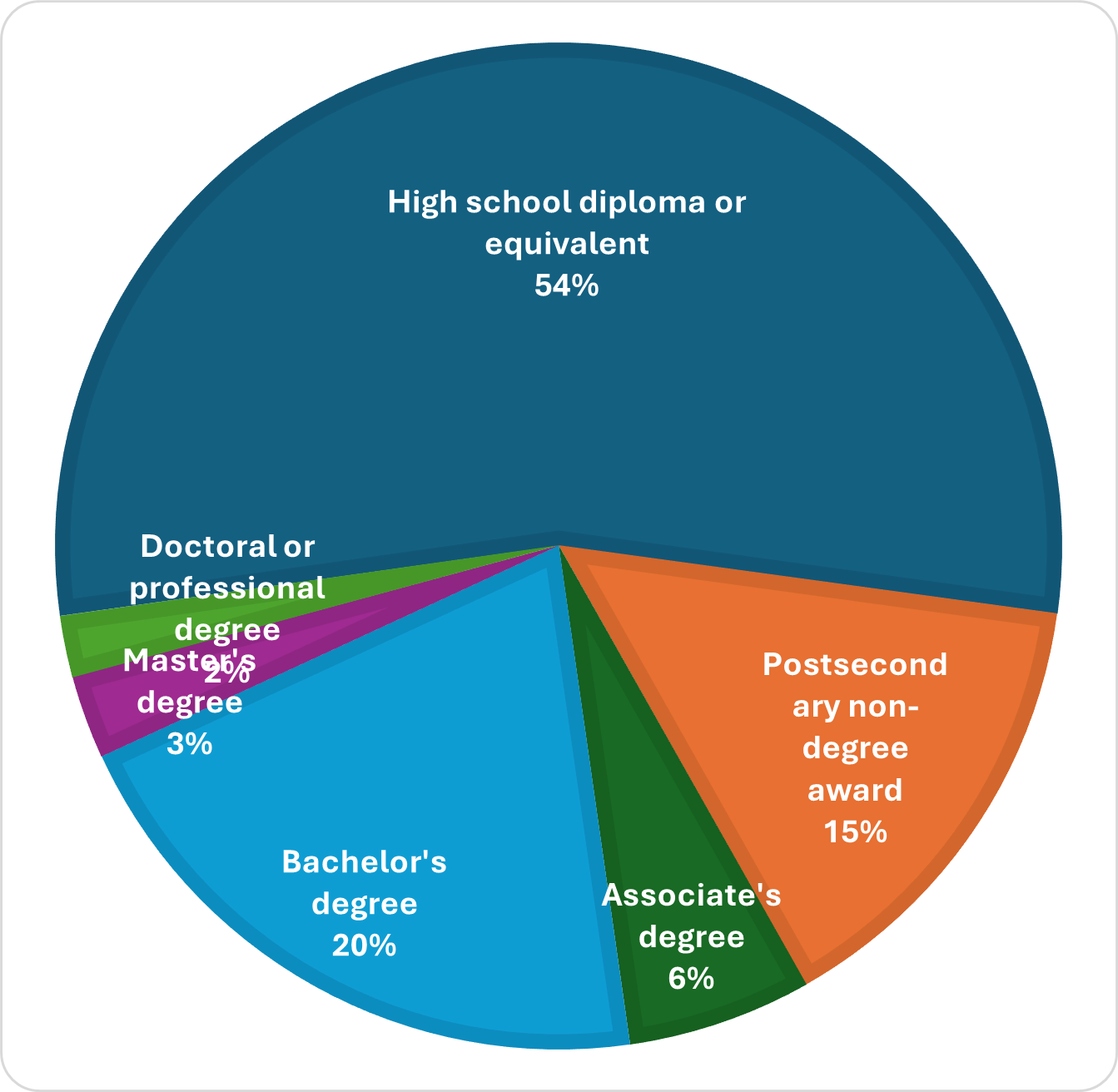
More than half (54%) of employment paying above the cost to live for a single person was in occupations requiring a high school diploma or equivalent. Another 15% was in occupations requiring a postsecondary non-degree award, and 6% was in occupations requiring an associate degree (Figure 4).
Figure 4. Share of Employment That Pays Above the Cost-of-Living for a Single Person in Central Minnesota, 2025
Source: DEED Educational Requirements and OEWS
Occupations typically requiring a Bachelor's degree accounted for 20% of employment above the single cost-of-living wage threshold, while occupations requiring a master's degree accounted for 3%, and occupations that need a doctoral or professional degree accounted for 2%.
This does not suggest that education is unimportant. Many occupations require postsecondary education, and higher levels of education are still necessary for many career paths. However, the data show that a four-year degree is not the only path to employment that pays above the basic needs cost-of-living threshold for a single person in Central Minnesota.
Career and technical education, apprenticeships, certificates, associate degrees, industry-recognized credentials, and on-the-job training all remain important parts of the region's workforce system. A strong labor market depends on clear connections between education, training, and the jobs people are preparing to enter.
From High School to Work and College
The pursuits of Central Minnesota high school graduates also provide important context for the education and wage pathways shown in Figure 4. While 25% of employment paying above the cost of living for a single person is in occupations that typically require a bachelor's degree or higher, 39% of Central Minnesota's 2024 high school graduates enrolled in a four-year college.
In addition, a substantial share of those four-year college students left Minnesota for school, with 1,256 enrolling out of state compared with 2,157 enrolling in state. This does not mean four-year degrees are unimportant, but it does show a difference between the education paths students are choosing and the education requirements of many jobs available in the regional economy. It also raises a workforce retention question, since students who leave the state for college may be less likely to return to the region after graduation.
At the same time, 31% of graduates were employed after high school and 19% enrolled in a two-year college, reflecting the multiple pathways students take after graduating. These outcomes reinforce the importance of helping students understand how different education and training options connect to wages, job availability and career opportunities in Central Minnesota.
Figure 5. Pursuits of Central Minnesota High School Graduates, Class of 2024

Source: Minnesota SLEDS
The Regional Economy in Perspective
No single measure fully captures the condition of Central Minnesota's economy. Job growth, unemployment, industry change, wages, education requirements and graduate pursuits each tell part of the story. Viewed together, they show a region where the workforce picture is becoming more complex.
The main issue is not simply whether the economy is growing, but how well people, jobs, wages, and training pathways are lining up. Some industries continue to expand, while others are adjusting or declining. Many jobs offer wages above the basic cost-of-living threshold, and those opportunities are spread across different education levels. At the same time, students are making postsecondary choices that do not always mirror the region's current job mix.
For employers, educators, workforce partners and communities, that makes clear information especially important. Understanding where jobs are growing, what they pay, and what education or training they require can help Central Minnesota better connect residents with opportunity and employers with the workforce they need.