

Careers in the Trades: A Tale of Two Genders

By Alessia Leibert
December 2025
Careers in the trades are becoming more appealing to high school students thanks to their affordability: They can be accessed through vocational schools, apprenticeships or on-the-job training rather than a traditional four-year college degree. This article examines whether careers in the trades are worth pursuing, distinguishing between two main families of trades-related careers:
- Industrial trades, geared towards employment in construction, manufacturing and transportation;
- Service-oriented trades, including childcare, food services, cosmetology and some jobs in healthcare, engineering and Information Technology services.
Some argue that only the first group is legitimately a trade, because these careers require manual skills learned through apprenticeship programs that are a hallmark of a trade. The first group of careers is historically dominated by men, while the second group tends to be dominated by women.
Preparing for the Trades in High School
To get a head start in a trade, a popular option is to take a Career and Technical Education (CTE) program in high school. Although CTE courses can prepare for a much broader spectrum of careers than just the trades, most training opportunities in the trades are under the umbrella of CTE.1 Figure 1 shows the example of three construction-related programs.
Figure 1
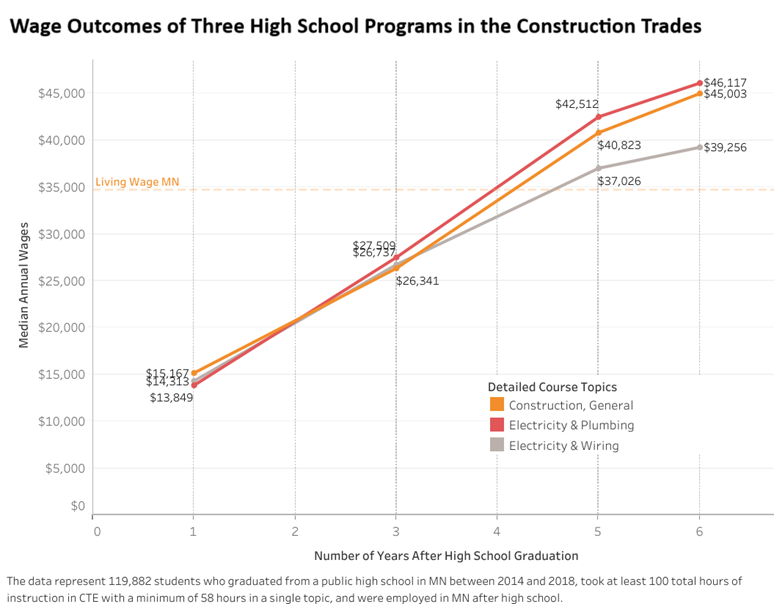
Participants attained a living wage of $34,7042 between four and five years post-high school. This result holds even among participants who did not complete any post-secondary credential.
This stands in contrast with service sector trades-related programs. Figure 2 displays three of these programs in healthcare.
Figure 2
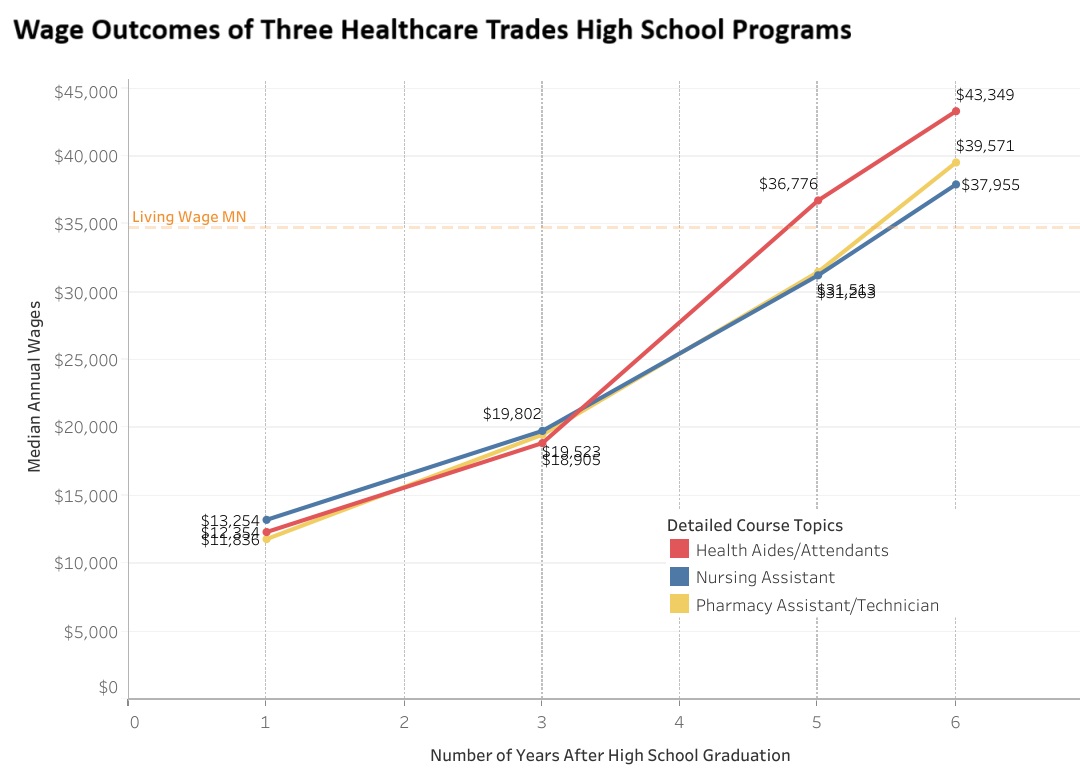
Compared to the examples in Figure 1, participants took longer to attain a living wage: between five and six years post-high school. Moreover, this result applies only to participants who completed a postsecondary credential; all other participants took over six years to attain a living wage. These data are available for 56 career fields through the High School Technical Education Pathways & Outcomes Tool.
This analysis shows that male-dominated programs in the trades are more effective at preparing students for financially viable careers right out of high school than female-dominated programs.
The Gender Divide in the Trades
As documented in this Females in Career and Technical Education study, men see better wage and employment outcomes from participation in high school technical education than women due to stark gender differences in course-taking patterns. Figure 3 illustrates this divide in the largest CTE programs in trade-related career fields.
Figure 3
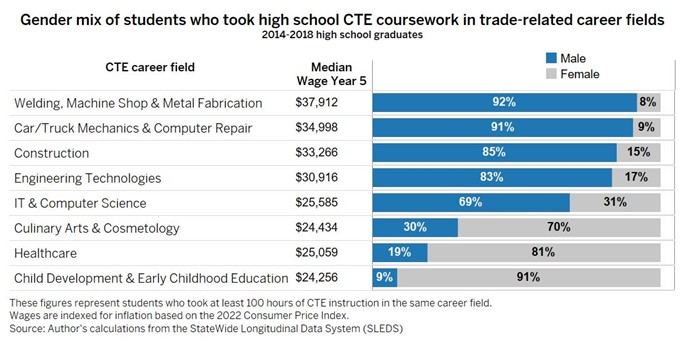
The most male-dominated career field, Welding & Metal Fabrication, led to the highest wages five years after high school. Women were more likely to select courses in Culinary Arts & Cosmetology, Healthcare or Child Development & Early Childhood Education. Although these fields are in demand, they lead to low wage jobs.
The fact that the gender mix of the subject areas shown in Figure 3 did not change substantially from 2014 to 2023 shows how difficult it is to break the mold of societal norms that underlie these choices.
One of the reasons why the top three programs in Figure 3 led to such high wages is that employers in manufacturing and construction have poured resources into high school CTE programs that have benefitted primarily men, opening up access to employer-provided on-the-job training as an alternative to postsecondary education.3 For example, upon completion of CTE programs in Construction, participants can enter paid training through Registered Apprenticeships preparing for remunerative careers such as Plumbers, Electricians and HVAC Technicians. Of the 12,133 active Registered Apprenticeships in Minnesota in 2025, only 8.2% are held by women. This huge gender imbalance is due to the bulk of apprentices being in the construction industry, which is male-dominated.
In conclusion, workers in the service sector more often need to invest in post-secondary degrees to advance in their career. Healthcare is a classic example: students can start training in a trade, such as Nursing Assistants, and then shift to a profession, such as Registered Nursing, upon completion of an associate or bachelor's degree. This path requires resources and academic preparedness. Higher education is less critical to career advancement in the industrial trades, because the skills acquired on the job, including through apprenticeships, are more important that formal schooling.
What Happens to Women Who Participate in Male-dominated Training Programs in the Trades?
Did women who pursued training in male-dominated fields earn wages comparable to their male peers? Table 1 breaks down wages by gender in the five male-dominated programs shown in Figure 3. Women earned less than men, especially in the top three programs. Women in Welding, Machine Shop & Metal Fabrication earned only 70% of mens' wages while those in Construction earned 69% of mens' wages.
| Table 1 - Wage Differences by Gender in Male-dominated CTE Programs, Five Years Post-High School | ||||
|---|---|---|---|---|
| Male-dominated high school training programs in the trades | Participants 2014-2018 | Annual Median Wage Year 5, Women | Annual Median Wage Year 5, Men | Earnings ratio women/men |
| Welding, Machine Shop & Metal Fabrication | 8,259 | $27,332 | $39,006 | 70% |
| Car/Truck Mechanics & Computer Repair | 11,050 | $25,677 | $36,276 | 71% |
| Construction* | 16,133 | $24,538 | $35,492 | 69% |
| Engineering* | 4,872 | $25,258 | $32,151 | 79% |
| IT, Programming & Computer Science | 7,325 | $23,479 | $26,404 | 89% |
| *These CTE programs include plumbing, electricity, carpentry, home construction and agricultural construction.
**Half of students in this category took courses in Drafting/Design Engineering. Others took Industrial Production and General Engineering. Although engineers are a profession and not a trade, most engineering technician jobs are considered a trade because they require less than a four-year degree. |
||||
Why? The primary reason is that female participants did not break into related industries. For example, of the 656 women who pursued programs in Welding, Machine Shop & Metal Fabrication, only 1% were employed in Manufacturing and 3% in Construction five years after high school graduation. In contrast, 18% of men were employed in Manufacturing and 24% in Construction, where wages are significantly higher.
Similarly, 47% of men who took construction-related programs were employed in related industries (Construction, Manufacturing, Utilities, Agriculture and Wholesale) versus 12.6% of women. The same is true for programs in Car/Truck Mechanics & Computer Repair.4 These findings are problematic because they imply that these girls prepared in high school for industries where they eventually did not work.
Low female representation in related industries is likely the result of multiple factors, including:
- Women did not apply to jobs in related industries out of choice, either because they did not take these training programs with the same intentionality as men or because they favored working conditions in other industries less well aligned with their educational background;
- Employers in related industries, such as Construction and Manufacturing, did not hire or retain women;
- Women did not persist in these industries once hired.
A report by the Institute for Women's Policy Research (IWPR) sheds light on some of the causes of women's low retention in the construction trades. The report found that nearly half (44%) of women in construction seriously considered leaving their jobs due to experiences of discrimination, harassment (sexual and racial), and lack of respect.
If the goal is increasing representation of women in these high-pay careers, taking the right courses in high school may not be sufficient in the absence of a support system that encourages women to enter and persist in the industries and careers best aligned with the education received.
Table 1 shows that women's wages are more comparable to those of men in Engineering Technologies and IT/Computer Science5, with earnings ratios of 79% and 89% respectively. This suggests that women found better acceptance in the industries that need these skills the most. Both programs prepare for careers in STEM. Increasing girls' exposure to these careers while in high school can contribute to increased female representation in viable trade-related careers.
Preparing for the Trades in Postsecondary School
The most popular trade-related postsecondary programs in Minnesota are shown in Table 2. Employment prospects upon graduation are for the most part excellent, as shown by the high percentages of students who found jobs. Wages are high in male-dominated majors and low in female-dominated ones, with the exception of Dental Assistants, Medical Assistants and LPNs, which led to earnings above the living wage of $36,768 per year.6
| Table 2 – Wage and Employment Outcomes of Postsecondary Education Programs in the Trades, Sub-baccalaureate Certificates and Associate Degrees, Academic Year 2021-2022 | |||
|---|---|---|---|
| Program Title | Number of graduates
|
Percent employed in Minnesota within the first year from graduation | Annual median wages |
| MALE-DOMINATED MAJORS | |||
| Vehicle Maintenance/Repair Technicians, Certif. and Associate degrees | 697 | 84% | $51,419 |
| Precision Metal Working, Certificates | 630 | 87% | $47,210 |
| Electricians, Line Workers & Power Transmission Installers, Certificates | 394 | 83% | $48,663 |
| Construction Trades, General, Certificates | 186 | 85% | $38,254 |
| HVAC Technician, Certificates | 186 | 81% | $53,363 |
| Drafting/Design Engineering Technicians, Associate degrees | 185 | 69% | $50,884 |
| Computer Systems Networking Specialists, Certif. and Associate degrees | 130 | 75% | $49,277 |
| Plumbing & Related Water Supply Services, Certificates | 110 | 82% | $54,047 |
| Truck & Bus Driver Operators and Instructors, Certificates | 107 | 83% | $55,504 |
| Computer Support Specialist, Certif. and Associate degrees | 93 | 78% | $35,448 |
| FEMALE-DOMINATED MAJORS | |||
| Nursing Assistants, Certificates | 1,186 | 84% | $19,622 |
| Cosmetology, Certificates | 902 | 82% | $27,748 |
| Dental Assistants, Certif. and Associate degrees | 358 | 83% | $45,613 |
| Early Childhood Education, Associate degrees | 282 | 41% | $30,737 |
| Medical Assistant, Certif. and Associate degrees | 194 | 87% | $37,860 |
| Licensed Practical/Vocational Nurse (LPN), Certificates | 158 | 83% | $45,105 |
| Child Development & Childcare Provider, Certif. and Associate degrees | 105 | 73% | $32,905 |
| Veterinary Technicians & Assistants, Associate degrees | 85 | 81% | $35,835 |
| Pharmacy Technicians, Certif. and Associate degrees | 71 | 63% | $36,251 |
| Culinary Arts, Certif. and Associate degrees | 64 | 82% | $29,843 |
| Source: Graduate Employment Outcomes (GEO) tool, Academic Year 2022 | |||
Many female-dominated careers in the trades, such as childcare workers, skincare specialists, veterinary assistants, nursing assistants and pharmacy technicians are in demand but underpaid because of the lower perceived societal value of care work.
Conclusions and Policy Recommendations
This study examines training options in the trades and their resulting workforce outcomes. The findings point to starkly different labor market experiences in the trades based on gender.
- High school courses preparing for male-dominated careers in the trades led to strong wage outcomes even in the absence of a college credential;
- Since most well-paying jobs in the trades are less accessible to women for structural reasons including occupational segregation by gender, women tend to pursue fields that require completion of a two-years credential. As documented in this study, the Minnesota economy, especially in Greater Minnesota, offers very few paths to living-wage jobs in female-dominated careers for individuals without postsecondary credentials;
- Evidence shows that women who pursue training programs in male-dominated trades careers earn substantially less than their male counterparts, primarily because they do not find employment in related industries or do not persist in these industries. An unwelcoming work environment is a frequently cited cause of low retention of women in the construction trades. More effort is needed to understand and address the barriers faced by women in the classroom and in the workforce in male-dominated trades.
These findings have strong equity implications. High school programs in the trades have been successful in expanding non-college career pathways for men, while women seeking a similar path struggle to attain a living wage. Women more often need to pursue a two-year or higher degree. Therefore, women will be hurt disproportionately by recent cuts in student financial aid programs (such as Pell grants and Federal Supplemental Educational Opportunity Grants) and higher education budgets and loans.
What can be done to make careers in the trades more financially viable for female students and bridge the opportunity gap that separates them from their male peers? Two sets of recommendations are outlined below:
- Rebalance the gender composition of education programs in the trades: Encourage more girls to enroll in high school coursework in non-traditional career fields, especially in engineering technologies and Information Technology which appear to be more favorable for women than the industrial trades. Mixed classrooms in high school technical education courses and better career counseling services can mitigate job segregation by gender in the labor market. However, this won't be effective unless women are able to experience acceptance in male-dominated industries or occupations on the job.
- Invest more in high school to postsecondary educational pathways: Participation in high school coursework in the trades should not have to come at the expense of coursework that prepares for completion of a sub-baccalaureate credential, if a career requires it for accessing living wage jobs. Therefore, it is essential to create clearer paths from high school to postsecondary education. One way to achieve this is to expand dual enrollment7 opportunities as part of high school CTE courses to accelerate credential completion and lower the financial burden of postsecondary education.
Just like the push for four-year degrees as the most important path to a good job was a myth, today's push for the trades as a path to the middle class is also a myth that clashes with the reality experienced by women in trades careers. As long as female-dominated service-oriented careers in the trades continue to require postsecondary education to attain a living wage, and women face barriers to entering industries that have been traditionally dominated by men, the trades won't offer women a path to the middle class.
Footnotes
1The Carl Perkins Career and Technical Education Act is the main source of federal funding for CTE at the secondary and postsecondary level. It is reauthorized periodically, most recently in 2018. For more information see https://www.acteonline.org/wp-content/uploads/2025/03/ACTE-Perkins101-Basics-Feb2025.pdf
2Based on 2023 living wage estimates (Source: DEED's Cost of Living tool for 2023).
3The trend towards greater investments in high school CTE programs on the part of employers started around 2013. A 2019 study based on interviews with employers in manufacturing (https://mn.gov/deed/newscenter/publications/trends/december-2019/skills-in-manufacturing.jsp ) showed that partnering with high schools by offering internships and work-based learning opportunities is a best practice to prevent hiring difficulties, as well as recruiting directly from high school CTE programs in the industrial trades.
4The data show that 46% of males who took these high school courses were subsequently employed in related industries (Construction, Manufacturing, Repair Services, Agriculture, Utilities and Transportation) versus only 14.4% of females.
5Definitions of the trades in engineering, healthcare and Information Technology services can be slippery because many of these jobs can be learned either through trade schools or through Associate's degrees.
6According to DEED's Cost of Living tool, $36,768 was the minimum annual wage needed to sustain a single adult with no children in Minnesota in 2024.
7While traditional dual enrollment was aimed at college-bound students, its integration with CTE programs allows participants to earn college credit prior to high school graduation while also developing career-specific skills.