

Workers and Minnesota’s Climate Goals

By Molly Ingram
March 2026
At A Glance:
- This past February, the updated Climate Action Framework was released.
- DEED conducted a workforce analysis examining how these climate strategies intersect with Minnesota's workforce.
- The report contains five key takeaways:
- Minnesota has maintained a strong economy while reducing emissions and can continue to do so.
- Jobs that support a cleaner, more resilient economy are widespread across Minnesota and represent a significant share of employment, though their local importance varies.
- Demand for workers is growing, and some needs are already materializing now.
- Meeting workforce demand in clean-economy industries will require stronger participation, retention, job quality, and skill-based mobility.
- Minnesota has strong workforce, education, and industry foundations, but meeting future clean-economy workforce demand will also depend on how well systems, supports, and data are aligned.
Introduction
 Minnesota's updated Climate Action Framework, released in February 2026, outlines a path to reduce emissions and strengthen climate resilience , shaped by input from hundreds of agency staff, partners, and community members, and represents the state's current policy direction on climate and economic resilience.
The Framework includes seven goal sectors:
- Clean transportation
- Climate-smart natural and working lands
- Resilient communities
- Clean energy
- Healthy lives and communities
- Clean economy
- Efficient and resilient buildings
Progress towards these goals depends on people as well as innovation and investment. A skilled workforce, including electricians, technicians, engineers, operators, planners, and many others, is essential for turning statewide goals into real outcomes.
The workforce supporting climate action efforts
Over the past two decades, Minnesota has experienced economic and employment growth while reducing greenhouse gas emissions. Modeling conducted for the Climate Action Framework suggests this trend can continue under both current policies and more ambitious climate action scenarios. Understanding the workforce needed to support that growth is an important part of preparing for Minnesota's future.
A new workforce analysis conducted by DEED, to supplement the Climate Action Framework, examines how these climate strategies intersect with Minnesota's labor market. Drawing on economic modeling, labor market information, industry research, and stakeholder input, the analysis highlights several key workforce trends and challenges.
Work that supports a cleaner, more resilient economy spans many jobs and industries.
Understanding how workers contribute to Minnesota's climate and resilience goals is important, but not straightforward. Workers and businesses can support these goals in many ways, from producing clean goods and services to adopting cleaner technologies and more resilient practices. Many also move between "clean" and "traditional" work from project to project, and some contributions are indirect or less visible. Together, these factors make this work difficult to define or measure, even though it is often discussed as a distinct set of "clean" or "green" jobs.
The workforce analysis supporting the Climate Action Framework focuses on employment in "clean-economy industries", meaning industries that directly contribute — or could contribute — to producing goods and services that enable emissions reductions. While no dataset currently exists that can identify all workers actively engaged in climate-related activities, this approach helps illustrate the scale of employment connected to reducing emissions and the potential for growth as demand increases.
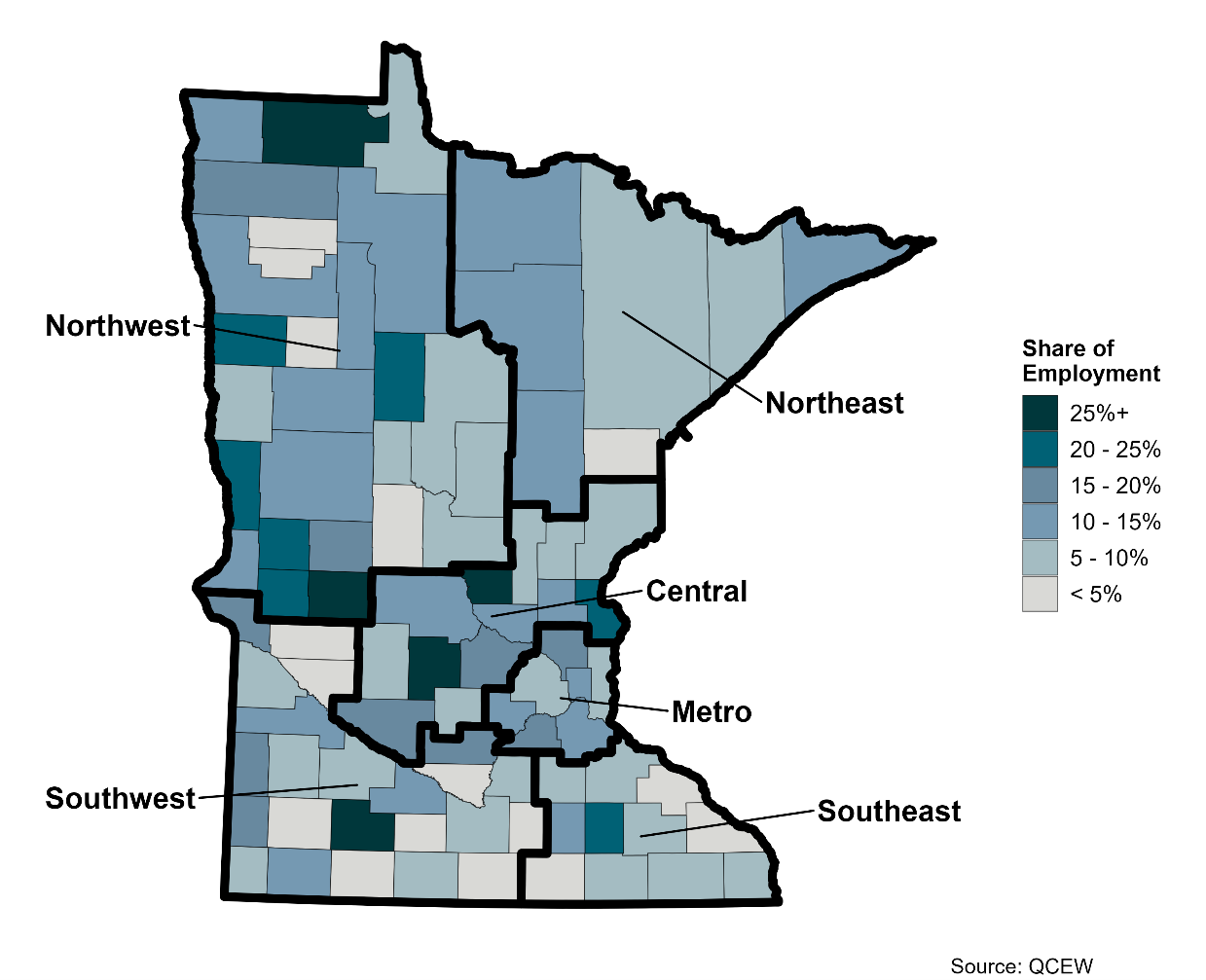
In 2024, Minnesota's clean-economy industries supported more than 380,000 jobs, or about one in eight jobs statewide. Taken together, these jobs would form the second-largest sector in Minnesota, behind only Health Care and Social Assistance. These jobs are present all across Minnesota, but their prevalence varies. In some counties, clean-economy jobs account for more than 25 percent of total employment, and in others, less than 5 percent.
Figure 1: Share of total employment in clean‑economy industries, in 2024
Download the Excel data
Construction and manufacturing account for the largest share of clean-economy employment, together representing more than 75% of these jobs. This reflects the central role these industries play in reducing emissions across greenhouse gas inventory sectors, including transportation, electricity generation, industrial , and buildings.
Demand for workers is growing, and some workforce needs are already materializing
Modeling done to inform the Climate Action Framework estimates that current climate and energy policies could increase projected job gains by more than 30% compared to earlier projections, especially in Construction and Professional and Technical Services.
In many industries, particularly in Greater Minnesota, more than half of projected 10-year growth has already occurred during the first two years of the projection period. Many of the occupations supporting this growth do not require a four-year degree, creating opportunities for workers entering or transitioning within the labor market.
At the same time, Minnesota's aging workforce, ongoing demographic shifts, and tight labor market may make it more challenging to meet this demand. Job openings have outpaced available workers in recent years, and many industries face rising replacement needs as experienced workers retire. At the same time, the workforce is also becoming increasingly more diverse.
Minnesota maintains consistently higher labor force participation rates and lower unemployment than the national average, leaving limited slack to meet growing demand. Meeting future workforce needs will require intentional, coordinated workforce development efforts, including stronger education and training pipelines, strategies to retain workers, and expanded access to opportunities.
As experienced workers retire, employers must recruit, train, and retain a new generation of workers to sustain capacity and support growth. At the same time, many clean-economy industries have historically struggled to attract and retain a diverse workforce. These trends create both urgency and opportunity for employers to better engage younger workers, workers of color, and other underrepresented groups.
Meeting workforce demand will require stronger participation, retention, job quality, and workforce mobility
Expanding workforce participation and improving job quality will be essential to attracting and retaining workers in critical roles. The vast majority of clean-economy jobs offer wages above family-sustaining levels; however, other aspects of job quality, including benefits, safe and stable working conditions, worker voice, and pathways for advancement, also influence whether workers can, or want to, enter and remain in these jobs.
Reducing practical barriers, such as access to transportation, childcare, housing, and clear hiring and training pathways, will help ensure these opportunities are accessible to a diverse range of workers and can remain accessible as workers' needs change over time. Flexible training options, adaptable career pathways, and supportive workplaces can all help increase long-term participation in the workforce.
Strengthening mobility within the existing workforce could also help Minnesota meet increasing demand even when labor market conditions are tight. A large share of the skills needed for growing clean-economy roles already exist across Minnesota's workforce, particularly in manufacturing, logistics, maintenance, construction, and utilities. Leveraging transferable skills can expand access to in-demand jobs, support mid-career transitions, and help employers fill critical roles more quickly.
Supporting this type of workforce mobility will require continued coordination across workforce development, education, and employer partners, along with better information on skills, job quality, and career pathways.
Building on Minnesota's strengths
Minnesota has strong workforce, education, and industry foundations needed to maintain its strong economy and position itself as a leader in innovation and resilience. The challenge ahead is to align systems, supports, and data so these strengths can scale and adapt as workforce needs evolve across regions.
Several enabling conditions can help Minnesota build on existing strengths and meet evolving clean-economy workforce needs:
- More responsive, skills-focused workforce data and systems. Improving data on skills, job quality, and workforce transitions – particularly transferable skills – would support more nimble education, training, and workforce planning as technologies, policies, and market conditions change.
- Stronger coordination across workforce partners.Continued collaboration among employers, educators, workforce organizations, community partners, and state agencies will be critical to aligning training, credentials, and career pathways with evolving clean-economy needs.
- Attention to job quality and worker supports. Ensuring that clean-economy jobs offer family-sustaining wages, benefits, safe and stable working conditions, and pathways for advancement will be essential for attracting and retaining workers and for delivering broad economic benefits.
- Sustained investment in workforce capacity. Long-term, predictable funding can help workforce systems respond to growth, manage uncertainty, and support workers as skill needs evolve.
Together, these actions can help Minnesota build a clean-economy workforce that is adaptable, inclusive, and durable, positioning the state to meet climate goals while supporting workers, businesses, and communities.
The full workforce report can be found at 2026 Climate Action Framework – Workforce.
Workforce in the Climate Action Framework
Many workforce-related strategies in the Climate Action Framework are included under Goal 6: Clean Economy, which focuses on building a carbon-neutral economy that creates high-quality, accessible jobs. Initiative 6.4, "Resilient and equitable clean economy workforce" emphasizes preparing workers for new, existing, and changing career opportunities and creating high-quality, accessible clean economy jobs, and includes the following sub-initiatives:
- Help workers and communities that depend on climate-vulnerable or carbon-intensive industries adapt and transition as climate and technologies change.
- Develop and promote clear education and career pathways for clean-economy jobs.
- Work with employers to create high-quality clean economy jobs that are accessible to all.
- Remove barriers to education and job opportunities to grow the clean economy workforce.
For the full list of action steps supporting these sub-initiatives, see Minnesota 2026 Climate Action Framework - Action steps.