

Self-Employment through the Business Enterprises Program
The Minnesota Business Enterprises Program (BEP) provides profitable vending business opportunities to qualified licensed, legally blind Minnesotans to broaden their economic opportunities. You may have come across one of our vending machines in a state or federal office building, a rest area, or on a state college or university campus.
Overview
The BEP provides training, certification, technical support, and management services to these self-employed vending business owners.
Qualified individuals must work with an SSB counselor, meet the requirements of our comprehensive evaluation process, and complete an extensive training to be certified to operate a BEP vending business.
The BEP administers this program under the authority of the federal Randolph-Sheppard Act and has an exclusive authority to establish vending businesses on state property.
-
Check here for news, podcasts and other features from the Business Enterprises Program
- KSTP Story: It’s given me my freedom': Blind convenience store worker optimistic about state workers coming back to the office
- Listen to this podcast all about the BEP program. It features Minnesota’s Scott Eggen along with BEP operators from Florida and Tennessee
- Listen to a podcast interview with one of our small business owners, Michael Colbrunn
-
The Management Committee (MC) actively participates with State Services for the Blind (SSB), the state licensing agency, in major administrative decisions and policy and program development affecting the overall administration of all business enterprises.
Mandated by both state and federal law, the MC meets at least four times a year. It's comprised of six members who are elected for two-year terms.
If you have questions or need to contact the committee, please call Chairman Michael Colbrunn at 507-469-9492.
-
- Business Enterprises Program Brochure
- Certified as Qualified Manual - process to become a licensed Blind community partner in the Minnesota Business Enterprises Program
- Respectful Workplace
-
For further information about the BEP, contact John Hulet at 651-539-2284.
Operator Stories
-
Building the Plane While Flying It: Mike Colbrunn's Trailblazing Journey in BEP
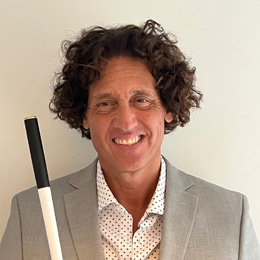 When Mike Colbrunn became a licensed Business Enterprise Program (BEP) owner-operator in September 2015, he stepped into a world of opportunity—and challenge—that would shape his career and redefine what was possible for blind entrepreneurs in Minnesota.
Mike's relationship with State Services for the Blind (SSB) dates back to 1997, when he received Adjustment to Blindness training. But it wasn't until 2015, when BEP became his employment goal, that he fully engaged with the program.
"I got my license in 2015," Mike recalls. "But the journey started years earlier when my counselor, Maureen, first told me about the program. At the time, I had a young family and a job, and I couldn't dedicate the time needed for training." It wasn't until a few years later, after shadowing a blind vendor and reconnecting with Maureen, that the timing—and the training—aligned.
From Vending to Visionary
Mike's growth as a business owner has been anything but conventional. With the support of SSB BEP mentors like John Hulet and Jerry Christensen, and through his involvement with the National Association of Blind Merchants, Mike immersed himself in upward mobility training and learned to think beyond traditional vending.
"I learned about different types of businesses that fall under the Randolph-Sheppard Act," he explains. "Having the open-mindedness to pursue other types of businesses allowed us to explore new opportunities that weren't previously prioritized."
That mindset led to one of his proudest accomplishments: securing a full food service dining contract at Camp Ripley, a U.S. Army National Guard training facility in Little Falls, Minnesota.
"This was our first time doing this as a program," Mike says. "Many states have these military dining contracts, but the infrastructure is already in place. We had to build the roadmap from scratch—and do it in just a few months."
The effort involved a massive team, including DEED fiscal and legal staff, John Hulet, Natasha Jerde from SSB, and Mike himself. "There's an expression, 'you're building the plane while you're flying it.' That's what it felt like at times," he says. "I'm extremely humbled that these people were doing this for me. They foresaw the outcome and believed in it."
A Business Built on Grit and Growth
Today, Mike oversees 12 locations, including Camp Ripley, and employs up to 35 people, about half of whom are full-time. His role is multifaceted—part operations, part strategy, and all-in commitment.
"I don't have a typical work week," he says. "I still fill vending machines, receive orders, manage the stockroom, and then spend the rest of my time on the computer overseeing accounts, budgets, and financials. I wear more than one hat for sure."
Despite the workload, Mike finds deep satisfaction in the autonomy and accountability that come with being self-employed. "You can really measure your own work in the bottom line. It's very results oriented."
Facing Challenges with Innovation
The vending and convenience industry is evolving rapidly, and Mike is keenly aware of the need to stay ahead. "Everything is going cashless faster. That requires technology—kiosks, equipment, and more. It's very difficult to keep up, and you don't want to be left behind."
Operating within a state-run program adds another layer of complexity. "You can't just make knee-jerk decisions. There are approvals, regulations, and timelines. But staying relevant is critical."
Advice for Aspiring BEP Entrepreneurs
Mike's advice to those considering BEP ownership is clear: "To be successful, you're going to have to put the work in. There's no easy way to do this. Your success depends on how much you're willing to put into it."
He also encourages future entrepreneurs not to limit themselves—or the program. "Things that seem impossible are sometimes possible. Sometimes the success isn't obvious. You really have to put a lot of your energy into your own success."
Collaboration is the Key
"John Hulet tells me all the time that 95% of my success is me, if not more," Mike says. "But I haven't been alone in this. I've been able to grow because the program supports my motivation to grow."
He believes that collaboration is key to the program's future. "The state can find new opportunities, but you need blind vendors who want to pursue them."
Mike is also passionate about mentoring. "I love opening up my business to any blind individuals who want to see what it's all about. If we can create different types of businesses, the program can attract more folks interested in self-employment."
Story originally published 2025
-
Mary Armstrong, Building a Business, Building a Life
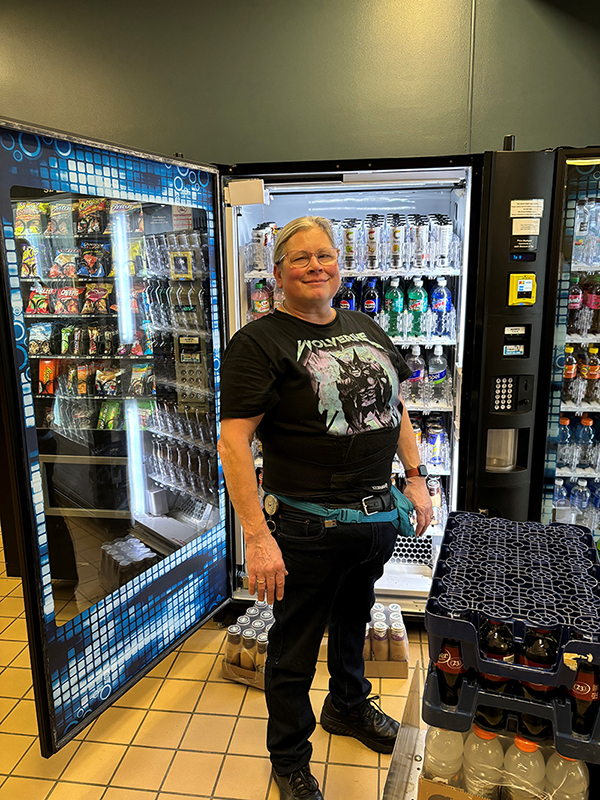 With forty years in the field, Mary Armstrong, a small business owner in the Business Enterprise Program (BEP), has experienced a lot of ups and downs and seen a lot of changes. Still, the program, which was launched by act of Congress nearly 90 years ago, giving blind and low vision entrepreneurs the opportunity to operate vending businesses on state and federal properties, is one she believes in. "Personally," she reflects, "I hope it sticks around. It's smaller than it used to be. There has been more consolidation in order to create viable businesses that can generate a decent income. But, it's a good opportunity, and I would recommend it."
Mary got started in the program working for other vendors, but soon enough, she was able to successfully bid on her own business. She first worked in several state office buildings before acquiring the business at Minneapolis Community and Technical College (now Minneapolis College) in 1991. "It wasn't a desirable location," Mary remembers, "Because there wasn't any storage space. But you had to just be willing to do the work." In 2014, she took over the business at St. Paul College, which she still runs today.
Reviewing her long career, Mary notes that sales peaked in the early 2000s, just before the bubble burst in 2008. Then, in 2014, working with the BEP program, Mary was able to install all new machines at her St. Paul location. Along with the industry as a whole, Mary's business took a hit during the pandemic, but sales have slowly recovered.
Before the pandemic shutdown, Mary hired staff to help with the work. Now, especially with the advances in technology, she finds it easy to manage the business solo. She uses a number of technology hacks to accomplish parts of her work. Now to read text, especially small print like the expiration dates on packaging, she uses the AI feature in the Be My Eyes app, or simply opens the camera on her iPhone which she's configured to identify text. Along with her phone, Mary uses her Olympus Voice Recorder to record sales.
As a graduate of the culinary arts program at Humboldt High School in St. Paul, Mary is no stranger to the food service industry. It only took a week of working in a restaurant, however, to determine that such work wasn't the right fit for her. Instead, after high school, she went on to St. Mary's College, where she got connected with two sports that would play an important part in her life.
The first of these was Goal Ball. In Goal Ball, each team, comprised of three blind or low vision players, attempts to get the bell-filled ball through the opponent's goal line, while defending their own goal with their bodies. Mary was a part of the storied 1986 Minnesota team which defeated New Jersey for the national championship.
At the same time, Mary began powerlifting, competing in World Power Lifting events. It was through lifting that she met her husband, and they've been married forty years.
In recent years, Mary has had to negotiate the complications of physical disabilities and chronic illness, which can sometimes now make hauling and stocking the products more difficult. After a good, long, four-decade career, she sees that retirement might be in the near future.Certainly, she already has a busy life beyond work, including important time baby sitting her grandchild, and continuing to work out, take long walks, and maintain her health.
Mary's energy is just part of what has helped her succeed in the vending business. In her decades of work, she's also honed the skills of an entrepreneur and learned the ins-and-outs of the vending business. "Hire an accountant," is one piece of practical advice she would pass on to prospective vendors, "You need someone to really track your business so that you're not inadvertently losing money."
She also knows the importance of product pricing, as well as paying attention to changing tastes and preferences. Recently, she reached an agreement to be an exclusive seller of one drink line, which enabled her to lower prices.
Finally, thinking back, Mary noted that running a vending business at a college has advantages she's came to appreciate. "Things slow down in the summer, and during the holidays, so those are times when it's easier to take a break."
"It's also great to go to some of the vending shows and see the new products, and what the trends are," she adds, "Then you come back re-energized."
Story originally published 2025
-
Eric Harms - An Eagle Eye for Success
 "You can be successful at anything, if you just keep moving forward," said Eric Harms, Business Enterprises Program (BEP) vending business owner.
The Minnesota BEP provides profitable vending machine business opportunities to qualified licensed, legally blind Minnesotans in order to broaden their economic opportunities. You have probably come across one of our community partner sites in a state or federal office building, a rest area, or on a state college or university campus.
Eric has been operating a vending business through BEP for over seven years. During that time, his business has expanded from three locations to eight, including over 30 vending machines and a seasonal store. He explains his early experience as a new business owner.
"When I started in the BEP, I was nervous about having so much responsibility as a business owner, but I knew I would be successful because I had the training, tools, and resources I needed, so I could focus on making the customer's purchasing experience the best it could be."
Located in St. Paul, Eric's vending business is called Eagle Eye Vending. He can be found filling vending machines at the Centennial Building, the Veterans Affairs Building, the Department of Administration Building, the Department of Transportation Building, the State Office Building, the Judicial Building, and the State Capitol. Eric also operates a convenience store at the State Capitol during the legislative session from February to May each year.
"I really like interacting with my customers", Eric explains. "You never know how you can impact someone's life with just a few kind words. I've had many experiences where customers will say how much they appreciate me and the service I provide. It makes me feel good and it motivates me to be even better."
Eric lost his sight as a child due to retinoblastoma. At a young age, Eric had to learn how to navigate the world without his vision. He believes some of the early life lessons he learned continue to help him today as a business owner. "When I was young, I needed to learn how to do things without my sight… often using alternative methods than sighted people and with different types of technology. Today, as a business owner, I continue to look for ways to make my business as efficient and effective as possible. Business requires you to adapt to a constantly changing environment. I think that is why I find it so enjoyable. You never know what challenge will come up next, but you know with every challenge comes opportunity. As a business owner, you must be able to look for that opportunity and try to seize it to make your business better." Eric learned that trial and error are constant in life and failure is inevitable. "Everyone fails and the more things you try, the more times you will fail," he explains. "Once you realize this and accept it, it becomes easier to try new things and find what works best for you…the most important thing is that you keep trying and exploring. This is the only way we really learn about ourselves and create the world we want to live in."
Along with his BEP colleagues across the country, Eric faced one of his biggest challenges in 2020 when the pandemic hit. "The pandemic was, and continues to be, a great challenge to many BEP operators," Eric describes. "Many of the locations I service have not returned to the pre-pandemic building populations and therefore sales continue to be lower than before the pandemic. Even though I continue to expand my business, my sales have yet to fully recover. It would be easy to give up, but I think my business will eventually recover if I continue to focus on the customer and their needs and look for additional locations to add to my business."
Eric is currently considering attaching a micro market to one of his business locations. A micro market is a self-checkout convenience store. It has all the benefits of a convenience store, but does not require the business owner to be always present to operate it.
"I'm really excited about this potential opportunity," Eric said. "I know this type of business may be the future of vending and I look forward to this new challenge."
Eric and his business were highlighted in a KARE11 interview last summer. One of the messages Eric shared was, "Blind people are the same as sighted people, we just may do things a bit differently." If you would like to see the entire interview, you can find it on YouTube. (36) The unsung hero at the MN capitol - YouTube.
When Eric is not running his business, he can be found cheering for the Twins and Vikings or even playing beep ball. What is beep ball? It is baseball where the ball emits a beeping sound and players rely solely on their hearing to hit and catch the ball. Eric plays on Minnesota Millers beep baseball team. The Millers are Minnesota's only competitive beep baseball team and are part of the National Beep Baseball Association (NBBA).
Eric is also a disc jockey. His love for the radio began when he was a teenager and worked as a part-time broadcaster for a local Albert Lea radio station. He now hosts his own online broadcast. "My radio broadcast airs on Saturdays from 6 – 9 pm CDT," Eric explained. "I really enjoy music, especially country. This gives me a format to share my favorite songs and to provide updates and information related to country music."
Eric is a member of the BEP Elected Committee of Blind Vendors. In this capacity, he is a representative for several of his BEP colleagues at quarterly meetings. He and his fellow committee representatives actively participate with the BEP director on ways to help move the program in a positive direction. "I really enjoy working with my colleagues, leaning about them, their businesses, and representing them to the best of my ability."
Eric has a passion for helping others and being a positive influence. "I've always wanted to help others by sharing my experience and providing them with encouragement. When I was younger, I was a mentor and teacher and I really enjoyed how this made me and those around me feel. I try to implement these experiences in my interactions with my customers as a way of giving back to the community."
Story originally published 2024
-
Mike LaVigne Looks Back on 45 Years with the Business Enterprise Program
 The Business Enterprise Program (BEP), part of State Services for the Blind's Workforce Development Unit (WDU), provides profitable vending machine business opportunities to qualified, licensed, legally blind Minnesotans to broaden their economic opportunities. The BEP provides training, certification, technical support, and management services to these self-employed vending business owners. The BEP originated with the Randolph- Sheppard Act, federal legislation passed in 1936.
Mike LaVigne, of Moose Lake, is the second most senior of the 25 BEP operators operating vending businesses in Minnesota.
Mike, who is legally blind and has mild cerebral palsy, started his career with BEP about 45 years ago, when he was employed at a grocery store in Virginia, Minnesota. He was offered a job operating vending machines and running the cafeteria at the Mankato Rehabilitation Center. He ultimately spent 22 years working at the rehabilitation center. Mike's next stop was Mankato State University (now Minnesota State University, Mankato); for 15 years he operated campus vending machines that served the students and faculty. Mike and his late wife, both outdoor enthusiasts, decided to move to northern Minnesota to be closer to recreational opportunities and settled in Moose Lake.
Mike's current business involves operating the vending machines at two locations: the Minnesota Correctional Facility – Moose Lake and the Minnesota Sex Offender Program – Moose Lake. He has two part-time employees who assist him. On a typical workday, Mike gets a ride to the facilities from his son or a friend. He is checked in by corrections staff, then goes to his storeroom to pick up supplies. He fills the vending machines, orders products, and collects money twice a week. Mike's vending machines stock "anything that will fit", including pop, candy, chips, frozen sandwiches, meat products, and cheese. According to Mike, his biggest sellers are pop, candy, chips, and eight-ounce packages of cheese, since inmates are able to do limited cooking in the microwaves in the facilities' break rooms.
Mike's business is very successful: he is one of the top three BEP operators in Minnesota in terms of income. Mike says, "I enjoy working…I know what I'm doing and I'm earning good money. I'm happy that the BEP program exists: otherwise I'd probably be… earning minimum wage."
Operating vending machines has changed over the years; Mike says jokingly that in the old days, he could repair them with "baling wire and duct tape." Now most vending machines are computerized, but he can still fix most problems himself. BEP staff at SSB assist Mike with more complex machine repairs, provide him with parts for repairs, and help with other business-related issues.
When he's not on the job, Mike likes to watch all kinds of TV shows, including science fiction, dramas, and comedies. He is also a movie buff and is looking forward to Avatar: The Way of Water. In addition, he enjoys outdoor activities like camping and kayaking.
Mike hopes to retire in the near future. He and BEP are actively looking for a BEP operator to eventually take over his business.
Story originally published in 2023
-
Meet Tim Flaata
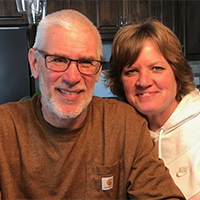 The biggest challenge in Tim Flaata's business is actually a blessing in disguise – keeping his vending machines stocked. "Sometimes I can't keep up with the demand," he chuckled. "You fill a machine, you turn around, and it needs to be filled again. But that's a problem worth having when you're running a business and working to maximize profits."
Flaata is a Business Enterprises Program (BEP) vending business owner, operating more than 70 vending machines at the Minnesota Correctional Facility (MCF) campus in Faribault. This is the largest MCF location in the Minnesota Department of Corrections system, and it provides Flaata a captive audience as customers.
Flaata has had Retinitis Pigmentosa (RP) since birth. Despite his eyesight getting progressively worse over his lifetime, it hasn't affected his spirit or his drive. "I know there are people out there with circumstances worse than mine," he said. "I think you need to make the best of your own situation, and I try to do that when I get up each morning. I could choose to sit at home and not work, but that's not me and it would not make me happy."
The BEP provides vending business opportunities on state and federal property for qualified, legally blind individuals. BEP director John Hulet believes Flaata epitomizes what the program is all about. "Tim is an outstanding business owner," Hulet said. "He shows up every day with a positive attitude, he's dedicated and reliable, and he genuinely cares about the customers he serves. He's taking advantage of the unique opportunity this program provides and does everything he can to make the most of it."
As an operator in the BEP for more than a year, Flaata is grateful for an opportunity to work hard and be his own boss. "Working in the BEP lets me control my own destiny in the business world," he said. "I have the freedom to make decisions that affect my livelihood, and to implement creative ideas to tackle the demands of a successful vending business. I am very appreciative of the opportunity the BEP has provided for me, and I look forward to going to work each day."
While Flaata has worked many different jobs over his career, he's gotten the most enjoyment as a business owner. He got the bug at age eleven when he started out as a paperboy in St. James. "That was my first job," he said. "I was responsible for paying for the product, delivering the product on time, and collecting payment for the product. I learned quickly the importance of organizing my time and providing great customer service."
"I also shoveled snow and mowed lawns," Flaata continued. "There's a special satisfaction you get when working for yourself."
Flaata's entrepreneurial spirit continued after high school. After working at a restaurant and grocery store, he became the owner-operator of his family's appliance sale and repair business. "I learned a lot about operating a business when I took it over: how to manage inventory, record-keeping, sales strategies, and maximizing productivity, just to name a few," he said. "There were many lean years, and I had to work odd jobs to keep the business afloat, but I thoroughly enjoyed it." Flaata also became a volunteer fire fighter during this time; he served for more than 30 years and advanced to the rank of Assistant Chief.
As his eyesight continued to diminish, Flaata gave up driving in his early thirties. Shortly thereafter he sold the family business and started a maintenance job at a nursing home. "I enjoyed running the business," Flaata said, "but I needed more stability in my life at that time. I was married, and I wanted to provide for my family and spend more time with them. A part-time opportunity at the nursing home turned into a full-time one with benefits." He continued with this position until moving to Owatonna in 2016.
Flaata learned about the BEP through his sister, who is also a BEP operator. He never felt the timing was right to consider it a viable option and thought he would need to relocate to get an opportunity. "Though I knew the BEP would be an interesting prospect, I also knew there would be training," he said. "At that time training required several months and had to be completed in St. Paul. I couldn't take time off from work, so I kept doing what I was doing."
That changed in 2016. Flaata's sister told him the BEP had a business opening in Faribault, and that most of the training could be completed on-line and at the MCF. "When John and my counselor met with me and explained everything, I became very excited," Flaata said. "My kids were grown up, and I was ready to get back to running my own business. I couldn't wait to get started."
"The BEP's training has been revised over the years to make it more individualized and can be completed at a pace the student is comfortable with," said Hulet. "While some of the training is conducted in St. Paul, many of the tasks can be completed on-line wherever the student has access to a computer. Tim was really motivated: he completed his training as fast as we had anyone go through it, and he did it while working full-time with the outgoing business owner."
Flaata hopes to continue operating his business until he decides to retire. He works with his wife Val, and they spend long hours together each week fulfilling the obligations of a vending business owner. "The work is hard but rewarding. Val keeps asking me if I'm ever going to take a vacation," Flaata laughed. "I keep telling her someday we will - but right now we have machines to fill."
Story originally published in 2022
-
Scott Eggen - Accessibility in Vending
State and federal laws give blind persons a priority to operate vending services on federal and state properties. SSB's Business Enterprise Program (BEP) provides training, certification, technical support, and management services to these self-employed business owners.
Scott Eggen maintains more than 125 vending machines in the St. Paul area. Recently he worked with Three Square Market, a company that provides micro-market vending technology, to make sure their kiosk technology is fully accessible. He helped design a kiosk that uses speech output for blind and low vision customers, and a repositioning feature for customers using wheelchairs.
Working with suppliers like Three Square Market makes technology accessible, both for business owners like Eggen and his customers.
Story originally published in 2020
-
Michael Colbrunn - Small Business Owner Modernizes to Serve Customers
Small business owners have been hit particularly hard by the COVID-19 pandemic, including those in SSB's Business Enterprise Program (BEP). But they are re-building and finding ways to re-launch their businesses.
Michael Colbrunn manages vending services at Minnesota State University in Mankato, where touchless point-of-sale solutions are increasingly important for convenience, health, and safety. Colbrunn worked with MSU to add card readers to his vending machines: MSU paid for the card readers, and BEP technicians obtained and installed new machines.
Blind vendors operate concession services in federal and state locations like office buildings, rest areas, and colleges and universities. The BEP program provides training, certification, technical support, and management services to these self-employed business owners.
Story originally published in 2020
-
Meet Marvin Langanki and Nathan Whitlow
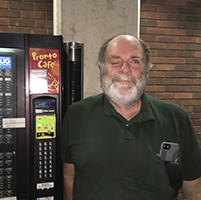 Two partnerships bring the convenience of cashless vending to Rochester Community and Technical College (RCTC) and Minnesota highway rest areas. And two Business Enterprises Program (BEP) participants are on the "cutting edge" of the new technology.
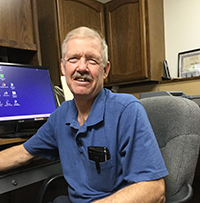 Marvin Langanki has been a BEP operator for 33 years, and is the first operator to utilize this technology at RCTC. "Credit card readers became available about eight years ago," Langanki said. "I did some reading and found that they increase sales by 20%. Vending machine sales have been going down for the past fifteen years, and most people don't carry much cash with them anymore."
Nathan Whitlow has been a BEP operator since 1981, and has seen a lot of changes in the vending industry. He's installed credit card readers in four operator-run rest areas along Interstate 35 in south central Minnesota. "We have them on about half of our machines right now," Whitlow said. "They've worked out pretty well. We don't have to deal with as much cash."
"The technology has been around for a while, and BEP operators have embraced it," said BEP Director John Hulet. "Our program chooses to invest in this technology in BEP businesses because we believe it is essential to remaining competitive."
Vending sales had declined at RCTC. "Campus enrollment has gone down due to online classes. I don't get to sell virtual candy bars!" Langanki joked. "But since adding credit card readers, sales have rebounded. When you swipe your card the information goes to an online bank. After about a week, a processing company transfers the funds to the vendor's account. It's safer in the long run; you don't need to handle any money."
"The readers are capable of giving us sales data about inventory, and where items need to be restocked," added Whitlow. "That helps us save trips. I wouldn't doubt that the industry will go completely cashless eventually."
BEP provides vending business opportunities to qualified and licensed legally blind Minnesotans, to broaden their economic opportunities. You've probably come across one of their sites in a state or federal office building, a rest area, or a state college or university campus.
Cashless payment systems have become popular in a wide range of vending machines. They accept credit and debit cards, and "mobile wallets" such as Apple Pay and Android Pay. Newer systems also add technology like touch screens that provide product information, especially useful as more people seek healthier foods, snacks, and beverages.
A 2014 industry study showed that American adults under 30 dislike using cash so much that 51% of them use credit or debit cards for purchases. A 2015 study showed that average vending machine sales increased 42% when a card reader was installed. Machines that offer cashless purchases also have average transactions of $1.60 – nearly 40 cents higher than their cash counterparts. "When you use plastic, you don't worry about it until you get the bill!" Langanki quipped.
"Millennials want a cashless option. They don't carry cash, and 50% of government workers will become millennials in the next five to ten years," Hulet said. "The majority of our vending businesses are on government property, so vendors must provide this option or risk missing out on sales to half of their customers."
"Marvin and RCTC work together to ensure students and faculty have a positive experience on campus. He also partners with the credit card service provider to ensure the equipment is operating effectively. Nathan stays knowledgeable about the latest products and technological advances in the industry, to better serve customers and enhance his business," added Hulet.
Langanki said that he always focuses on customer service. "Everything I sell can be bought somewhere else. I really only have my charm to sell them!" he remarked. "I'll do anything so that customers can get what they want."
Story originally published 2019
-
Meet Paul Bloomst and Alex Lee
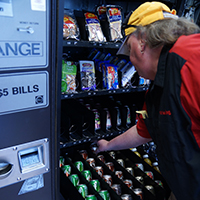 In 2017, several small business owners in the Business Enterprise Program were recognized for their efforts to offer healthier snacks in their vending machines. Paul Bloomst, who operates vending services at City Hall in Minneapolis, and Alex Lee, who manages vending services at the First National Bank building in St. Paul, held events where consumers could sample some of the new healthy products on offer.
 Consumer tastes are always shifting. For business owners like Paul and Alex, the trick is to find the sweet spot that brings together the right blend of products at the right price point. "We have people asking for healthy options," Alex commented, "But still, our best sellers are the old standbys. Among the healthier products, waters and baked chips sell well. Otherwise, we've had to shift away from some products that have too short of a shelf life, or too high of a price point."
In 2017, Paul worked with a wellness committee for Minneapolis city employees to offer healthier snacks in the vending machines at City Hall and the Public Service Center. Results from a survey the committee conducted with city employees indicated an interest in having healthy options in the vending machines. Through trial and error, Paul has worked to offer the right mix of items.
"People like the baked chips more than I thought they would," Paul says, "They also like Sun Chips and nuts." Like Alex, Paul is trying to navigate the line between what customers say they want, and what they actually will buy. "We know that folks want to eat healthy, but then, at their afternoon break, they'll go for the sugar fix."
The 34 small business owners who manage nearly 200 locations around the state need to draw on a broad set of skills in order to be successful. Among these is the ability to anticipate customer preferences. "I can sell some of the more expensive health bars in some locations, but, in most places, they aren't moving," Alex reflected, "The same thing is true with some of the products with a short shelf life – in most places, the demand isn't quite there yet."
"We just keep experimenting," Paul says, "and sooner or later, you come up with a good mix that makes most people happy."
Story originally published in 2018