

Insights from the Frontlines: Employers Still Struggle with Finding Workers They Need Despite Loosening Labor Market


By Rita Beatty and Luke Greiner
March 2026
Minnesota's labor market is not as tight as it was a few years ago, but many Minnesota employers continue to face challenges finding the workers they need, according to workforce and economic development professionals who seek to connect employers with the talent their businesses need to grow and thrive. These staff work at various organizations across Minnesota such as: chambers, economic development organizations, municipalities, Local Workforce Development Boards and the Department of Employment and Economic Development (DEED), and assist employers in navigating these opportunities and challenges. Starting in 2025, DEED launched a voluntary, non-scientific survey of these employer services staff that will be conducted twice each year. Eventually, results from the Employer Experience Survey will build a time series that not only tracks the health of Minnesota's labor market but also sheds light on emerging trends and shifts affecting Minnesota's employers in real time.
The most recent round of this twice-a-year survey closed February 27, 2026. The first survey was live during the last two weeks of September 2025. DEED's Labor Market Information (LMI) Office analyzed the results and put the latest results into an interactive data visualization. This data tool allows workforce and economic development leaders and staff and others to see the labor market from the perspective of those who work directly with employers. Eventually these results will be displayed in a way that shows changes over time in employer needs, workforce trends, general outlook and more.
Some themes that emerged from the survey responses include:
- Staff say while employers may have more applicants for open positions, they still lack qualified applicants, especially for the trades and entry‑level health care roles. Staff also noted that employers struggle with the lack of soft skills, including communication and punctuality, among workers.
- Employers are being more selective in hiring to try to find the right fit and boost retention. As part of this effort, more employers are emphasizing workplace culture, predictable scheduling and other changes, but workers seem to wish for more than some employers offer, staff say.
- Staff note that changes in federal and state policy have created additional work for employers and uncertainty about business conditions in both the near-term and long-term.
- There is growing recognition of the value of collaboration and industry-sector workforce strategies. Staff mention multi-employer partnerships, shared training programs and an increase in the use of apprenticeships.
Because the employer services staff who were surveyed work with employers across a range of industries and serve employers in regions throughout Minnesota, their responses can provide a glimpse into regional differences and highlight workforce challenges or opportunities faced by particular industries. Additionally, employer services staff can provide a high-level summary of employer sentiment across the businesses they work with, helping present a more balanced view of hiring ease, overall outlook, and other employer perspectives.
Hiring is still challenging
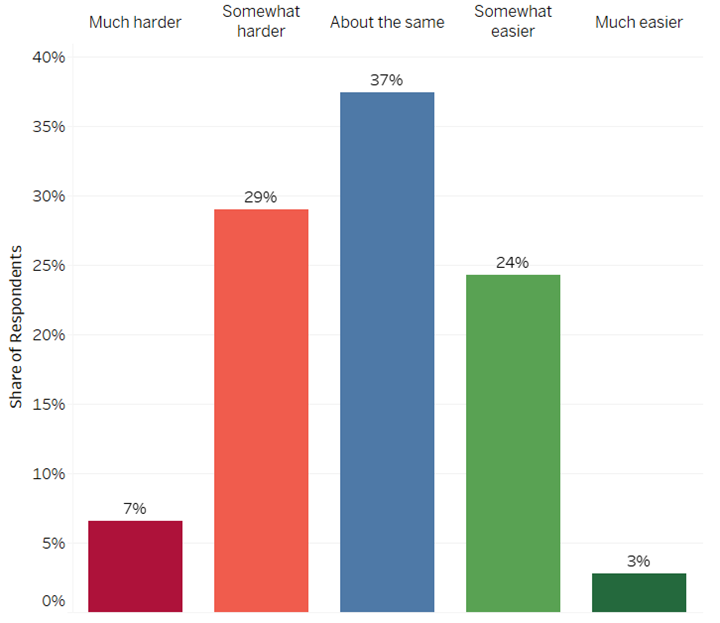
In February 2026, 112 workforce development and economic development staff who work with Minnesota employers completed the Employer Experience Survey, and 107 of those respondents indicated they have worked with employers for at least one year. Of those 107 respondents, just three indicated that the employers they are working with are having a much easier time hiring compared to a year ago, while 26 said somewhat easier, 40 said about the same, 31 said somewhat harder and seven said much harder. These responses are similar to the responses in the survey of employer services staff in September 2025.
For comparison, according to Minnesota business respondents to a January 2026 unscientific Federal Reserve Bank of Minneapolis survey of businesses in the ninth district, 61.5% of Minnesota businesses were not actively looking for workers in the fourth quarter of 2025. At the same time, over 72% of those Minnesota businesses that are hiring found it moderately to extremely difficult to find workers. Open-ended responses mentioned that there are more applicants, but not qualified ones. Minnesota responses were similar to responses from business responses from across the ninth district.
Figure 1. On average, compared to one year ago, how would you rate employers' ease of hiring for the positions they are trying to fill?
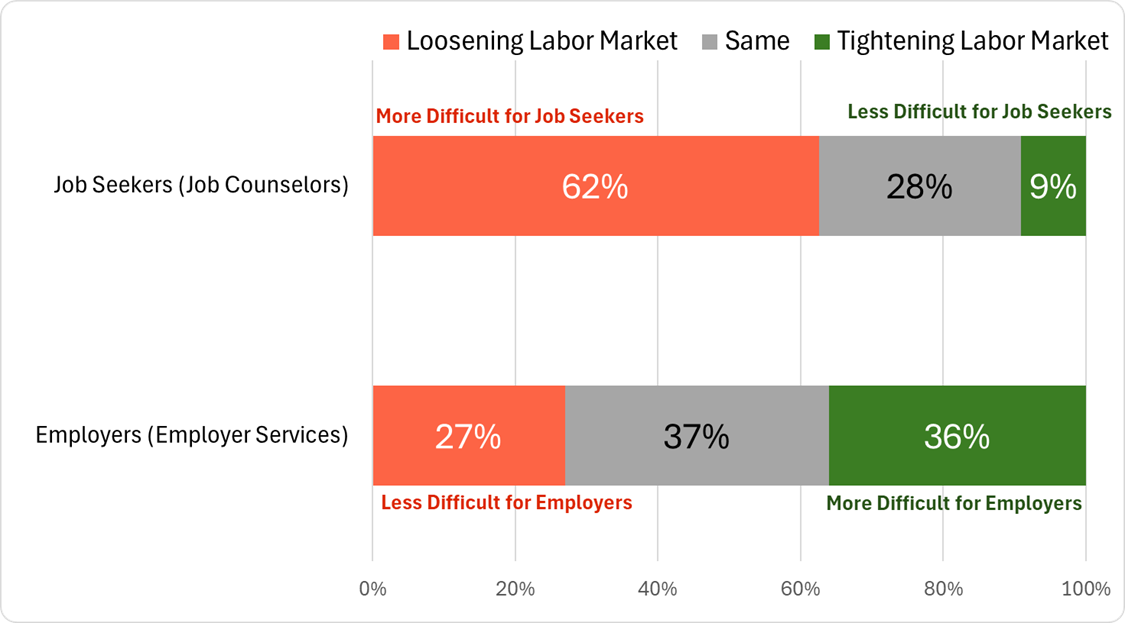
The employer services staff responses might seem like a disconnect with responses from staff who work with job seekers, who said that it has become harder for workers to find jobs and get hired. However, employer services staff may be more likely to serve employers who have positions that are more difficult to fill. Similarly, job counselor staff may be more likely to serve job seekers who have more challenges in finding employment. In both cases, the end customers that staff serve could account for this disconnect in survey responses.
Figure 2. Perspective of the Labor Market Compared to A Year Ago
View a spreadsheet to access the data represented in Figure 2.
When asked about the supply of qualified candidates, survey results highlighted the polarized experiences employers face when trying to fill similar occupations. Some respondents said certain occupations have become more difficult to find qualified applicants for, while others said those same occupations have become easier to fill compared to a year ago. Although hiring difficulty can reflect broader labor market conditions, employer-specific factors such as location, starting wage, reputation, and public visibility also play a major role.
Consensus among employer services professionals is reflected in the net difficulty score. Protective Service Workers ranked among the most challenging occupations for employers to find qualified applicants for compared to a year ago. Educators and Librarians, Construction and Skilled Trade Workers, and Personal Care Workers were also more likely to be identified as harder to fill than easier to fill. In contrast, Office Support Staff, Cleaning and Maintenance Workers, and Food Service Workers were more often described as less difficult to fill than they were a year ago.
Figure 3. Net Difficulty Score for Finding Qualified Candidates

View a spreadsheet to access the data represented in Figure 3.
There was some alignment between the Employer Experience Survey and the Job Search Experience Survey in the occupations identified as harder to hire for employers and easier to get hired into for job seekers. For example, employer services staff reported that Healthcare Specialists, Drivers and Movers, Construction Workers, Personal Care Workers and Management occupations have become more difficult for employers to fill compared to a year ago, while job counselors noted that job seekers are finding it easier to get hired into those same occupations.
Employers Are Beginning to Use Artificial Intelligence (AI), but Awareness Remains Limited
Survey responses suggest that artificial intelligence is already being used by many employers, though awareness of that use is still somewhat limited among the professionals who work with them. About 39% of respondents said employers use AI tools or systems somewhat often, while another 12% said they use them very often. At the same time, 37% selected "don't know/unsure," indicating that many employer-facing staff may not have a clear sense of how widely AI is being adopted. Among those aware of AI use, the most common applications were increasing productivity by automating routine, repetitive activities and screening applicants, far outpacing other uses such as marketing open positions, writing or proofreading documents, replacing positions formerly filled by humans, or integrating AI into products and manufacturing processes. Overall, the results suggest that employer use of AI is most visible in practical, efficiency-focused tasks rather than more transformative or workforce-replacing applications.
Figure 4. Frequency of AI Use by Employers
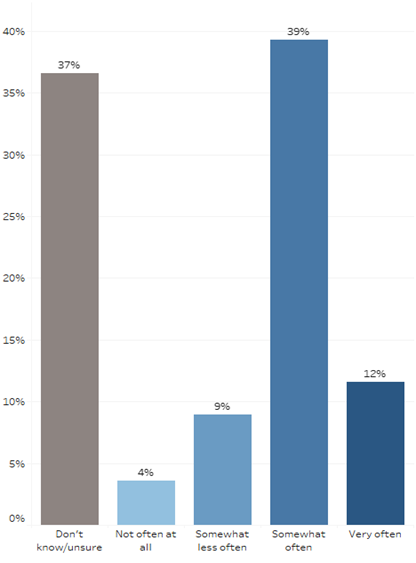
A slight majority (52%) of employer service staff now say the employers they work with utilize AI very often (13) or somewhat often (44); 13% said somewhat less often (10) or not often at all (4). Another 37% said they didn't know or were unsure if the employers they work with use AI tools or systems. Respondents who answered anything other than didn't know/unsure were invited to answer an optional open-ended follow up question. Of those responses, 37% percent say employers primarily utilize AI in the hiring process, with most citing AI use in applicant screening, while 50% say employers use AI primarily for operational functions, with most respondents saying employers use AI to increase productivity by automating routine or repetitive activities. Only one respondent said employers primarily use AI to replace positions formerly filled by humans.
The percentage of February 2026 Employer Experience Survey respondents who say employers they work with utilize AI very often or somewhat often is up slightly from the last round of the survey conducted in September 2025, when 48% of respondents said the same.
Figure 5. Perception of How Employers Use of AI

Minnesota Employer Outlook
Employer services staff who took part in the February 2026 survey had an improved perception of employer outlook for the next six months, compared to responses on the September 2025 Employer Experience Survey. One- third of respondents described employers' 6-month outlook as positive while 42% described it as pessimistic. Another quarter didn't know or were unsure.
This is in alignment with a recent survey of employers themselves. According to Minnesota business respondents to the January 2026 Federal Reserve Bank of Minneapolis survey of businesses in the ninth district referenced above, nearly 40% of Minnesota business respondents indicated they were somewhat or very pessimistic, while nearly 35% said they were somewhat or very optimistic. The remaining 25% Minnesota businesses were neutral in their outlook.
Figure 6. Share of Responses by Outlook and Location

View a spreadsheet to access the data represented in Figure 6.
Southwest Minnesota appears to have the weakest six-month employer outlook, with two-thirds of responses falling on the pessimistic side, including the highest share reporting employers are very pessimistic. The Twin Cities and Central Minnesota also lean negative, though less sharply, as both regions have larger shares of respondents describing employers as somewhat pessimistic rather than somewhat optimistic. In Central Minnesota, 38% said somewhat pessimistic compared to 31% who were somewhat optimistic, while in the Twin Cities 52% said somewhat pessimistic compared to 20% who were somewhat optimistic. By contrast, Northeast and Northwest Minnesota show the most optimistic outlooks, with larger shares of respondents selecting somewhat optimistic than somewhat pessimistic.
Conclusion
The Employer Experience Survey will continue to go out twice a year to workforce and economic development professionals who work directly with Minnesota employers, encouraging them to share their insights on general conditions as well as special topics of interest. The companion Job Search Experience Survey will also continue to go out twice a year to DEED, Local Workforce Development Board and partner organization staff who serve job seekers in Minnesota.
Together, these surveys provide a unique two-sided view of the labor market – capturing both the job seeker experience and the employer perspective. In both cases, the insights shared by experts who work with job seekers and experts who work with employers provide a unique, balanced view of changing labor market conditions and trends over time. By highlighting where employers and job seekers are aligned, and where gaps exist, these survey results give DEED, Local Workforce Development Boards, workforce partners, economic development organizations and other stakeholders additional insights to strengthen connections and better serve both employers and job seekers across Minnesota.