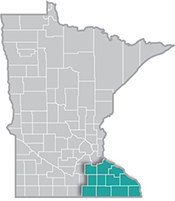
 Southeast Minnesota is a health care and agricultural powerhouse. The region is home to the renowned Mayo Clinic and some of the world's most recognized food companies and brands.
Advanced manufacturing is especially strong here, with machinery, chemicals, and electronics among the top products.
Want the freshest data delivered by email? Subscribe to our regional newsletters.
Southeast Minnesota's veterinary services industry has grown steadily over the past decade, offering a wide range of career opportunities from entry‑level roles to advanced professional positions that support the health of pets and livestock.
8/15/2026 2:11:25 PM
Amanda Blaschko
Southeast Minnesota's animals, whether family pets or livestock on farms, rely on a network of veterinary professionals to keep them healthy. Behind every checkup, surgery and dental procedure is an industry that has grown over the past decade, offering career paths from entry-level positions to advanced professional degrees. Here's a closer look at what the data show about this industry:
In 2025, there were 72 Veterinary Services establishments in Southeast Minnesota that provided medical, surgical and dental care for pets and animals, including the farm animals that remain central to the region's agricultural economy. These establishments provided 716 jobs with an average weekly wage of $47,736 in 2025. Employment increased over a ten-year period, showing a net gain of 139 jobs, or a 24.1% rise. Compared to the state growth rate, this is modest. Minnesota's Veterinary Services industry as a whole grew by 2,595 jobs since 2015 — a 42.9% increase — with about 68% of that growth captured in the Twin Cities Metro Area.
The Veterinary Services industry offers a wide range of occupational opportunities, each with its own educational path. Entry points requiring a high school diploma or equivalent include Animal Caretakers, Medical Secretaries & Administrative Assistants, and Receptionists & Information Clerks. An associate degree opens doors to roles such as Veterinary Technologists & Technicians or Veterinary Assistants & Laboratory Animal Caretakers. A bachelor's degree supports positions such as General & Operations Managers, while becoming a Veterinarian requires a doctorate or professional degree.
Looking ahead, employment projections show that nearly all of these occupations are expected to grow faster than the average of 4.5% across the total of all occupations. The one exception is Receptionists & Information Clerks, whose growth rate lags due to shifting demand across many different industries. Even so, this occupation ranks second in total hires projected from 2022 to 2032, meaning it remains a significant source of job opportunities despite its slower growth rate (see Table 1).
| SOC Code | Occupation | Estimated Employment | Median Hourly Wage | Educational Requirements | 2022-2032 Percent Change | 2022-2032 Total Hires |
|---|---|---|---|---|---|---|
| 0 | Total, All Occupations | 246,900 | $26.11 | (x) | +4.5% | +309,933 |
| 291131 | Veterinarians | 170 | $61.09 | Doctoral or professional degree | +17.1% | +114 |
| 292056 | Veterinary Technologists & Technicians | 270 | $24.31 | Associate's degree | +19.0% | +404 |
| 319096 | Veterinary Assistants & Lab. Animal Caretakers | 90 | $18.21 | Associate's degree | N/A | N/A |
| 392021 | Animal Caretakers | 440 | $17.96 | High school diploma or equiv. | N/A | N/A |
| 111021 | General & Operations Managers | 4,720 | $43.43 | Bachelor's degree | +7.1% | +4,761 |
| 436013 | Medical Secretaries & Administrative Assistants | 4,400 | $24.37 | High school diploma or equiv. | +5.6% | +2,652 |
| 434171 | Receptionists & Information Clerks | 880 | $17.84 | High school diploma or equiv. | +3.0% | +3,147 |
Source: Occupational Employment & Wage Statistics, MN Educational Requirements, & Employment Outlook
Taken together, the numbers tell a story of steady growth. Southeast Minnesota's Veterinary Services sector continues to offer a diverse mix of career opportunities, from high school-level entry points to advanced professional degrees, supporting the health of both household pets and the farm animals that remain central to the region's rural economy.
For more information about industry employment in Southeast Minnesota, contact Amanda Blaschko at amanda.blaschko@state.mn.us.

