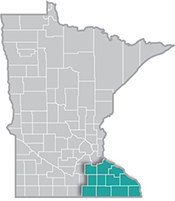
 Southeast Minnesota is a health care and agricultural powerhouse. The region is home to the renowned Mayo Clinic and some of the world's most recognized food companies and brands.
Advanced manufacturing is especially strong here, with machinery, chemicals, and electronics among the top products.
Want the freshest data delivered by email? Subscribe to our regional newsletters.
Southeast Minnesota added just over 1,850 residents between July 2024 and July 2025, according to new population estimates from the U.S. Census Bureau.
4/22/2026 10:55:08 AM
Amanda Blaschko
Southeast Minnesota added just over 1,850 residents between July 2024 and July 2025, according to new population estimates from the U.S. Census Bureau. That's slightly slower than the prior year's gain of 2,150 people, but the composition of that growth has shifted in a notable way. The region is now attracting fewer international migrants while losing fewer residents to other parts of the state or country.
Population changes in two ways. The first is through vital events: births and deaths, which demographers call natural change. The second is through migration, both international (people moving here from other countries) and domestic (people relocating from elsewhere in the U.S.).
Between July 1, 2023 and July 1, 2024, Southeast Minnesota gained about 2,700 international migrants, but lost just over 800 residents to domestic outmigration. This past year tells a different story: international migration dropped to 1,000 people while domestic migration flipped to a net gain of around 150 residents. In other words, the region is drawing fewer newcomers from abroad, but has started retaining and attracting people from elsewhere in the U.S.
Natural change also shifted notably between the two years. The region recorded about 700 more births than deaths in 2024-2025, more than double the prior year's natural increase of around 275 more births than deaths. Despite this stronger vital event contribution, Southeast Minnesota's total growth slowed from 2,150 in 2024 to 1,850 residents in 2025 due to the sharp decline in international in-migration.
| Table 1. Cumulative Estimates of the Components of Population Change, 2024-2025 | |||||||
|---|---|---|---|---|---|---|---|
| Geographic Area | Annual Change, July 1, 2024 to July 1, 2025 | ||||||
| Total Population Change | Vital Events | Net Migration | |||||
| Natural Change | Births | Deaths | Total | International | Domestic | ||
| Minnesota | 33,000 | 12,071 | 62,576 | 50,505 | 20,786 | 12,486 | 8,300 |
| Southeast Minnesota | 1,857 | 691 | 5,664 | 4,973 | 1,166 | 1,009 | 157 |
| Dodge | 94 | 121 | 281 | 160 | -27 | 20 | -47 |
| Fillmore | 51 | -39 | 236 | 275 | 90 | 12 | 78 |
| Freeborn | 12 | -84 | 313 | 397 | 96 | -6 | 102 |
| Goodhue | 45 | -7 | 535 | 542 | 52 | 17 | 35 |
| Houston | -134 | -109 | 128 | 237 | -25 | -2 | -23 |
| Mower | 288 | 83 | 514 | 431 | 205 | 187 | 18 |
| Olmsted | 940 | 653 | 1,956 | 1,303 | 287 | 440 | -153 |
| Rice | 389 | 106 | 657 | 551 | 283 | 270 | 13 |
| Steele | 10 | 31 | 395 | 364 | -21 | 4 | -25 |
| Wabasha | -17 | -38 | 211 | 249 | 21 | 8 | 13 |
| Winona | 179 | -26 | 438 | 464 | 205 | 59 | 146 |
| Source: U.S. Census Bureau, Population Estimates Program | |||||||
Map 1. Components of Population Change, 2024-2025

The county-level data reveals how that regional shift plays out locally. In 2024-2025, three counties (Olmsted, Rice and Mower) grew from both births and migration. Five others (Fillmore, Freeborn, Goodhue, Wabasha and Winona) are migration dependent: deaths outnumbered births, but enough people moved in to offset those losses. Two counties (Dodge and Steele) are holding steady through births alone, adding residents naturally even as more people move out than in. Houston County stands alone as the only place losing population both ways.
Comparing the two years shows which counties are bucking regional trends. Olmsted saw its international migration drop by more than half (from 1,168 to 440) while its domestic outmigration improved (from losing 500 residents to losing 153). Mower's international migration also fell sharply (from 519 to 187) but managed to flip from domestic loss to a small gain. Meanwhile, Winona has sustained strong domestic in-migration across both years (177 in 2023-2024, 146 in 2024-2025) even as other counties were losing residents to other parts of the state.
Steele and Wabasha shifted from net population loss to near-stability, though for different reasons. Steele's turnaround came from reduced outmigration, with net migration improving from a loss of 83 residents to a loss of 21. Wabasha gained just enough international and domestic migrants to nearly offset its natural decrease. Houston County's decline cooled slightly, dropping from a loss of 225 residents in 2023-2024 to 134 in 2024-2025, though the drivers remained the same: more deaths than births and continued outmigration.
Minnesota as a whole saw international migration fall from a net gain of 29,540 people in 2024 to 12,486 in 2025, while domestic migration swung from a loss of 1,161 residents to a gain of 8,300. The fact that Southeast Minnesota is following the state trend suggests these shifts may be driven by factors beyond local control, such as changes in federal immigration policy or broader national migration patterns.
For the region, this means population growth is both slowing and rebalancing. International migration, which had been the primary engine of growth, has cooled significantly. At the same time, the region has become more attractive to domestic migrants, though those gains are modest and unevenly distributed. Whether these trends hold will depend partly on national immigration patterns and partly on whether the region can sustain its newfound appeal to domestic migrants.
For more information about population trends in Southeast Minnesota, contact Amanda Blaschko at Amanda.Blaschko@state.mn.us.

