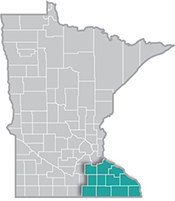
 Southeast Minnesota is a health care and agricultural powerhouse. The region is home to the renowned Mayo Clinic and some of the world's most recognized food companies and brands.
Advanced manufacturing is especially strong here, with machinery, chemicals, and electronics among the top products.
Want the freshest data delivered by email? Subscribe to our regional newsletters.
According to our long-term employment projections, Southeast Minnesota is expected to add 12,280 net new jobs between 2022 and 2032.
3/19/2026 10:55:08 AM
Amanda Blaschko
According to our /deed/data/data-tools/employment-outlook/index.jsplong-term employment projections, Southeast Minnesota is expected to add 12,280 net new jobs between 2022 and 2032. But new job creation is only part of the picture. When you factor in workers retiring and people shifting between occupations, the number of projected openings is much higher. This blog walks through projected demand at each /deed/data/data-tools/educational-requirements-occupations/index.jspeducation level using two lenses: new job creation, which shows where the economy is growing, and total hires, which captures the full scope of hiring activity including retirements and occupational transfers.
Logistics and food service drive new job growth at the lowest /deed/data/data-tools/educational-requirements-occupations/index.jspeducational requirement level, with Stockers and Order Fillers, Laborers and Freight, Stock, and Material Movers, Cooks, Fast Food Workers, and Construction Workers leading the way. Total hires tell a story of high volume and high turnover as Fast Food and Counter Workers alone project nearly 1,400 hires per year on average. These occupations offer accessible entry points into the workforce, though median wages generally top out between $15 and $22 per hour.
This tier reflects a distinct split between two occupational groups: Transportation and Healthcare. Heavy and Trailor Truck Drivers and Industrial Machinery Mechanics generate a high number of new jobs, while Medical Assistants lead new job growth on the healthcare side. Wages step up meaningfully here, with most occupations providing median wages between $22 and $30 per hour.
Healthcare dominates this educational requirement level almost entirely. Registered Nurses project 650 net new jobs and over 7,200 total hires, appearing at the top of both lists by a wide margin. The consistent presence of RNs across both numeric and percent measures signals structural, long-term demand rather than short-term fluctuation.
Growth in occupations that require a Bachelor's degree is concentrated in Management, Computer and Mathematical, and Healthcare Practitioner occupations, with Medical and Health Services Managers, General and Operations Mangers, and Software Developers among the strongest gains in new job creation. Despite modest new job growth, Educational Instruction occupations rank in the top five for total hires, a pattern driven by occupational transfers and labor force exit openings. Median wages are consistently strong, with most occupations ranging from $38 to over $61 per hour.
There are many careers that require a Master's degree that are concentrated in Community and Social Service and Healthcare Practitioner occupations, reflecting growing regional demand for mental health and clinical services. The same occupations appear in both new job creation and total hires, signaling stable long-term demand rather than turnover-driven hiring activity.
For Doctoral or Professional Degrees, Healthcare Practitioner occupations define this credential tier entirely, with every top occupation in both new job creation and total hires coming from clinical provider roles. Growth is distributed across Nurse Practitioners, Physician Assistants, Physical Therapists, Pharmacists, and Physicians, reflecting broad expansion in clinical services rather than demand concentrated in a single occupation.

In sum, two themes cut across every /deed/data/data-tools/educational-requirements-occupations/index.jspeducational requirement level. First, Healthcare Practitioner and Healthcare Support occupations appear at every rung of the education ladder, from Nursing Assistants to Nurse Practitioners, reflecting the strong concentration and breadth of Southeast Minnesota's Healthcare economy. Second, while occupations with lower educational requirements generate the highest projected hiring volume, they often tend to have higher turnover and lower wages. Instead, wages increase steadily with each additional credential level, making education a consistent factor in long-term earning potential.
For more information about educational requirements for occupations in Southeast Minnesota, contact Amanda Blaschko at Amanda.Blaschko@state.mn.us.

