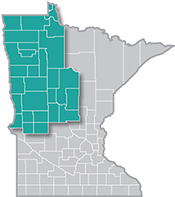
 The presence of such industry powerhouses as Polaris, Arctic Cat and New Flyer make Northwest Minnesota a hub of transportation equipment manufacturing.
From wheat and potatoes to soybeans and sugar beets, the region is a major producer and processor of food staples and specialty agricultural products.
Want the freshest data delivered by email? Subscribe to our regional newsletters.
What's driving new health care sector growth in Northwest Minnesota?
6/15/2026 1:32:47 PM
Anthony Schaffhauser
Northwest Minnesota's health care sector is growing again, but the jobs driving today's growth look very different from the last time it grew. As DEED celebrates Follow Your Heart to a Caring Career Month in July, we have a fresh look at Health Care & Social Assistance employment through 2025, with a focus on what's driving growth in Northwest Minnesota and how that compares to the rest of Greater Minnesota.
Minnesota's Health Care & Social Assistance sector reached 556,992 jobs in 2025, up 4.4% from 2024 and 18.9% above its 2015 level. The Twin Cities metro (+25.1% since 2015) and Southeast Minnesota (+14.8%) lead all regions in Health Care employment (Figure 1). As explored in last year's blog, this isn't surprising: the metro benefits from an enormous, diverse health care market spanning virtually every specialty, while Southeast is home to Mayo Clinic and its Destination Medical Center, a regional and national draw for both patients and providers. These structural advantages set both regions apart from the rest of Greater Minnesota.
With that context in place, Northwest Minnesota's Health Care & Social Assistance sector trends are best understood in comparison to the three remaining Greater Minnesota regions: Central, Northeast, and Southwest.
Figure 1: Cumulative Health Care & Social Assistance Employment Growth by Region, 2015 to 2025

Source: DEED Quarterly Census of Employment and Wages (QCEW)
Over the full 2015–2025 period, Northwest Minnesota's cumulative sector growth of +12.9% significantly leads the comparable Greater Minnesota regions (Central +7.7%, Southwest +8.0%, Northeast +4.3%). But zoom in to 2023–2025 and the picture shifts: Southwest surged to +9.0% growth in just two years, and Central posted +6.7%, outpacing Northwest's +6.4%. Northeast, the longtime underdog, is gaining steam with +5.8% growth.
In other words, the full decade still favors Northwest, but recent job growth in the comparable regions has closed the gap. The more interesting question is why each region is growing, and whether Northwest's drivers are the same as its neighbors'.
Northwest Minnesota's health care employment has had two distinct three-year growth periods since 2015, separated by pandemic-era losses and a slow recovery. The sector peaked in 2018, declined, and then recovered past that 2018 high in 2023, setting up the current surge. The subsectors powering each period's growth, however, are almost completely different (Table 1).
| Sector/Subsector | Employment | 2016-2018 | Employment | 2023-2025 | ||||
|---|---|---|---|---|---|---|---|---|
| 2016 | 2018 | Job Change | Share of Growth | 2023 | 2025 | Job Change | Share of Growth | |
| Health Care & Social Assistance | 37,281 | 39,362 | +2,081 | 100.0% | 39,096 | 41,632 | +2,536 | 100.0% |
| Hospitals | 11,456 | 12,244 | +788 | 37.9% | 12,115 | 12,863 | +748 | 29.5% |
| Nursing & Residential Care | 11,930 | 12,365 | +435 | 20.9% | 11,127 | 12,489 | +1,362 | 53.7% |
| Social Assistance | 6,333 | 6,312 | -21 | -1.0% | 7,722 | 8,243 | +521 | 20.5% |
| Ambulatory Health Care | 7,560 | 8,440 | +880 | 42.3% | 8,131 | 8,036 | -95 | -3.7% |
Source: DEED Quarterly Census of Employment & Wages
The two periods produced similar total job growth – about 2,100 to 2,500 jobs over three years – but through entirely different means. In 2016 to 2018, Ambulatory Health Care and Hospitals together generated 80% of the region's gains, while Social Assistance was flat and Nursing & Residential Care played a supporting role. From 2023 to 2025, that dynamic has inverted: Nursing & Residential Care Facilities alone accounted for 54% of all growth, Social Assistance contributed another 21%, and Ambulatory Health Care Services has gone from the region's strongest employment growth generator to the only one losing jobs.
Hospitals, notably, are the one constant, contributing roughly 30% to 38% of growth in both periods and growing at nearly the same rate (+6.9% then, +6.2% now).
This is not a minor shift in emphasis. It is a structural reorientation of where Northwest Minnesota's health care workforce is growing, from clinic-based and outpatient care toward residential care and community services. For workforce and economic development professionals, the implications for training pipelines, facility capacity, and recruitment strategies are different today than the last time the sector grew, just seven years ago.
The Nursing & Residential Care rebound from the pandemic is a defining story of Northwest Minnesota's current health care expansion. After falling from a peak of 12,365 jobs in 2018 to a low of 10,843 in 2022 – driven by the long-term care staffing crisis – the subsector has added 1,645 jobs over the past three years and now stands at 12,489 jobs, a new high.
Northwest's Nursing & Residential Care Facilities growth rate of +12.2% since 2023 is broadly in line with comparable regions: Central posted +15.8%, Southwest +13.5%, and Northeast +7.9%. This subsector rebound is a Greater Minnesota phenomenon, not a Northwest-specific one. What distinguishes Northwest is that the recovery carries a larger share of total growth here than elsewhere, because Ambulatory Health Care, which is growing in every other comparable region, was not contributing job growth in Northwest.
Average weekly wages at Nursing & Residential Care Facilities have risen from $568 in 2019 to $805 in 2025. That's 42% wage growth compared to 34% across the Total, All Industries. However, wage growth slowed in 2025 (+3.3%) compared to 2024 (+5.3%), even as employment accelerated. Adjusting for inflation with the CPI-U shows real wage growth of 2.7% for 2024 and 0.7% for 2025, the same two percentage point difference.
The combination of faster hiring and slower wage escalation suggests the pipeline of available workers improved rather than facilities simply outbidding each other for the same limited pool. That's an encouraging signal. Stay tuned for a future blog taking a deeper look at the Nursing & Residential Care subsector and its workforce outlook for the region.
Ambulatory Health Care has the sharpest contrast in the two periods. It went from the Northwest's fastest-growing subsector (+11.6% from 2016 to 2018) to the only subsector losing jobs (-1.2% from 2023 to 2025). Northwest is the only region where Ambulatory Health Care employment is still below its 2019 level, and the only region where it declined from 2023 to 2025.
Ambulatory Health Care encompasses a wide range of outpatient settings: Physician offices, specialty clinics, home health care services, and others. We have more detailed data to reveal which are driving Northwest's underperformance. A breakdown by detailed industry group within Ambulatory Health Care Services would sharpen the workforce development response considerably and is worth pursuing in future analysis. There may also be implications for economic development as wages of the highly paid professionals employed in this sector are re-spent to support other businesses. Can the region become more competitive to attract these providers?
The trends described here point to real opportunities for workforce and economic development action in Northwest Minnesota. Supplying the workers that Nursing & Residential Care and Social Assistance need, while continuing to ensure the large Hospitals subsector is supported, is a workforce development imperative. These subsectors also offer workers strong wages and real advancement opportunities, making recruitment and training investment here a high-return proposition. For the region's economic development, understanding why Ambulatory Health Care has subpar growth should be near the top of the agenda. Future blogs will dig deeper to inform these priorities.
For more information about Health Care industry trends in Northwest Minnesota, contact Anthony Schaffhauser at Anthony.Schaffhauser@state.mn.us.

