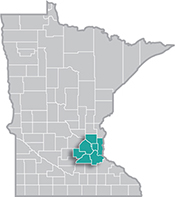
 The Minneapolis-St. Paul metropolitan area is a national leader in finance, advanced manufacturing, agriculture and retailing.
Medical devices, electronics and processed foods are strong suits recognized globally.
Want the freshest data delivered by email? Subscribe to our regional newsletters.
The Seven-County Metro Area had a population of 3.2 million people in 2024
3/19/2026 10:43:22 AM
Tim O'Neill
According to data from the U.S. Census Bureau's American Community Survey (ACS), the Seven-County Metro Area had a population of 3.2 million people in 2024. At the same time, data from Quarterly Workforce Indicators (QWI) shows that the region had 1.8 million jobs. Zooming in on both sets of data reveals a complex and multigenerational mix of people and workers in the region.
There are now at least six generations living together in the Metro Area. Born between 1981 and 1996, Millennials are the largest generation, with about 734,500 people, surpassing both the younger Generation Z (657,100 people) and the older Generation X (628,400 people). Baby Boomers, ranging from 60 to 78 years of age in 2024, make up the 4th largest generation in the region with a population of about 556,400 people. Generation Alpha, with about 481,100 people, will continue to grow until a new year is established for whatever the next generation is named. Rounding out the Metro Area's population, the combination of the Silent Generation (those born between 1928 and 1945) and the Greatest Generation (those born between 1901 and 1927) accounted for an estimated 141,700 people in 2024 (Table 1).
| Table 1. Metro Area Population by Generation, 2024 | |||||
|---|---|---|---|---|---|
| GENERATION | Number | Percent | Years | Youngest | Oldest |
| Generation Alpha | 481,100 | 15.0% | 2013 – Now | 0 | 11 |
| Generation Z | 657,100 | 20.5% | 1997 – 2012 | 12 | 27 |
| Millennials | 734,500 | 23.0% | 1981 – 1996 | 28 | 43 |
| Generation X | 628,400 | 19.6% | 1965 – 1980 | 44 | 59 |
| Baby Boomers | 556,400 | 17.4% | 1946 – 1964 | 60 | 78 |
| Silent & Greatest Generation | 141,700 | 4.4% | 1945 and earlier | 79 | |
| Total Population | 3,199,200 | 100.0% | |||
| Source: Census Bureau, American Community Survey 5-Year Estimates | |||||

As those in Generation Alpha (born between 2013 and the mid-2020s) are not yet old enough to participate in the labor market, there are at least five generations at work in the Metro Area. These workers range from teenagers in Generation Z to senior citizens yet working from the Silent and Greatest Generations. Digging into the QWI data, one can clearly see that Millennials make up the largest share (35.9%) of employment in the region. This is equivalent to an estimated 651,500 jobs. Accounting for an estimated 544,900 jobs, those in Generation X make up 30.0% of employment in the region. It should be noted that Millennials and Gen X together account for the vast majority of the Metro Area's prime-working age population, or those between the ages of 25 and 54 years. Labor force participation rates reach their highest levels for workers between these ages.
At the bookends of the region's labor force, Gen Z, Baby Boomers, and those from the Silent and Greatest Generations account for fully one-third (34.0%) of the Metro Area's total employment. That's equivalent to over 617,000 jobs in the region held by Gen Z workers, Baby Boomers, and those still working among the Silent and Greatest Generations. Broken out, about one-fifth (19.1%) of the region's jobs are held by younger Gen Z workers (an estimated 346,800 jobs). About one-seventh (14.9%) of the region's jobs are held by Baby Boomers, Silent, and Greatest Generation workers (an estimated 270,200 jobs).
For a bit more generational flavor, let's take a quick look at industry employment in the Metro Area by the QWI's broad generation groups.
Whether it's an industry like Accommodation & Food Services that has a higher concentration of Gen Z workers or Manufacturing that has a higher concentration of Gen X workers and Baby Boomers, all industries across the Metro Area will have a unique and diverse mix of generations in the workforce. To learn more, check out DEED's /deed/data/lmi-reports/generations/index.jspGenerations in the Workplace in Minnesota and its regions reports. And be sure to check out Navigating Generational Differences in the Workplace on April 1 to see how employers can better understand and navigate generational dynamics to build stronger, more inclusive teams.
To discover more about the Twin Cities Metro Area, contact Tim O'Neill, Labor Market Analyst, at Timothy.ONeill@state.mn.us

