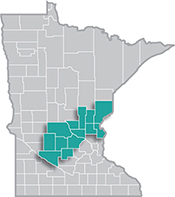
 Central Minnesota is a manufacturing stronghold, with several global manufacturing firms operating there.
The region is especially well known for its expertise in food processing, printing, furniture manufacturing, appliances, machinery and heavy equipment manufacturing.
Want the freshest data delivered by email? Subscribe to our regional newsletters.
While Central Minnesota is projected to experience strong employment growth through 2034, the largest number of job opportunities will come from replacement needs in occupations with high turnover, not just the fastest-growing jobs.
11/23/2026 1:18:28 PM
Luke Greiner
Central Minnesota's economy is expected to see steady growth over the coming decade, with employment projected to increase 3.4%, outpacing Minnesota's statewide growth rate of 3.0%, according to DEED's newly released regional /deed/data/data-tools/employment-outlook/index.jspEmployment Projections. While this growth signals a positive outlook for the region, the occupations growing fastest aren't necessarily those offering the most job openings.
Health Care dominates Central Minnesota's fastest-growing occupations from 2024 to 2034. Nurse Practitioners lead the way, with employment projected to increase 46.3% over the ten-year period, followed by Physician Assistants (29.8%) and Ophthalmic Medical Technicians (28.4%).
Other rapidly growing occupations include Psychiatric Technicians, Physical Therapist Assistants and Medical and Health Services Managers, as well as two different healthcare-related teaching positions. Data Scientists also make the top ten, highlighting opportunities beyond Health Care. While these occupations are expanding quickly, many represent relatively small portions of the workforce overall. As a result, rapid percentage growth doesn't always translate into the largest number of job openings (Table 1).
| Occupation | Total Openings | Projected Change |
|---|---|---|
| Nurse Practitioners | 456 | +46.3% |
| Physician Assistants | 285 | +29.8% |
| Ophthalmic Medical Technicians | 141 | +28.4% |
| Psychiatric Technicians | 314 | +25.5% |
| Physical Therapist Assistants | 241 | +25.5% |
| Medical and Health Services Managers | 1023 | +25.3% |
| Data Scientists | 32 | +23.8% |
| Health Specialties Teachers, Postsecondary | 66 | +19.2% |
| Occupational Therapists | 184 | +17.6% |
| Nursing Instructors and Teachers, Postsecondary | 76 | +17.6% |
Source: DEED Employment Outlook
Looking at total projected openings from 2024 to 2034 reveals a different picture, with larger occupations that tend to have higher turnover at the top of the list. Cashiers lead with 14,272 projected openings, followed closely by Fast Food and Counter Workers (14,181) and Retail Salespersons (11,435).
These occupations generate substantial opportunities even with modest employment growth or projected declines. Total employment of Cashiers, for example, is expected to decline 3.4%, yet thousands of openings will remain as workers change occupations or retire. Construction Laborers, Truck Drivers, and Stockers and Order Fillers also show significant opportunities with higher growth rates (Table 2).
| Occupation | Total Openings | Projected Change |
|---|---|---|
| Cashiers | 14,272 | -3.4% |
| Fast Food and Counter Worker | 14,181 | +3.4% |
| Retail Salespersons | 11,435 | +2.0% |
| Stockers and Order Fillers | 8,002 | +11.6% |
| Laborers and Freight, Stock, and Material Movers, hand | 7,125 | +2.7% |
| Construction Laborers | 7,044 | +9.4% |
| Janitors and Cleaners, Except Maids and Houskeeping Cleaners | 6,905 | +2.7% |
| Heavy and Tractor-Trailer Truck Drivers | 6,619 | +5.4% |
| Waiters and Waitresses | 6,282 | 0.0% |
| Farmers, Ranchers, and Other Agricultural Managers | 6,144 | -4.9% |
Source: DEED Employment Outlook
Workforce development professionals, educational institutions and employers benefit from understanding the different components of employment projections. However, focusing solely on employment growth percentages can overlook the substantial number of job openings created as workers retire or move into other occupations, which often is a much larger number than new job growth.
For example, Cashiers are projected to experience a 3.4% decline in employment by 2034, yet the occupation is expected to generate approximately 14,300 openings, nearly five times the combined 2,868 openings projected for the ten fastest-growing occupations shown in Table 1. In fact, every occupation in Table 2 among the ten with the most projected openings is expected to generate more than twice as many openings as those ten fastest-growing occupations combined.
Employment growth tells only part of the story. Understanding both growth and replacement openings provides a more complete picture of workforce demand. For job seekers, this means opportunities exist even in occupations with projected employment declines. For educators, employers and workforce development professionals, it reinforces the importance of considering total openings when planning training programs, allocating resources and preparing Central Minnesota's future workforce.
For more information about employment projections in Central Minnesota, contact Luke Greiner at Luke.Greiner@state.mn.us.

