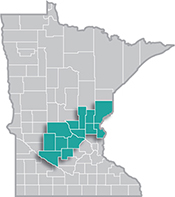
 Central Minnesota is a manufacturing stronghold, with several global manufacturing firms operating there.
The region is especially well known for its expertise in food processing, printing, furniture manufacturing, appliances, machinery and heavy equipment manufacturing.
View our latest blogs on CareerForce. Want the freshest data delivered by email? Subscribe to our regional newsletters.
Central Minnesota’s largest occupations span retail, health care, transportation, education and management, illustrating wide wage ranges and multiple pathways to strong careers without necessarily requiring a four-year degree.
8/24/2026 1:18:28 PM
Luke Greiner
Central Minnesota's largest occupations reflect both the size and diversity of the region's economy. From Retail and Health Care to Transportation, Education and Management, the jobs employing the most people span a wide range of wages and education requirements.
Cashiers are the region's largest occupation, with about 8,410 jobs, followed closely by Retail Salespersons at 8,080 jobs. Fast Food and Counter Workers also rank among the largest occupations, with 6,530 jobs. These careers typically require a high school diploma or equivalent and short-term on-the-job training, and help illustrate the significant role that retail, hospitality and service industries play in the regional labor market.
But some of the region's largest occupations also offer substantially higher wages. General and Operations Managers employ about 6,680 workers and have a median annual wage of roughly $91,700. Registered Nurses, with approximately 6,080 jobs, have a median annual wage of more than $105,000. Elementary School Teachers also appear among the top 20 occupations, with about 3,510 workers and a median wage near $79,000. These occupations typically require a bachelor's degree, though Registered Nurses can also start with an associate degree in Minnesota.
Importantly, many of Central Minnesota's larger occupations do not require extensive postsecondary education or training, including a bachelor's degree or higher. Heavy and Tractor-Trailer Truck Drivers, for example, employ about 5,630 workers and have a median annual wage of more than $63,000 and can be started with a high school diploma and a commercial driver's license. Construction Laborers and Maintenance and Repair Workers also offer median wages approaching $60,000 while typically requiring a high school diploma or occupational training rather than a four-year degree.
While not necessarily an indicator for demand, the most common occupations offer insight into the types of occupations that have the largest amount of opportunity.
The region's largest occupations reinforce an important workforce message: there is no single pathway to a successful career. Central Minnesota employers need workers with different levels of education, training and experience. Helping students and job seekers understand the connection between occupation size, wages and education requirements can help them identify and prepare for career paths that fit both their interests and the needs of the regional economy.
/deed/assets/local-look-cen-2026-08-24-figure-1_tcm1045-764968.png
For more information about occupations in demand in Central Minnesota, contact Luke Greiner at luke.greiner@state.mn.us.

