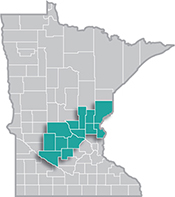
 Central Minnesota is a manufacturing stronghold, with several global manufacturing firms operating there.
The region is especially well known for its expertise in food processing, printing, furniture manufacturing, appliances, machinery and heavy equipment manufacturing.
View our latest blogs on CareerForce. Want the freshest data delivered by email? Subscribe to our regional newsletters.
Central Minnesota offers many economic and lifestyle advantages to residents.
4/22/2026 1:18:28 PM
Luke Greiner
Central Minnesota offers many economic and lifestyle advantages to residents. For example, many people live within commuting distance to the Twin Cities metro area, allowing workers to access the large Twin Cities labor market while living in less expensive and populated communities. However, the cost of covering basic needs is higher than some might expect. According to DEED's /deed/data/data-tools/col/index.jspCost of Living Tool, Central Minnesota has the second-highest cost of living among the state's six planning regions, ranking behind only the Seven-County Twin Cities metro area.
For a household with two full-time workers and two children, the estimated annual cost of living in Central Minnesota is $98,496. That means each worker would need to earn $23.68 per hour to meet basic household expenses. Among the largest monthly costs are housing ($1,864), childcare ($1,298), food ($1,266), and transportation ($1,221). Together, these costs show how quickly everyday expenses can add up for working families. According to wage data, about half of all jobs in the region have a median wage that would meet these needs.
The Cost of Living represents neither a poverty living nor a middle-class living but rather a simple living that meets basic needs for health and safety. To meet the mandate of a basic needs living study, the following costs are excluded, even though several may be part of a normal, healthy life: savings, vacations, entertainment, eating out, tobacco and alcohol.
Rather than describing what families are spending, as the Consumer Expenditure Survey does, the /deed/assets/COL%202025%20Report_tcm1045-741959.pdfCost of Living study examines the cost of basic needs. For example, we might buy one apple for our two children and split it in half if that's all we can afford. That's our spending. But our family actually needs two apples. That's our basic need. And rather than looking at the rate of change over time as the Consumer Price Index does, the Cost of Living looks at dollar costs. As shoppers, we don't ask the cashier how many percentage points higher the apple's price is today than the last time we shopped. We ask: How much does the apple cost?
Using that analysis, data show that the costs can also be steep for a single parent with one child. In Central Minnesota, this household type faces an estimated annual cost of living of $59,796, requiring an hourly wage of $28.75 working full-time, year-round to meet basic needs. In this case, the largest monthly expenses are housing ($1,407), child care ($886), food ($629) and transportation ($624). These figures highlight the financial pressure that can fall on one income when both housing and child care consume large shares of the budget. Around 40% of jobs in Central Minnesota have a median wage high enough to sustain that cost of living.
Figure 1. Cost of Living in Central Minnesota for Two Parents and Two Children, 2025

Even for a single adult with no children, the cost of living remains significant. In Central Minnesota, a single person aged 19 to 50 faces an estimated yearly cost of $37,332, which would require an hourly wage of $17.95 working full-time, year-round. Housing is the largest expense at $1,119 per month, followed by transportation, food, and taxes. Thankfully, about 82% of jobs in the region have a median wage that could cover the cost to live for a single person.
These estimates reflect the cost of basic needs rather than discretionary spending, making them a helpful benchmark for understanding economic conditions in the region. They can provide useful context for conversations about wages, workforce challenges, career planning, and community development.
For more information about the cost of living in Central Minnesota, contact Luke Greiner at Luke.Greiner@state.mn.us.

