October 2026
10/9/2026 3:39:54 PM
Lisa Larges, State Services for the Blind Outreach Coordinator
When we think about success in the workplace, standard qualification checklists often come to mind. We think about technical expertise, industry knowledge and the ability to execute core responsibilities efficiently. While these hard skills open the door to a new position, long-term success in any career is built on a much broader set of everyday abilities.
Thriving in a professional environment relies heavily on soft skills such as building positive relationships, conveying confidence and arriving on time. Among the soft skills that blind, DeafBlind and low vision employees bring to the workplace are the travel skills that empower them to navigate with confidence. These navigation tools are actively used every day, both outdoors and indoors. Employees rely on them when mapping out transit bus routes to get to work on time, safely crossing streets, and pinpointing building entrances. Indoors, these skills come into play when mastering floor plans, locating offices, finding meeting spaces and more.
"This National Disability Employment Awareness Month (NDEAM), we celebrate the diverse skillsets that make our workforce resilient, innovative and effective" said DEED Deputy Commissioner for Workforce Services and Operations Evan Rowe. "Excellent job performance relies on technical know-how, solid interpersonal relationships, and total independence in our work environments. By mastering the full toolkit, blind, DeafBlind and low vision professionals continue to demonstrate that true accessibility and career achievement go hand in hand."
State Services for the Blind (SSB) connects program participants with training in orientation and mobility (O&M). The goal for SSB and Vocational Rehabilitation Services (VRS) is to ensure that people with disabilities have the skills they need to compete in the job market. Using nonvisual travel techniques, like a white cane or a guide dog, understanding traffic patterns, and knowing strategies for mapping out new spaces are essential skills for being job ready. With these skills in hand, the morning commute transitions smoothly to the first meeting of the day, and then to a chat with coworkers in the breakroom, before heading out to meet with a client in a separate location.
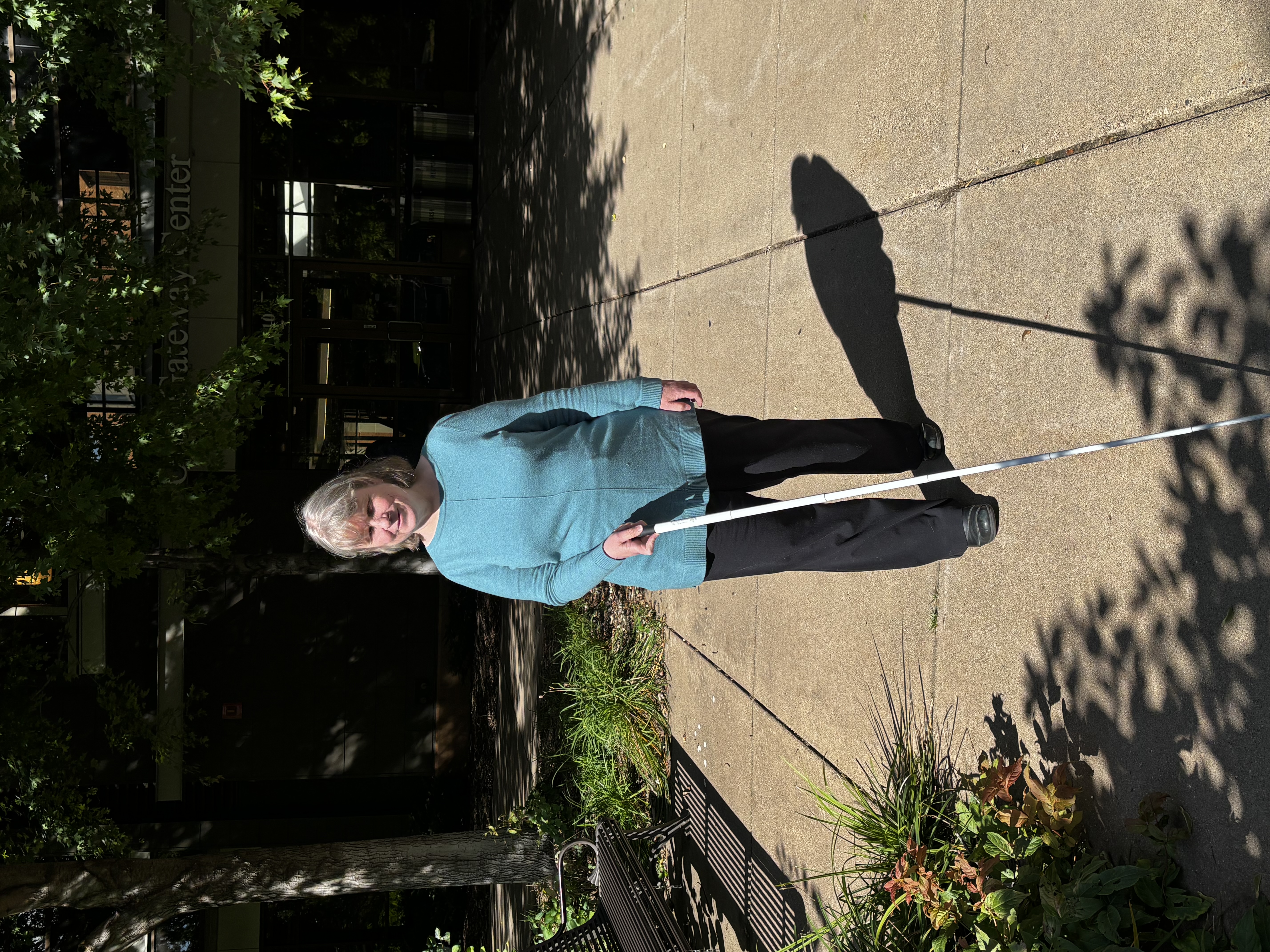 Kathy McGillivray has drawn on these skills throughout her long and successful career in accessibility services in higher education. McGillivray, who now serves as the director of the Center for Learning and Accessible Student Services (CLASS), is a sought-after speaker, as well as an active member of her community.
“As a blind professional, I’ve found that having solid travel skills has really been important for me,” she says. “I work on a university campus and often need to go between buildings for meetings. I've also attended a fair number of conferences as a presenter or a participant. In these situations, being comfortable using a white cane and having some strong travel skills has been critical."
On Oct. 13, SSB and community partners will gather at the Capitol to mark White Cane Awareness Day. The day, observed nationally since being authorized by congress and declared by President Johnson in 1964, recognizes the way in which the white cane has been used as a tool promoting independence and advancement for blind, DeafBlind and low vision Americans. The public is invited to attend this event which will begin at 9:30am and will include special activities, community resources and a short program.
communities
workforce


