 The Minneapolis-St. Paul metropolitan area is a national leader in finance, advanced manufacturing, agriculture and retailing.
Medical devices, electronics and processed foods are strong suits recognized globally.
Want the freshest data delivered by email? Subscribe to our regional newsletters.
The Twin Cities Metro Area’s manufacturing sector employs relatively few young workers, but those who do work in the industry tend to earn higher wages and work more hours than their peers in other industries.
9/15/2026 4:10:50 PM
Tim O'Neill
The Seven-County Twin Cities Metro Area was home to nearly 170,000 Manufacturing jobs in 2025, making it the second largest-employing industry in the region. And these are high-paying jobs. On average, Manufacturing workers in the Metro Area made annual wages of nearly $97,200. This was 16.2% higher than the average annual wage across all industries in the region.
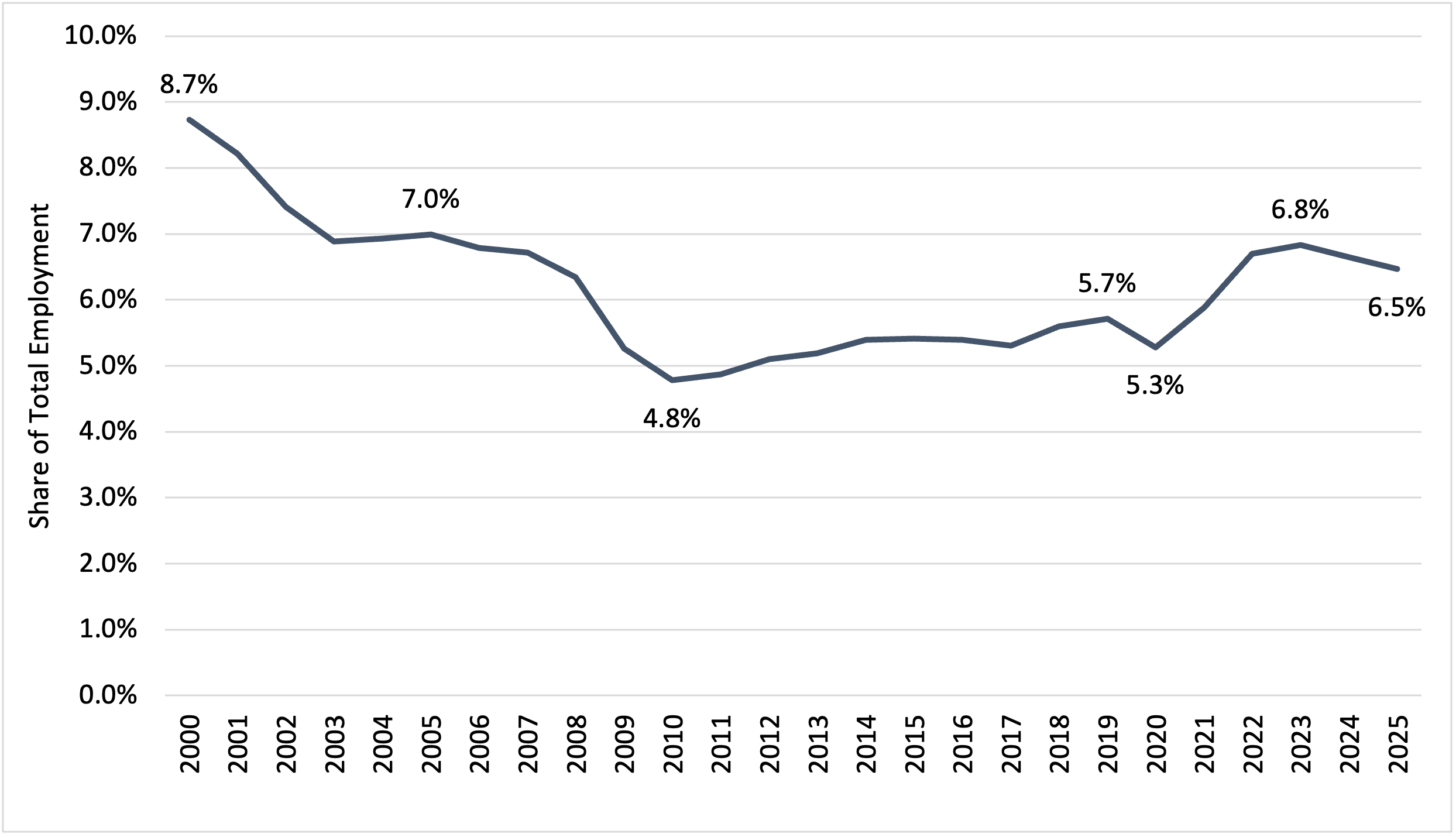
The data also reveals that Manufacturing workers in the region tend to be in their prime working years, between 25 and 64 years, and are less likely to be in the youngest or oldest age groups. In 2025, for example, 6.5% of the Metro Area's Manufacturing workers were 24 years of age and younger. This is compared to 12.6% of workers across all industries being 24 years of age and younger. Let's take a closer look at younger workers in the Metro Area's Manufacturing sector (Figure 1).

Trends also reveal more exaggerated changes for youth employed in Manufacturing when compared with total employment in the industry. Between 2000 and 2010, the number of workers 24 years and younger in Manufacturing declined by nearly 12,200. This 61.9% decline was twice as severe as the 30.4% decline in the industry's total employment change during that period. Between 2010 and 2019, the number of Manufacturing workers 24 years and younger rebounded by about 2,600. This 35.1% increase was 2.7 times the 12.9% growth rate for the industry's total employment (Figure 2).
These exaggerated trends have continued in recent years as well. During the COVID pandemic, between 2019 and 2020, just over 1,000 workers 24 years and younger left the Manufacturing sector. This 10.5% decline was 3.3 times the rate of decline for the total industry (-3.1%). But in the recovery, between 2020 and 2023, about 3,000 workers 24 years and younger joined the Manufacturing sector. This 32.9% increase was 11.7 times the rate of increase for the total industry (+2.8%). Most recently, between 2023 and 2025, about 1,100 workers 24 years and younger left the Manufacturing sector. This 9.5% decline was 2.1 times the rate of decline for the total industry (-4.4%) during that period (Figure 2).
Source: Quarterly Workforce Indicators
Our Quarterly Employment Demographics (QED) tool also reveals employment data by age, with additional industry detail. With this data one can see that Beverage & Tobacco Product Manufacturing had the highest share of workers under 25 years of age (12.9%) in 2025 when compared with other in-depth Manufacturing sectors. Wood Product Manufacturing (11.4%) and Food Manufacturing (11.2%) also had higher shares of younger workers in the Metro Area.
When compared with total Manufacturing employment, other in-depth sectors with higher shares of young workers included Electrical Equipment & Appliance Manufacturing (8.9%), Transportation Equipment Manufacturing (8.5%), Primary Metal Manufacturing (8.1%), Nonmetallic Mineral Product Manufacturing (8.1%), and Furniture & Related Product Manufacturing (7.7%). In-depth sectors with lower shares of younger workers included Printing & Related Support Activities (5.2%), Chemical Manufacturing (5.4%), Paper Manufacturing (5.6%), and Computer & Electronic Product Manufacturing (5.8%) (Figure 3).

Along with employment shares, DEED's QED data also shows median hourly wages and median hours worked, which tend to be much higher in Manufacturing. For example, the median hourly wage for Manufacturing workers 19 years and younger was $19.98 in the Metro Area in 2025. This increased to $26.06 for workers 20 to 24 years. These rates were $16.92 and $21.56, respectively, for workers across the total of all industries.
Meanwhile, workers aged 19 years and younger worked a median of 186 hours per quarter in 2025. This increased to 480 hours per quarter for workers 20 to 24 years. These rates were 106 hours and 283 hours, respectively, for workers across the total of all industries. In summary, younger workers in Manufacturing tend to work more hours and get higher wages than their counterparts across the total of all industries.
October is Manufacturing Month in Minnesota. You can find many Manufacturing Month resources, including information about career exploration and hiring events taking place throughout the month around the state on the CareerForce website.
To discover more about Manufacturing in the Twin Cities Metro Area, contact Tim O'Neill, Labor Market Analyst, at Timothy.ONeill@state.mn.us
October is Manufacturing Month in Minnesota. You can find many Manufacturing Month resources, including information about career exploration and hiring events taking place throughout the month around the state at CareerForce's Manufacturing Industry page.

