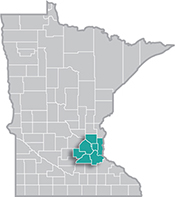
 The Minneapolis-St. Paul metropolitan area is a national leader in finance, advanced manufacturing, agriculture and retailing.
Medical devices, electronics and processed foods are strong suits recognized globally.
Want the freshest data delivered by email? Subscribe to our regional newsletters.
There are countless career pathways an individual might embark upon.
4/22/2026 10:43:22 AM
Tim O'Neill
There are /deed/data/lmi-reports/workforce-path-success/index.jspcountless career pathways an individual might embark upon. For example, after graduating from high school, one might explore a four-year degree or find employment in the labor market right away. Another might join the military, and yet another might start an apprenticeship. Some choose to continue their education by enrolling in a community or technical college or a university. We could do an endless blog series just about all the established and unique pathways a person living in the Twin Cities Metro Area might do as they journey from education into a career. For this blog, let's just look at occupations requiring a two-year degree in the region.

There are numerous colleges and universities offering two-year programs in the Metro Area. For the purposes of this blog, we'll look at those programs that result in obtaining an associate degree. According to data from the /deed/data/data-tools/graduate-employment-outcomes/index.jspGraduate Employment Outcomes (GEO) tool, there were just over 6,800 graduates obtaining an associate degree in the Metro Area in 2023. In their second year after graduation, these completers earned a median hourly wage of $25.07, with nearly a quarter of completers finding work in Health Care. Other industries employing a higher share of such completers included Retail Trade, Manufacturing, Professional & Technical Services, and Food Services & Drinking Places (Figure 1). The vast majority (86.7%) of associate degree completers in the Metro Area remained in the region for work two years later.
Continuing to analyze DEED's GEO data, the associate degree instructional programs with the most graduates in the Metro Area in 2023 included:
From DEED's various educational tools, including Graduate Employment Outcomes, /deed/data/data-tools/college-major-tool/index.jspCollege Major to Industry of Employment and /deed/data/data-tools/college-career-connector/index.jspCollege Major to Career Connector, people can start to understand the typical job market outcomes for someone obtaining an associate degree. We can also look into a resource like DEED's /deed/data/data-tools/oid/index.jspOccupations in Demand (OID) tool to see what occupations requiring an associate degree that are in high demand. As of 2025, the occupations showing especially high demand in the Metro Area that typically require an associate degree for entry include:
Occupations with the highest demand are indicated with "five stars" in the OID tool, but occupations with three or four stars are also considered to be in high demand. This data is based off of various sources, including DEED's /deed/data/data-tools/job-vacancy/index.jspJob Vacancy Survey (JVS), /deed/data/data-tools/oes/index.jspOccupational Employment and Wage Statistics (OEWS), and /deed/data/current-econ-highlights/ui-statistics.jspUnemployment Insurance (UI) claims statistics. Check out Table 1 to view all the high-demand occupations in the Metro Area that typically require an associate degree for entry.
| Table 1. Metro Area Occupations in Demand Requiring an Associate Degree, 2025 | |||||
|---|---|---|---|---|---|
| SOC Code | Job Title | Demand Indicator | 25th Percentile Wage | Median Wage | Projected Growth Rate |
| 291141 | Registered Nurses | Five Stars | $89,048 | $103,822 | 5.5% |
| 292034 | Radiologic Technologists & Technicians | Five Stars | $79,794 | $84,258 | 6.1% |
| 291292 | Dental Hygienists | Five Stars | $98,557 | $101,993 | 6.8% |
| 292056 | Veterinary Technologists & Technicians | Five Stars | $49,223 | $55,999 | 21.5% |
| 232011 | Paralegals & Legal Assistants | Four Stars | $60,994 | $76,190 | 3.2% |
| 292055 | Surgical Technologists | Four Stars | $78,884 | $82,186 | 5.4% |
| 173026 | Industrial Engineering Technologists & Technicians | Four Stars | $60,783 | $70,352 | 7.7% |
| 333051 | Police and Sheriff's Patrol Officers | Four Stars | $81,555 | $97,755 | 4.6% |
| 292035 | Magnetic Resonance Imaging Technologists | Three Stars | $91,287 | $101,075 | 9.8% |
| 319096 | Veterinary Assistants & Laboratory Animal Caretakers | Three Stars | $43,363 | $44,774 | 18.5% |
| 292032 | Diagnostic Medical Sonographers | Three Stars | $96,868 | $105,466 | 14.1% |
| 434161 | Human Resources Assistants | Three Stars | $48,618 | $54,649 | -3.8% |
| 151231 | Computer Network Support Specialists | Three Stars | $65,429 | $81,143 | 7.6% |
| 436012 | Legal Secretaries & Administrative Assistants | Three Stars | $53,279 | $64,315 | -22.1% |
| 173011 | Architectural & Civil Drafters | Three Stars | $63,853 | $70,783 | 3.3% |
| 194031 | Chemical Technicians | Three Stars | $47,313 | $55,804 | 7.7% |
| 173022 | Civil Engineering Technologists & Technicians | Three Stars | $67,045 | $79,813 | 3.8% |
| 499062 | Medical Equipment Repairers | Three Stars | $55,698 | $62,205 | 20.7% |
| 291126 | Respiratory Therapists | Three Stars | $84,496 | $93,530 | 14.2% |
| 292031 | Cardiovascular Technologists & Technicians | Three Stars | $70,463 | $86,767 | 4.8% |
| 173023 | Electrical & Electronic Engineering Technologists & Technicians | Three Stars | $66,706 | $79,362 | 0.2% |
| 173013 | Mechanical Drafters | Three Stars | $65,128 | $74,935 | -4.9% |
| 211094 | Community Health Workers | Three Stars | $47,000 | $49,027 | 12.1% |
| 312011 | Occupational Therapy Assistants | Three Stars | $56,710 | $63,730 | 20.2% |
| Source: DEED Occupations in Demand | |||||
To discover more about occupations in demand in the Twin Cities Metro Area, contact Tim O'Neill, Labor Market Analyst, at Timothy.ONeill@state.mn.us.

