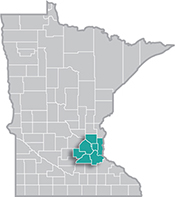
 The Minneapolis-St. Paul metropolitan area is a national leader in finance, advanced manufacturing, agriculture and retailing.
Medical devices, electronics and processed foods are strong suits recognized globally.
Want the freshest data delivered by email? Subscribe to our regional newsletters.
As we enter the new year, let’s quickly revisit recent labor force trends in the Metro Area from 2025.
1/29/2026 10:43:22 AM
Tim O'Neill
As we enter the new year, let's quickly revisit recent labor force trends in the Metro Area from 2025. We can grab and analyze this data from the /deed/index.jspDepartment of Employment and Economic Development's (DEED) /deed/data/data-tools/laus/index.jspLocal Area Unemployment Statistics (LAUS) data tool. Among DEED's most popular tools, LAUS data reveals labor force statistics for the state of Minnesota, its regions, counties and even some of the state's larger cities. This data is released monthly and is based off of a number of surveys including the Current Population Survey (CPS) and /deed/data/data-tools/current-employment-statistics/index.jspCurrent Employment Statistics (CES). Let's see why this data is so popular.
According to the most recent LAUS data, the Seven-County Metro Area had an estimated labor force size of 1,776,490 people. Right away, using this data, we can see just how large the region's labor force is. While the Metro Area accounts for just seven out of 87 counties in Minnesota, it accounts for well over half (56.3%) of the state's total labor force. Included in the labor force are two main populations: employed and unemployed, who are not employed but are actively looking for employment opportunities. In November of 2025, the total number of employed persons in the Metro Area was just over 1,710,100. The total number of unemployed persons was just over 66,300. Against the total labor force size, this number of unemployed persons was equivalent to an unemployment rate of 3.7% (Figure 1).

Over the year, between the Novembers of 2024 and 2025, the Metro Area's labor force size increased by just over 18,400 persons. This increase completely coincided with the region's increasing unemployment, which climbed by just over 25,800 persons. At the same time, the region's employed population decreased by just over 7,400 persons (Table 1). These trends in the Metro Area's employed and unemployed populations have resulted in an increased unemployment rate over-the-year, where it climbed from 2.3% in November 2024 to 3.7% in November 2025.
| Table 1. Metro Area Labor Force Statistics, November 2025 | ||||||
|---|---|---|---|---|---|---|
| Area | Labor Force | Employment | Unemployment | |||
| Nov. 2025 | OTY Change | Nov. 2025 | OTY Change | Nov. 2025 | OTY Change | |
| Metro Area | 1,776,490 | +18,408 | 1,710,159 | -7,427 | 66,331 | +25,835 |
| Anoka County | 206,071 | +2,097 | 198,238 | -847 | 7,833 | +2,944 |
| Carver County | 63,689 | +522 | 61,532 | -353 | 2,157 | +875 |
| Dakota County | 251,849 | +2,746 | 242,691 | -951 | 9,158 | +3,697 |
| Hennepin County | 722,228 | +7,395 | 694,956 | -3,106 | 27,272 | +10,501 |
| Ramsey County | 290,289 | +3,286 | 278,885 | -1,068 | 11,404 | +4,019 |
| Scott County | 91,006 | +922 | 87,832 | -381 | 3,174 | +1,303 |
| Washington County | 151,358 | +1,440 | 146,025 | -721 | 5,333 | +2,161 |
| Minnesota | 3,155,173 | +30,566 | 3,032,456 | -17,522 | 122,717 | +48,088 |
| Source: DEED Local Area Unemployment Statistics | ||||||
Zooming in, one can see similar labor force patterns across all seven counties in the Metro Area. And this data is backed up by a recent CareerForce Job Search Experience Survey. According to those workforce development professionals who completed the survey, nearly two-thirds stated that it was harder than a year ago for their job-seeking customers to find work. Using both quantitative and qualitative data, we can get a better understanding for how the Metro Area's labor force is doing.
For those who are unemployed, CareerForce services can help. Check out this month's Jump Start Your Job Search resources online to get a fresh start in the new year.
To discover more about the Twin Cities Metro Area, Contact Tim O'Neill, Labor Market Analyst, at Timothy.ONeill@state.mn.us

