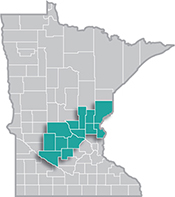
 Central Minnesota is a manufacturing stronghold, with several global manufacturing firms operating there.
The region is especially well known for its expertise in food processing, printing, furniture manufacturing, appliances, machinery and heavy equipment manufacturing.
View our latest blogs on CareerForce. Want the freshest data delivered by email? Subscribe to our regional newsletters.
Understanding where young people see their future is critical for workforce and community planning.
2/20/2026 1:18:28 PM
Luke Greiner
Understanding where young people see their future is critical for workforce and community planning. A recent student survey across Central Minnesota – covering Benton, Chisago, Isanti, Kanabec, Kandiyohi, McLeod, Meeker, Mille Lacs, Pine, Renville, Sherburne, Stearns and Wright counties – offers new insight into how students are thinking about life after graduation.
Since the beginning of the school year, most responses have come from Sherburne, Wright and Stearns counties, with more limited participation from several rural counties and no responses from students in Kanabec, Pine, Isanti, McLeod or Kandiyohi counties. As additional schools participate, this picture will continue to sharpen. Even at this early stage, however, clear patterns are emerging.
Figure 1. Indicated Residency of Responding Students in Central Minnesota, 2025-2026

As shown in Figure 2, when asked where they would prefer to live after high school, nearly one-third (32%) of Central Minnesota 9-12th grade students said they are "not sure." This uncertainty highlights how many young people are still exploring their options and weighing factors such as education, jobs, housing and family connections.
Figure 2. Where do Central Minnesota students want to live after high school?

Figure 3. Where do Minnesota students want to live after high school?

Interestingly, the distribution of preferences is incredibly similar to the roughly 5,000 survey results statewide (Figure 3). Among students who expressed a preference in Central Minnesota, rural areas stood out. About 21% said they would like to live in a rural area somewhere else, while 18% preferred a large city or metro area. Another 14% hoped to stay in or near their current town and 13% wanted to remain in the same area but not the same community. Only 3% identified the Twin Cities as their preferred destination.
Isolating the results to 12th grade students highlights how plans can change in these formative years. Instead of 32% not sure where they want to live, that share drops to 26% and a larger share indicate they want to live in or near their hometown or a rural place somewhere else as they get closer to graduation. Notably, the share that is interested in moving to the Twin Cities or a large city or metro someplace else remained the same.
These results challenge the common perception that most students plan to leave for major metropolitan areas. Instead, many appear open to rural and small-town communities—both locally and elsewhere—if opportunities align with their goals. For educators, workforce partners and local leaders, this presents both an opportunity and a responsibility.
Expanding access to career exploration, postsecondary pathways and local work-based learning can help students turn uncertainty into informed choices. Strengthening the connections to local employers and employment opportunities will also be key to retaining and attracting young talent.
As survey participation grows across all Central Minnesota counties, these insights can help guide strategies to build a workforce that reflects students' aspirations and supports long-term regional vitality.
I welcome educators and administrators who are interested in having their students participate to contact me at Luke.Greiner@state.mn.us for more information.

