 Southwest Minnesota is a national leader in agricultural production, and renewable energy.
The region's thriving manufacturing sector includes food processing, machinery, printing, metal products, and computers and electronic products.
Want the freshest data delivered by email? Subscribe to our regional newsletters.
People utilizing the CareerForce system in Minnesota to look for work are having a harder time finding employment now compared to last summer.
10/23/2025 10:57:58 AM
Amanda Blaschko, Luke Greiner
Staff at the Minnesota Department of Employment and Economic Development (DEED) are always seeking new ways to collect data, analyze current labor market conditions and serve Minnesotans better. In collaboration with Local Workforce Development Boards and community-based partners, DEED surveys hundreds of workforce development professionals in the CareerForce system, which includes DEED staff, Local Workforce Development Board staff and community partners across Minnesota.
These frontline workforce development professionals in the CareerForce system serve thousands of job seekers across Minnesota every week, so they are able to offer a great sense of the current job search environment across the state as well as comparisons to the job search environment a year ago. A survey of job seekers themselves would likely not be able to provide such an objective comparison over the year, nor would it be possible to consistently survey job seekers after they find employment.
The collected survey results are transformed into an /deed/data/data-tools/job-search-experience/index.jspinteractive data visualization that allows staff, partners and the public to see the labor market through the eyes of those who work directly with job seekers. Conducted twice each year, the survey will build a time series that not only tracks the health of Minnesota's labor market but also sheds light on /deed/newscenter/publications/trends/september-2025/jvs.jspemerging trends and shifts affecting job seekers in real time.
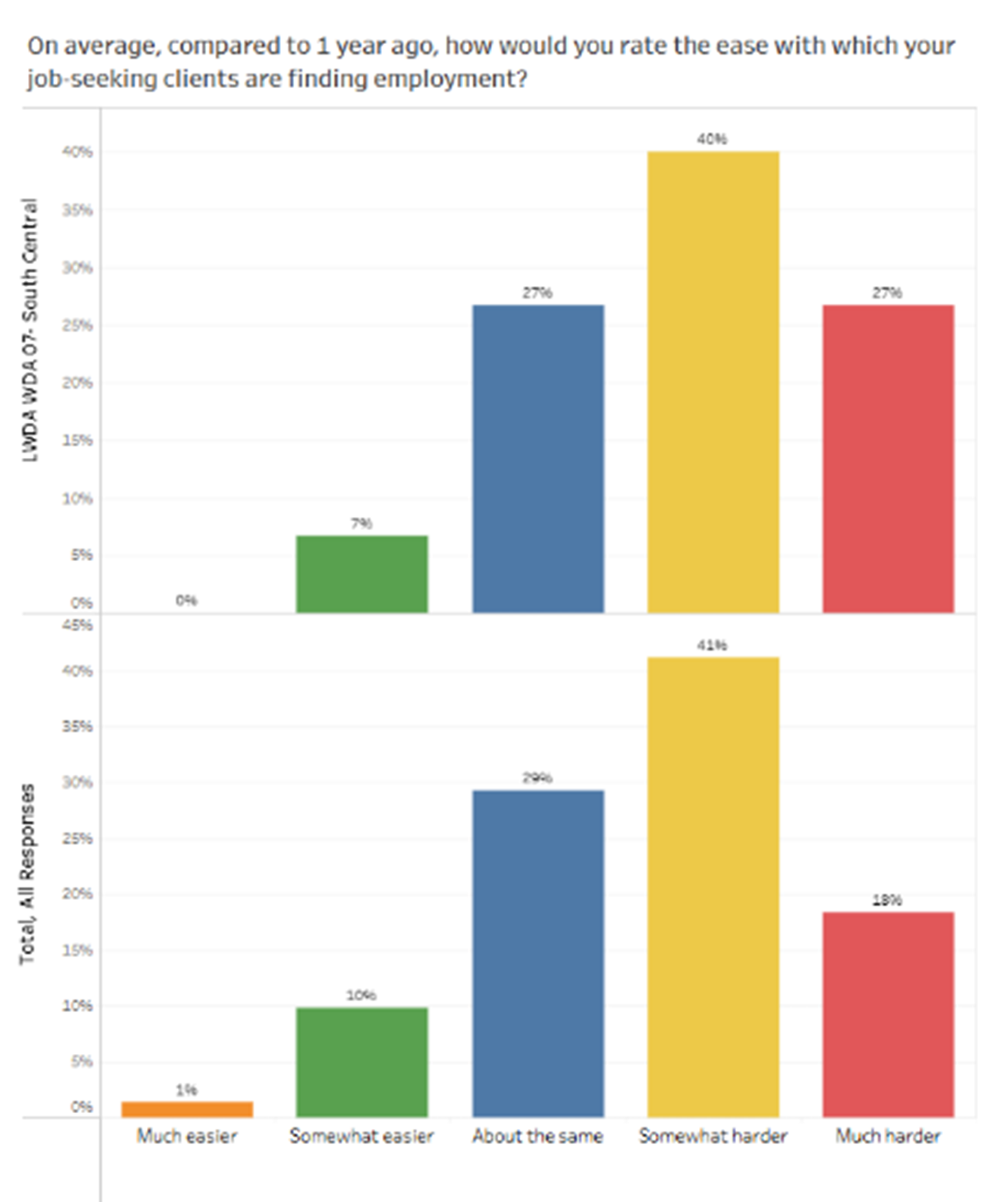
Results from the Job Search Experience Survey collected in July 2025 indicate people utilizing the CareerForce system in Minnesota to look for work are having a harder time finding employment now compared to last summer. Of the 294 CareerForce staff and partner survey respondents who said they worked with job seekers in the past year, 33 (11%) said it was somewhat easier or much easier for the job seekers they serve to find employment, 86 (29%) believed it was about the same and 174 (59%) said it was somewhat harder or much harder to find employment compared to a year ago.
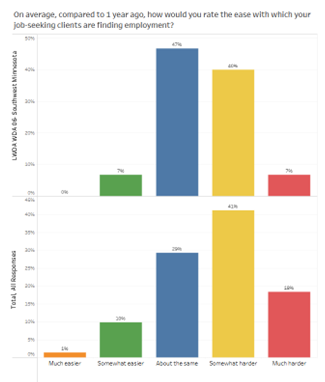
But in South Central Minnesota, a much higher share of job counselor respondents stated that hiring has gotten harder over the past year, with 67% believing that jobseeker clients are finding it harder to get employed, including 27% who said it was much harder than a year prior. In contrast, less than half (47%) of job counselors in Southwest Minnesota said that hiring was harder, and another 47% said hiring conditions were about the same as the past year. In both regions, only 7% of job counselors who responded said that job seekers were finding it easier to get hired, which was lower than the state overall (11%).
The survey also asked about which specific occupational groups were having an easier or harder time finding employment, with the following areas showing increased hiring chances:
In contrast, the fields where hiring had gotten considerably harder include:
The perception of the labor market by staff who work with job seekers aligns with DEED's most recent /deed/data/data-tools/job-vacancy/index.jspJob Vacancy Survey, which has indicated a softening labor market since the pandemic-related hiring frenzy of 2021 and 2022. Employers in the Southwest region reported just under 9,200 job vacancies in 2024, down from an average of around 14,000 in both 2021 and 2022.
Another factor that drives the "feel" of the labor market is the competition for job openings, not strictly the number of openings. From January through June of 2025, there were nearly 1,000 more unemployed workers in Southwest Minnesota seeking a job compared to the same period the year prior. With the quantity of job openings trending downward at the same time that more people are unemployed and looking for a job, it reflects a weakening labor market where opportunities are shrinking and competition for available positions is intensifying.
For more information about job openings in Southwest Minnesota, contact Luke Greiner at Luke.Greiner@state.mn.us or Amanda Blaschko at Amanda.Blaschko@state.mn.us.

