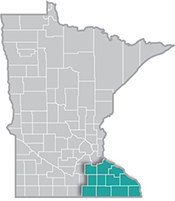
 Southeast Minnesota is a health care and agricultural powerhouse. The region is home to the renowned Mayo Clinic and some of the world's most recognized food companies and brands.
Advanced manufacturing is especially strong here, with machinery, chemicals, and electronics among the top products.
Want the freshest data delivered by email? Subscribe to our regional newsletters.
November marks American Indian and Alaska Native Heritage Month
11/19/2025 10:55:08 AM
Amanda Blaschko
November marks American Indian and Alaska Native Heritage Month, a time to recognize the rich cultural heritage and contributions of Indigenous peoples across the nation. In Southeast Minnesota, this celebration takes on special significance for the approximately 1,800 Native American residents. However, representing just 0.3% of the region's residents, Southeast has the state's smallest share as of 2023.
Though their numbers are comparatively small, Southeast Minnesota's American Indian and Alaska Native population has been steadily growing over the past decade. Since 2013, the community has increased by 23.5%, adding 343 new residents. This growth mirrors Southwest Minnesota's 30.4% increase of 683 Indigenous residents, while the other four planning regions in Minnesota all saw decreases in their Native population during this same period.
The Prairie Island Indian Community stands as a vital cultural anchor in the region. This federally recognized Dakota Sioux community, whose reservation lies just west of Red Wing, maintains sovereign status that grants them self-governance rights and access to federal services through established treaties.
| Table 1. Employment Characteristics, 2023 | |||||
|---|---|---|---|---|---|
| Southeast Minnesota | Minnesota | ||||
| In Labor Force | Labor Force Partic. Rate | Unemp. Rate | Labor Force Partic. Rate | Unemp. Rate | |
| Total Labor Force | 278,450 | 67.3% | 3.5% | 68.5% | 3.9% |
| 16 to 19 years | 16,001 | 55.0% | 9.1% | 52.7% | 9.9% |
| 20 to 24 years | 28,308 | 82.7% | 5.4% | 83.4% | 6.5% |
| 25 to 44 years | 114,724 | 88.6% | 3.1% | 88.7% | 3.5% |
| 45 to 54 years | 50,336 | 87.3% | 2.9% | 87.8% | 2.9% |
| 55 to 64 years | 50,904 | 74.2% | 2.6% | 72.8% | 3.0% |
| 65 to 74 years | 15,523 | 28.5% | 2.2% | 27.8% | 3.4% |
| 75 years & over | 2,598 | 6.4% | 2.0% | 6.6% | 3.1% |
| Employment Characteristics by Race & Hispanic Origin | |||||
| White alone | 238,259 | 66.4% | 3.0% | 67.5% | 3.4% |
| Black or African American | 9,516 | 67.8% | 12.6% | 71.0% | 8.4% |
| American Indian & Alaska Native | 663 | 48.8% | 5.3% | 57.7% | 11.4% |
| Asian or Other Pac. Islanders | 10,159 | 73.4% | 3.5% | 74.6% | 3.5% |
| Some Other Race | 7,146 | 77.7% | 5.8% | 75.9% | 5.6% |
| Two or More Races | 12,665 | 75.0% | 4.6% | 74.2% | 6.1% |
| Hispanic or Latino | 17,486 | 77.1% | 5.2% | 77.1% | 5.9% |
| Source: 2019-2023 American Community Survey, 5-Year Estimates | |||||
According to the Census Bureau, employment data for American Indians and Alaska Natives reveals important disparities that deserve thoughtful attention. In 2023, the labor force participation rate for American Indians and Alaskan Natives stood at 48.8% in Southeast Minnesota, significantly lower than the regional rate of 67.3% and the statewide rate for American Indians of 57.7%. While representing just 0.2% of Southeast Minnesota's total labor force, American Indians reported an unemployment rate of 5.3%, which exceeds the regional average of 3.5%, but is notably lower than the 11.4% unemployment rate for American Indians statewide.
These figures suggest that while Southeast Minnesota's American Indian population is growing, there remain meaningful barriers to workforce participation. Addressing these disparities requires understanding the unique challenges facing the American Indian community, which may include geographic access to employment, educational opportunities, cultural considerations in the workplace or historic systemic barriers.
Strategic partnerships between employers and tribal communities are essential to address employment barriers. With culturally responsive training and inclusive hiring practices, Southeast Minnesota can support its growing Indigenous population while strengthening the regional economy through increased workforce participation.
For more information about Southeast Minnesota's labor force, contact Amanda Blaschko at Amanda.Blaschko@state.mn.us.

