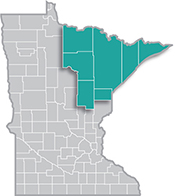
 Home to the state's second-largest metro, the Northeast Region has a strong industrial sector, tied largely to the area's abundant natural resources.
Most of the manufacturing base centers on mining and forest products industries. More than half of the sector's employment is in paper and machinery manufacturing.
Want the freshest data delivered by email? Subscribe to our regional newsletters.
Wages for all three primary dental roles exceeded the regional median wage
12/31/2025 11:38:25 AM
Carson Gorecki
I had my semiannual dental visit earlier this month and after talking with my Dental Hygienist and Dentist, it got me to thinking about the dental workforce in our region. Their professional experience and observations align with the data that show that many occupations in the dental field continue to be in high demand.
In 2025, there were an estimated 100 General Practitioner Dentists working in Northeast Minnesota along with 290 Dental Hygienists and 330 Dental Assistants (see Table 1). Wages for all three primary dental roles exceeded the regional median wage. Additionally, dental wages were greater than their corresponding occupational group wages.
| Table 1. Dental-related Occupational Employment and Wage Statistics, 2025 | |||||
|---|---|---|---|---|---|
| Occupation | Northeast Minnesota | Minnesota | |||
| Estimated Employment | Median Annual Wage | Projected Percent Growth (2022-2032) | Estimated Employment | Median Annual Wage | |
| Total, All Occupations | 139,940 | $48,810 | +3.3% | 2,920,470 | $54,545 |
| Healthcare Practitioner and Technical Occupational Group | 11,570 | $83,289 | +7.3% | 187,480 | $96,735 |
| Healthcare Support Occupational Group | 10,020 | $38,039 | +8.9% | 176,750 | $38,827 |
| Dentists, General | 100 | $188,520 | +1.6% | 2,500 | $212,801 |
| Dentists, All Other Specialists | n/a | n/a | n/a | 330 | $131,837 |
| Dental Hygienists | 290 | $91,369 | +7.0% | 4,660 | $100,376 |
| Dental Assistants | 330 | $60,049 | +5.9% | 5,590 | $65,725 |
| Dental Therapists | n/a | n/a | n/a | 146 | n/a |
| Sources: MN DEED Occupational Employment & Wage Statistics, Minnesota Dept. of Health | |||||
Wage and Job Count Dashboard | American Dental Association
While dental occupations are expected to grow faster than the regional average, they are limited by the number of Assistants, Hygienists, and Dentists that can be produced by postsecondary programs. There is only one Dentistry program in Minnesota, at the University of Minnesota-Twin Cities and it enrolls about 100 students per class. Additionally, there are only ten Dental Hygienist programs in the state and only one in our region. Lake Superior College's Dental Hygiene associate degree program produces on average 18 graduates per year. There is also only one Dental Assistant program in the region (14 statewide), at Minnesota North College – Hibbing campus. This program has also produced about 15 graduates in recent years. A program across the border at Northwood Tech in Wisconsin also adds a few more Assistants to the regional labor pool.
Fortunately, our data shows that a majority of the graduates from local Hygiene (63% of grads) and Assistant (84% of grads) programs end up employed in Northeast Minnesota! Hygienists and Assistants can be attractive occupations with their above average wages and relatively low educational and training requirements. In this way, they are similar to Registered Nurses.
One challenge for regional dental practices trying to recruit Assistants and Hygienists are wages that are lower relative to other areas of the state. The median wages for Assistants ($28.87/hr) and Hygienists ($43.93/hr) are about 91% of the statewide medians for those roles. The pay gaps are even larger relative to wages offered in the Twin Cities metro area. Interestingly, Dentists and Assistants in Northeast Minnesota earn higher wages than their national colleagues, while the median wage for Hygienists in the region slightly lags the national rate.
An interesting and somewhat recent development in the Dental workforce has been the introduction of the Dental Therapist/Advanced Dental Therapist roles. Seen as a way to meet the high demand for dental care without increasing the supply of Dentists, Dental Therapists are licensed mid- and advanced-level practitioners able to perform many activities once only available to Dentists.
In this way, Therapists can act with more autonomy just as Nurse Practitioners and Physician Assistants can relative to Physicians and Doctors. Minnesota was the first state to authorize the licensure of Dental Therapists. Given the newness of the Therapist role, there is not yet much labor market information available, but the Minnesota Department of Health indicates that there were 146 licensed in Minnesota as of 2024. That is the smallest number among all licensed healthcare providers, and only 15% currently work in rural settings.
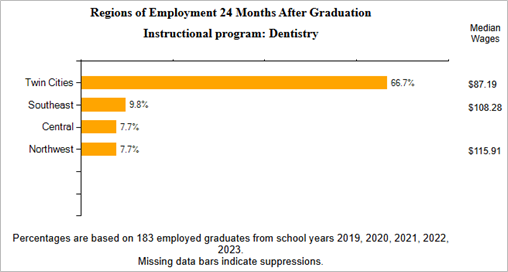
The dental workforce is a crucial component of the overall Healthcare system. If you have tried to make an appointment at a dentist office any time recently, you probably know that their services are in very high demand. A dentist in the region that also serves on the Minnesota Rural Health Advisory Committee pointed out to me that Dental School is one of the most expensive professional degrees, averaging about $312,000 of debt. This, in addition to limited spots, will only serve to limit the number of new dentists entering the field. This problem is accentuated in rural areas, which often depend on students that grew up in a rural context returning to serve their communities. For example, less than 8% of graduates from the University of Minnesota School of Dentistry were employed in Northeast Minnesota (see Figure 1).
Figure 1. Share of University of Minnesota School of Dentistry Graduates Employed in Minnesota by Region, 2019-2023
These trends and workforce challenges in the dental field will likely continue into the near and mid-term future, if not longer. Even if there is a Dentist available, the lack of sufficient Hygienists and Assistants will limit the number of patients a practice can effectively serve. So next time (and it could be a while) you are in your dentist's office, be sure to tell your local tooth workers you appreciate them. They will likely have a sharp implement and water tube in your mouth, so it's wise to be nice anyway. We all know they wait for us to be unable to speak coherently to ask us how our weekend was.
For more information about careers in Northeast Minnesota, contact Carson Gorecki at Carson.Gorecki@state.mn.us.

