How Data Informs Sustainability for the State
4/24/2020 2:51:11 PM
Earth Day has Minnesota Roots.
This week marks the 50th anniversary of Earth Day (April 22, 1970). Vice President Walter Mondale, a former Minnesota senator, worked closely with Senator Gaylord Nelson from Wisconsin to lead efforts to establish Earth Day. Mondale and Senator Nelson’s concerns about pollution on the St. Croix River and in Lake Superior was part of the drive to establish Earth Day in 1970.
Over the past 50 years, Earth Day has evolved into Earth Week, with participation around the world. Minnesota state agencies lead environmental efforts.
Just in time for Earth Week, we sat down with Jordan Wente and Tanya Belanger to discuss the roles that Minnesota IT Services (MNIT), and the Office of Enterprise Sustainability play in meeting the state’s sustainability goals. Jordan Wente is a research analysis specialist for the Office of Enterprise Sustainability within the Minnesota Department of Administration, where he manages the state’s Sustainability Reporting Tool. Tanya Belanger is a program coordinator at MNIT and the agency’s Sustainability Coordinator.
Jordan: Minnesotans believe in the need to be good stewards of our environment and natural resources. That mindset is also spelled out in goals set by the legislature, and administration priorities. It just makes sense for the state to incorporate sustainability work, ethos, and prioritization into our operations because we know that this is a priority for Minnesotans. We also know that the state can lead by example.
Tanya: The state is a leader in so many ways. By walking the walk, we can have a large impact. Minnesota state government is one of the state’s largest employers, and we have a carbon footprint through our facilities, water usage, electricity, and vehicle fleet, among other things. When we take measurable steps to reducing our footprint, by focusing on implementable changes, we can set an example for others to follow.
Jordan: You can’t manage if you don’t measure. Governor Tim Walz signed Executive Order 19-27 in April 2019, which sets standards for sustainability across all state agencies. To meet these standards, it is critical that we have a data-driven approach. Right now, there is a huge push around the world to use data to inform decisions. We are all striving to better quantify and optimize operations based on our data. With sustainability it’s the same approach.
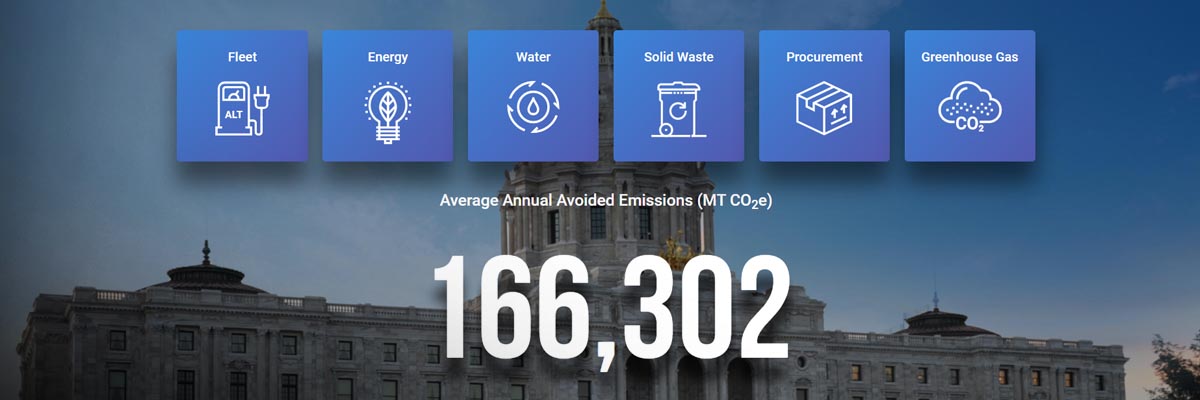
It is my job to quantify state sustainability operations and track those operations across our focus areas: greenhouse gas emissions, energy, fleet fossil fuel, solid waste, water consumption, and sustainable procurement. The collection of that data involves millions of data points throughout a year. We’ve integrated the data into a central location where it can be used for planning purposes, analytics, and statistical analysis. The central location, the sustainability reporting tool, helps agencies benchmark where they are relative to the goals in the executive order, and how they can move forward each year to reduce their footprint.
It’s also important for us to be transparent about the sustainability of government operations. Previously, sustainability was typically tracked in an anecdotal manner, not against fixed goal. By using data and transparent reporting tools, the state is leading the way to make sure that any Minnesotan can measure our progress.
Tanya: Huge! Our technologists are working at every single agency across the executive branch. We can think about how technology can play a role in sustainability on a large scale. For example, last year we implemented an e-signature capability that helps reduce the use of paper, and we can encourage our agency partners to utilize these tools that are easier and sustainable.
Jordan: I see a trend for greater automation in data. As we have more real-time data on our operations with automation, we better answer the questions that really matter to our stakeholders.
Tanya: MNIT is going to really focus on what the sustainability data says about our facilities. I will be using the Sustainability Reporting Dashboard, and other tools, in partnership with the Office of Sustainability to identify opportunities for reduction of water, energy, and solid waste consumption.
Our second priority will be to improve our education and awareness conversation among MNIT employees through tabling events and outreach campaigns. Our final priority, and one that is exciting, is how MNIT can go above and beyond Governor Walz’ executive order to further the state’s sustainability priorities through technology. Technology can be an incredible catalyst for change, and there is a hunger for an increasingly digital government. At MNIT, we can do our part to make sure that change happens with sustainability in mind.
Jordan: I hope that we are celebrating a circular or zero-waste economy.
Tanya: I agree with that, and I will leave you with an inspiring article on the topic. Read about it here!
Digital Government
Technology

