Graduates Defend Minnesota’s Cyberspace
11/7/2017 5:01:44 PM
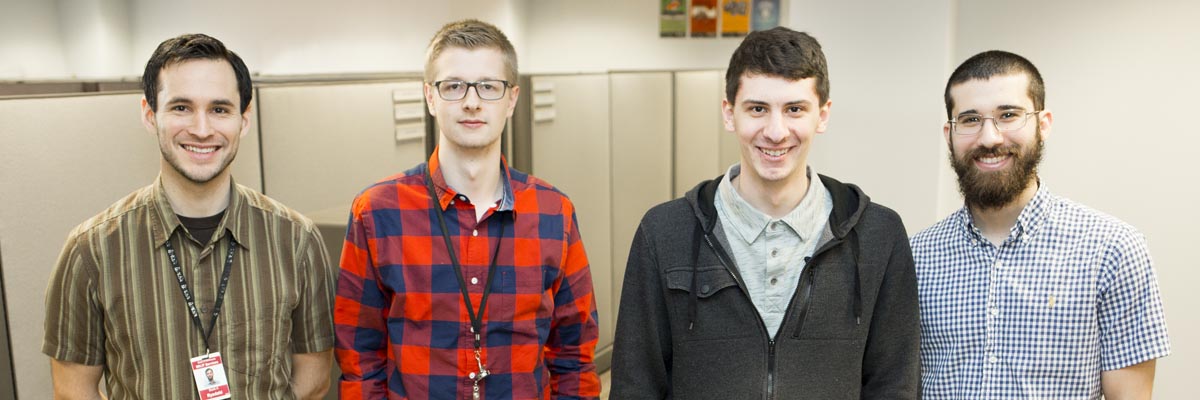
Left to Right: Scott Rysdahl, Jordan Potti, Jordan Jenkins, Miles Forbes
Cybercorps-- Defending America’s Cyberspace. It sounds like something from a futuristic sci-fi movie, right? Well, it is looking to the future, and it is science, but it’s definitely not fiction. The defense of cyberspace, and the need for a highly evolved workforce is very real. It’s a need that is being addressed by the National Science Foundation (NSF) in a unique way through Scholarships for Service (SFS). This national initiative has also opened opportunities for MNIT to recruit and build the next generation of professionals that protect the government’s critical information infrastructure.
MNIT is proud to have four Cybercorps grads working as Information Security Analysts in our security operations program today. Miles Forbes, Jordan Jenkins, Scott Rysdahl, and Jordan Potti engage everyday in defending Minnesota’s cyberspace. They know firsthand the vulnerabilities and threats that expose our systems and data, and the diligence needed to transform cybersecurity research into active practice.
The vast majority of SFS grads go to work for a federal agency, especially those "three-letter acronym" agencies that pop into most people's minds when they hear the word "cybersecurity". One of the benefits is access to the federal job fair held in Washington DC. Potti recounted his experience: within an hour of entering the hall, he was ushered upstairs to an interview with the Department of Homeland Security. With each of the grads, their level of commitment and dedication to cybersecurity is very apparent, and it’s worth mentioning some of that federal super-secret spy work they all passed up to use their talents defending and safeguarding us in the state of Minnesota.
Forbes, Jenkins and Rysdahl agree that the Cybercorps SFS is great opportunity for anyone, even if they don’t have an IT or cybersecurity background. Forbes explained that cybersecurity requires a diverse skillset and the ability to see where relationships exist and then identify anomalies in those relationships. In Forbes’ SFS cohort, one person majored in graphic design, another in literature, and his own major was in math.
Forbes was wrapping up his bachelor’s degree in math at the University of South Alabama when he was approached by a professor about an opportunity to apply for the Cybercorps SFS. “I’m 25, and now I have my master’s.” The program paid for it all – books, tuition, travel, a stipend, a computer, and his thesis on how to protect the intellectual property of digital components during international manufacturing. That’s something he wouldn’t have been able to accomplish so quickly otherwise, he explains.
Early in 2017, Forbes attended the national cybersecurity job fair in Washington DC. There he met Aaron Call, MNIT’s Director of Information Security who encouraged him to apply at MNIT, one of the organizations that qualifies for SFS service fulfillment. SFS recipients must fulfill their term of service as IT cybersecurity employees in any Federal, state, local, or tribal government organization. So far, only two states— Minnesota and Iowa—actively recruit Cybercorps SFS graduates.
Jenkins began his education at Anoka Ramsey Community College and continued at St. Cloud State University when he was accepted into the SFS program. Jenkins and Rysdahl learned of opportunities at MNIT from Chris Buse after they’d been in the program a few months. St. Cloud State University is the only program-eligible institution in Minnesota.
Jenkins has now been at MNIT for about five months and currently works in MNIT’s Threat and Vulnerability Management Unit. He is very interested in penetration testing, that is, attacking our own systems like an adversary to find and fix weaknesses. Scott Rysdahl has been working as a Security Analyst in MNIT’s Security Operations Center for the past 18 months. He was attending Lake Superior College in Duluth and had a bachelor’s degree in English when he applied for the SFS and began working towards his master’s degree at St. Cloud State. Rysdahl is currently working to finish his master’s thesis.
Jordan Potti interned with MNIT, and has been working with MNIT MDH Application Security for about six months. Potti, like Rysdahl, attended Lake Superior College in Duluth. He was accepted into the Scholarship for Service program and completed his degree at St. Cloud State University, something he says would not have been possible without the Cybercorps scholarship. He really enjoyed the extra volunteer commitments, and thought it was great having the program push him to do more. “Wow, if everyone did that in college, they’d be so much better off when they finish.” Potti says he enjoys everything about cybersecurity. In his spare time he does a blog, writes a lot of open source security tools, and does a lot of “bug bounty”, where huge organizations like the Department of Defense and private corporations pay you to try and find the “bugs” and hack into their applications or systems.
While at St. Cloud State, Jenkins, Rysdahl and Potti all participated in the Collegiate Cyber Defense Competition (CCDC) where student “Blue Teams” attempt to defend big simulated businesses from the “Red Teams” (industry specialists who actively conduct intensive hack attacks). Potti and Rysdahl both participated as team captains. Their team placed third at regional competition, and won the state competition two years ago. This year, Potti be on the other side of the fence as he volunteers on the CCDC Red Team, so we’ll stay tuned to hear about that experience later!
Although Cybercorps SFS requires a lot of commitment from recipients, it gives back a great deal and they highly recommend the program to anyone. Rysdahl’s advice to students considering application to SFS is to weigh the pros and cons before you start, because the level of service and commitment is exceptionally rewarding, but also rigorous and demanding.
As part of the scholarship program, all recipients are required to participate in volunteer work while they are in school, doing things like teaching kids of all ages at libraries and summer programs, staffing booths at cybersecurity events and seminars, giving and attending lectures, and participating in research groups.
“It’s more service than scholarship,” Forbes explained. Rhysdahl adds, “With other scholarships, the work is 95% done once you receive it, but in this program, when you get the scholarship, your work is just beginning.” Jenkins echoed that thought, “There’s a lot more involved than you think.”
Potti’s advice for anyone considering Cybercorps SFS is to just do it. “There’s no downside, and there are so many benefits, you won’t regret it.”
Aside from the monetary benefits, Jenkins explains it like this: “It’s a chance to go above and beyond, and it forces you to do extra things that maybe you wouldn’t seek out.” As Forbes put it, the Cybercorps aren’t “boots on the ground”, but they are the forces that are defending our nation’s economy and our way of life.
For more information about the SFS program, visit the National Initiative for Cybersecurity Careers and Studies website. Details about the Cybercorps Scholarship for Service program can be found on the St. Cloud State University website.
Cybersecurity
Careers

