MNIT Leadership Discuss Diversity and the Legacy of Inclusion
2/27/2020 9:16:35 AM
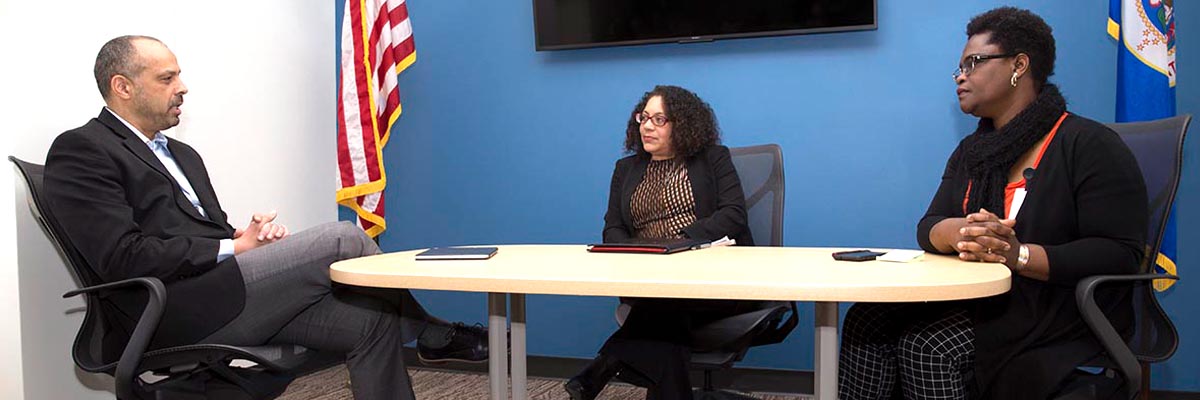
Pictured above from left to right: MNIT Commissioner Tarek Tomes, MNIT Data Architect Ellena Schoop, and MNIT Assistant Human Resources Director, Annie Porbeni discussing diversity and inclusion.
Minnesota IT Services (MNIT) is committed to promoting inclusive practices within our agency. We know that state government works best when its workforce resembles that people that it serves. As part of our Black History Month focus on notable African American figures in technology, we wanted to take the time to also speak with our Commissioner, Tarek Tomes, who is MNIT’s first African American Commissioner.
Ellena Schoop, a Data Architect at MNIT, spoke with Commissioner Tomes and MNIT’s Assistant Human Resources Director, Annie Porbeni, in a recent interview. The below is edited and condensed for clarity.
Commissioner Tomes: Diversity is everything related to different perspectives and different ideas. It is everything from the race, to gender, to beliefs, to where people come from. It’s how you blend all those different perspectives together. True diversity allows us to celebrate and understand our differences, which is impossible to unless you allow yourself to share in someone else’s experiences.
Like you, I’ve been confronted with this question many times. I never had a teacher of color. For many people, that’s a really foreign construct, and sometimes can be taken for granted. I never walked through my day-to-day with that being an inhibitor or concern, but it’s a reality. My kids don’t have teachers of color. When you think about where we are in society in 2020, it is still an exception when children of color have teachers of color. Where you live and geography plays a large role in that. But I grew up in public schools, so do my kids, and the opportunities for them to be in places where they have mentors that look like them are rare. I think it’s important for us to understand how vital it is to have those diverse perspectives.
Commissioner Tomes: At times, it feels almost overwhelming, but it is also incredibly humbling. I can’t say that I approach my work differently because of that because I have been doing this my whole career. I’ve always worked with the perspective that, “I want to break down barriers. I want to make it so someone is not afraid to hire someone of color after I’m gone.” The experience that they have with me as an employee is one that really makes them feel that people of all different backgrounds are capable – look into the capabilities of a person and not how the person looks.
I was lucky enough to work for Mayor Carter in St. Paul who is the first African American mayor in the history of St. Paul. It’s tough sometimes – in 2020 we are still celebrating a lot of firsts. It shows you where we are and where we’re not, and how far we still have to go.
For me, as it relates to the role of CIO, it isn’t as much about me, as it is about the opportunity that different perspectives and viewpoints bring. I certainly have things I feel strongly about that I support, and my background and where I come from plays a large role in that. It’s about how the work we do can help others and how to ensure that the positive impacts we have endure after we have moved on.
One of the things that is difficult for any of us to navigate is that I’m incredibly proud of who I am, but I refuse to be defined as a black CIO. I refuse to be defined by anything other than the same measures of success that others would have. I think that as we walk those lines of pride sometimes, it’s important that we don’t let ourselves be marginalized or put into a box of “pretty good black CIO” or “pretty good black manager.” First and foremost, we want to serve others and be good managers, irrespective of where we come from.
Annie Porbeni: For me, it was a bit of a surprise. I do have a different perspective of what diversity means coming from my background. Diversity wasn’t a word that was used growing up outside of the United States in Nigeria. I was first exposed to the term “diversity” when I had the opportunity to get my master’s degree in Canada. It was also when I first encountered the idea that who you are can be framed by the color of your skin.
Another surprising aspect I am finding is the lack of diversity in management. I am the highest-ranking woman of color in MNIT and I don’t like to be the first and only. It’s a bit discouraging because I know that there are so many others before me that could have been hired but maybe weren’t. When I find myself in that position, I ask, “Why is it that way?”
Being the assistant HR Director, I sometimes question why it is so difficult to find people who are capable of the work that are from different locations, groups, or especially people of color. Unfortunately, while we look at the term “diversity” in terms of uniqueness, or a positive difference, at other times “diversity” is only looked at in terms of race. When people don’t go beyond the issue of race, that’s where we can have the kinds of things where we have one-off accomplishments that we fall into – as the first people of color in our positions.
For me, that’s a problem and with that, and shows the need to work on changing how we view diversity. I agree with Commissioner Tomes that we need to constantly be bringing people of color, people with different backgrounds, into these positions. It’s a part of my job that I take very seriously.
Annie Porbeni: The mentorship program is an opening box for us. It’s a great opportunity for us to move beyond. We have an interesting dimension in how we want to bring cross-cultures together, giving people a different kind of mindset in terms of where a person is coming from. I think we can move beyond just understanding someone’s culture. There’s a lot we can do with the mentorship program, but it’s a good first step to where we are going.
Commissioner, I know you’re very interested in the sponsorship part of the program and that’s the next step. Sponsorship is intentionally looking at someone and making sure that you are able to guide that person from Point A to Point B.
Commissioner Tomes: I totally agree. I think that we need to make ourselves available for people to talk to and honestly share personal journeys in a vulnerable way, as well as encouraging people to really go out and make a difference.
Making ourselves available may also mean helping people to grow themselves as they think about connecting in the bigger world. I can help them answer, “How can I as a technologist make a difference in this world?” With the work that we do, I think our impact is so enormous, we lift up stories that sometimes wouldn’t otherwise be told and we do it in a manner that tells a truth by data. Our truth does not live in a manipulated manner, nor in a space where there’s always context to put around things. By having those conversations, we convey ownership to people that are responsible to outcomes, we empower stakeholder groups to how they can advocate for different results.
Commissioner Tomes: I would like my legacy to be that I was there for our folks. I was there for the technologists that worked in this organization. That I empowered and supported them. That I tried everyday to serve them in a way that allows them to be the best that they can be. That we use technology to help people’s lives. That we were unafraid to tackle the difficult challenges. That we were unafraid of the consequences of failing. That we did not make a big detour around risky asks. That we embraced the opportunity when the spotlight was brightest, and when the needs of the people that were going to be impacted by technology were the greatest. Whether that be insulin, or people returning home from incarceration, or housing barriers, that we embraced the opportunity to leverage technology to change those outcomes.
This is as exciting a time to do what we do as there has ever been. The rate of innovation and change, and the community of technologists that are connected with doing things to help people, is growing so much. If you can build a culture that gives people meaningful opportunities, and they feel valued and there is a genuine interest in them and their growth – you have the foundation to really make a difference. That’s really exciting.
Annie Porbeni: That would be a much easier question if I could answer it with respect to my kids. Something I always put on myself is that when I leave a place, the employees will always remember that that HR Director is the one that made it possible for me to be able to not only believe in myself, but to continue in a space where I’ve never had the opportunity before. It’s never about the Director, it’s about the human resource. It is always about: if I can do it, you can do it. There should never be any barriers to get there.
I feel that I can use my position to create those changes within this space. I also believe in influencing those at the top of the organization to think about the ways that we provide opportunities to our staff differently than they have thought about it in the past. I want my legacy to be providing that awareness, the consciousness to try and overcome norms that impact in disparate ways. To give a sense of worth and courage to those that don’t believe they are deserving or capable of opportunities in the workplace.
Leadership

