Changes in State Tech to Support the New Worker
9/25/2020 12:42:44 PM
September marks six months since Governor Tim Walz declared a public health emergency and the World Health Organization officially declared a pandemic, ushering in our new reality. Since that time, most of us have seen an incredible amount of change in our daily lives, remote work being at the top of the list for many. According to Minnesota’s Department of Employment and Economic Development, 30% of Minnesota workers teleworked during June because of COVID-19.
By April, more than 35,000 of state employees were working remotely. Minnesota IT Services (MNIT) supported this rapid transition of our statewide workforce, increasing capacity to secure networks, training employees on collaboration tools, deploying hardware and software – all with a focus on our partners’ needs.
The work that MNIT completed in a few short weeks enabled the agency the opportunity to demonstrate an ability to scale up for IT crisis response – maturing our service delivery years ahead. To talk about this change, we interviewed MNIT employees who played a large role in shaping our COVID response.
/mnit/about-mnit/leadership/jeff-nyberg.jspJeff Nyberg, MNIT’s Chief Technology Officer and Assistant Commissioner, notes that while COVID-19 pushed MNIT forward, “We have been preparing for this as long as high-speed internet has existed. The tools were already in place to prove that many of us don’t have to be elbow-to-elbow in an office to be productive.” Minnesota’s executive branch had two projects in progress that were accelerated when COVID-19 hit, to ensure state employees could be safe and secure at home. The first was the rollout of a collaboration tool, Microsoft Teams, to the executive branch. Since March, the executive branch has sent about 50,000 instant messages a day through the collaboration tool, and holds as many as 2,800 meetings on the platforms. These numbers continue to increase as more agencies adopt the tool.
The second change was the rollout of Multi-Factor Authentication (MFA) to all state employees to keep them secure while working remotely and protect state data. Now over 99% of state employees use MFA to access technology resources remotely. This adoption reduced the number of potentially compromised state employee email accounts by over 80% in one year (September 2019 – September 2020).
With these tools, Nyberg predicts that we have the opportunity to spread our workforce across the State of Minnesota. “We know now that we can successfully employ the talented people living in Bemidji and Grand Marais.” A remote workforce can even allow state government to include more voices in the room. Our tools, and our need to stay connected during these difficult times, have led to a shift in many teams at MNIT, a more collaborative environment, or as Nyberg notes, “It’s brought us together to move forward.” MNIT has made many changes to the ways that it provides services, based on the radical collaboration that COVID-19 enabled.
“We know through experience that people can be innovative, successful, and resilient while working remotely.”
Jeff Nyberg, MNIT's Chief Technology Officer
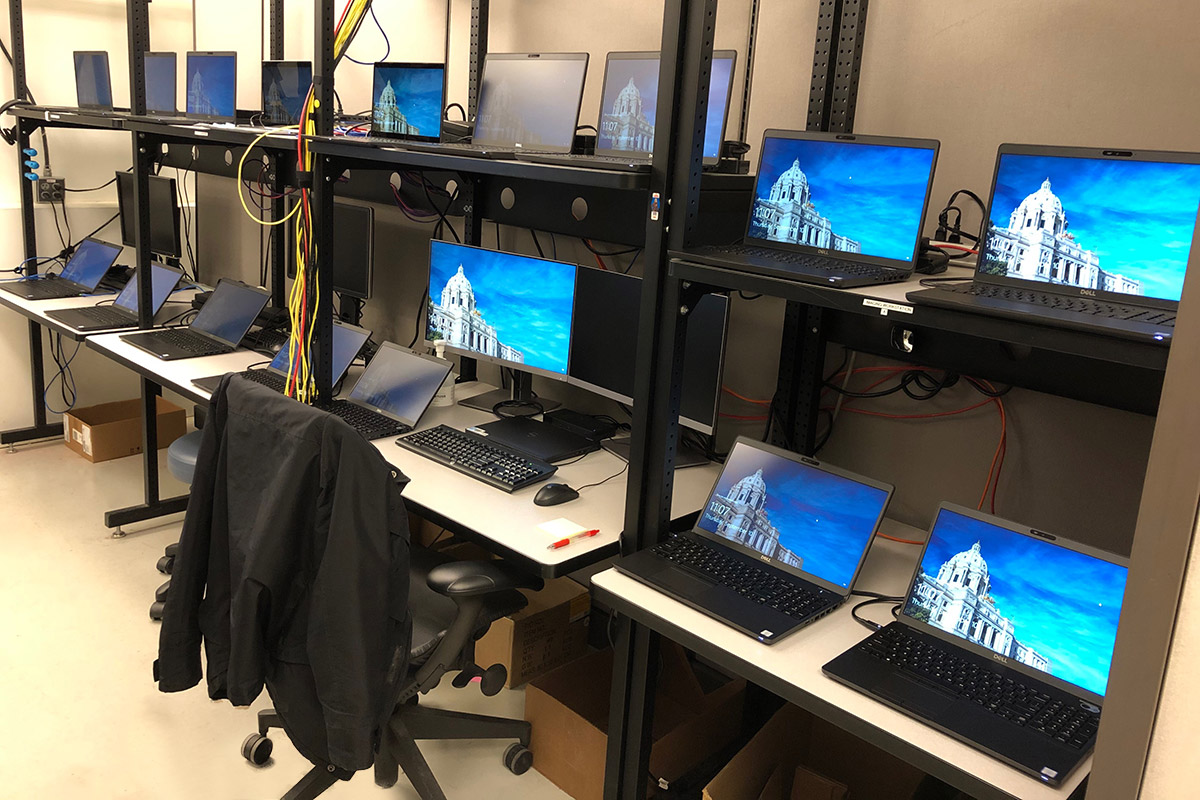
Over the past six months, Jack McCumber, an Enterprise Workstation Deployment Technician at MNIT, has spent time in parking lots across the metro area handing out replacement laptops to state employees. A year ago, this process used to take almost two hours. MNIT employees would physically go to a person’s workstation, set up their new devices, and then work with them to ensure they had the software and applications needed to complete the user’s work. If you worked in Greater Minnesota, you may have even received a laptop in the mail that you didn’t know how to set up on your own.
MNIT’s workstation team began its transition to a more efficient and end user-focused process back in December 2019, but COVID-19 created an opportunity to speed up the change. MNIT’s deployment team knew they had to find a safe and secure way to get laptops out to the new teleworkers across the state as quickly as possible to maintain availability of state services. McCumber says, “One of the biggest changes we made from a user perspective was creating a remote login. By having the user login to their new computer from a remote location, we can make sure they have the software they need, and they can set up their laptop with their own password before they even pick it up.” From the technician perspective, this also saves a lot of time. A full replacement of a computer, including software installation, logging in with the user’s information, and swapping the actual equipment, has decreased by at least an hour of work, allowing MNIT to replace about 80-90 computers a week.
Other improvements over the past six months include installing software for multiple computers at one time from a remote location, allowing the end user to book an appointment with the workstation team using Microsoft Bookings, and curbside pickup. “A lot of people saw a new form of customer service recently. We now have the ability to be closer to our end users and give them an opportunity to ask for help. The bottom line is that they are noticing a better service and getting a computer that works,” says Paul Bladl, Enterprise Workstation Deployment Supervisor.
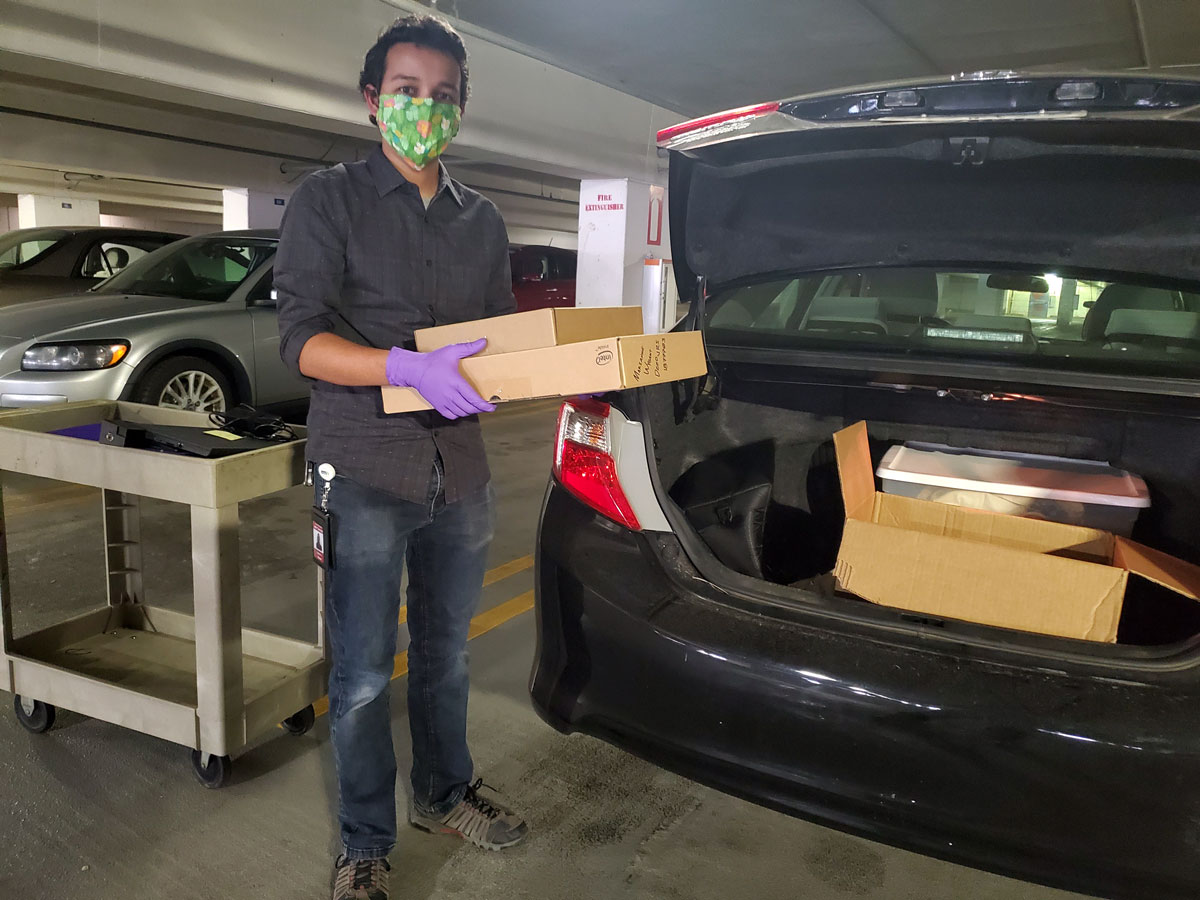
MNIT's curbside pickup option.
MNIT’s networking team faced an immediate question of how to replace the secure phone that many state employees had access to at their desks. Many were unable to use personal phones to make calls or were call center agents that required the phone to be connected to software applications for the call center. The team had 48 hours to come up with the best solution, one which involved ensuring that the devices could be procured in a rapid timeframe. The home office routers allowed state employees to connect the phones they had in their office with a secure state network to continue their work at home. Within two weeks, the networking team deployed 1,100 of these home office routers. As of today, we are now at more than 3,000 users.
Casey Neumann, Systems Supervisor at MNIT, adds that the most difficult part of that first deployment was coordinating the logistics for delivering the devices to all the locations needed. Once that initial hurdle was addressed, the team moved on to ensuring that they could use the home office router systems to become more efficient. Automation allows for immediate notifications to all MNIT network and voice teams of requests for a device to get hundreds of devices ready to deploy in an hour.
While home office routers were initially used for call center agents, who need to have a state-issued phone at home, their use case could be anyone that wants to have a phone at their desk at home. In most cases, these routers are more cost effective for state agencies than state-issued cell phones.
“With the home office routers, state employees can stay secure, always be connected to VPN, and have network and firewall access follow them all back home. Basically, it makes it feel like they are sitting back at their desk in the office.”
Casey Neumann, Systems Supervisor at MNIT
As state employees made the unprecedented shift to working from home, MNIT staff have been instrumental in ensuring that business partners are able to keep their services available, and even expand them, to help Minnesotans in need.
/mnit/about-mnit/leadership/jenna-covey.jspJenna Covey, Chief Business Technology Officer for MNIT partnering with the Department of Natural Resources (DNR), notes that her staff are more frequently operating in the emergency management structure of the agency, with weekly meetings to provide updates on IT. One issue that emerged at DNR is how to ensure that staff had access to the tools they needed to work safely, whether in the field, in a park office, or at home, with differing levels of technology access. If a researcher needed to report back a large amount of data in Zippel Bay, they would need to be able to do so with constraints on access to high-speed internet at home. Data management and technology disparities are a critical component of ensuring that the DNR is able to respond to COVID-19 and has been part of their long-term strategies moving forward.
“The MNIT and DNR teams found innovative ways to use existing tools that have created incredible efficiencies for our partners,” adds Covey. For the first time in state history, the agency was able to be use existing technology to notarize a signature remotely. Partnering with the Attorney General’s office to ensure compliance, and the DNR’s Land and Minerals Division, MNIT pushed forward the use of e-signatures to find a solution that fit our current environment and will be used moving forward.
The role that technology plays in helping state agencies is not one that will diminish.
"Even in chaos, there’s an opportunity. We’ve been given an opportunity to get buy-in and generate awareness for technology that we wouldn’t have had without the pandemic."
Jenna Covey, Chief Business Technology Officer for MNIT partnering with DNR

