
Honoring Asian American and Pacific Islander Heritage Month
5/5/2026 8:00:00 AM
The Minnesota Department of Veterans Affairs (MDVA) recognizes May as Asian American and Pacific Islander Heritage Month. We celebrate our diverse Asian community that represents a long history in our state and brings a cultural richness that includes dozens of different nationalities.
Three MDVA team members talked about the significance of this month in their lives.
 Rhodora Alanes came to the MDVA in 2024 as a registered nurse and care coordinator in our Minnesota Veterans Homes – Domiciliary Minneapolis campus. Prior to coming here, she was a hospice nurse for 13 years. She says she had an overwhelming feeling when she came into the Minneapolis Veterans Home for the first time to interview for her job. “I can’t explain the feeling of awe,” Rhodora says. “It was like, ‘Wow! I’m here, in this building where these Veterans live.’ It’s a great honor.”
Why is it important to recognize the Asian community's role in American history and culture?
It's really a great thing that Asian Americans are being acknowledged and are seen now. I would say that we are underrepresented and not really acknowledged as Americans.
If you think about it, America was fundamentally shaped through the contributions of Asian Americans, through cultural development, scientific innovations, healthcare and especially economic growth.
In addition, Filipinos were involved in the military service, particularly in World War II. But it's not really known by most Americans that Filipinos have contributed greatly to American history and culture, especially when it comes to service during the War.
Describe a role model from Asian and Pacific Island culture and how they influenced you.
A role model for me is my paternal grandfather. He didn't really have much of an education – he left school after the first grade and didn't know how to read and write. Yet he built his own business and sent all nine of his children to school.
The one thing that struck me about him was that he was loved by his employees. He had integrity, and you can’t learn that. You can't buy that.
I feel like I value great integrity, and I would say that I learned that from my grandfather.
How does your work at MDVA help make a difference for Veterans and for creating a welcoming, inclusive community?
I believe Filipinos have a great work ethic. Asian American, but specifically the Filipinos, are known around the world for filling in the labor needs in many different countries. In particular, I think we are drawn to healthcare and focus on healthcare expertise. We provide care with conscientiousness, love and pride. Veterans sacrificed and served to protect our country. It is right that we serve them back with respect, dignity and honor.
We treat each other equally—no matter what position you are at work, we are all the same. MDVA is a great workplace with rich diversity. Each of us has great stories to tell with different backgrounds and experiences. There's so much to learn from each other!
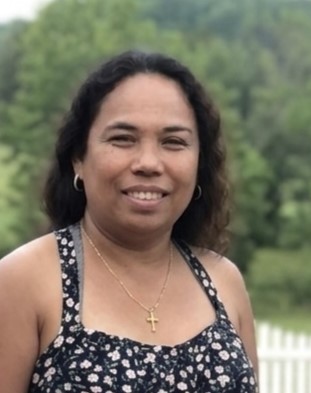 Delia Sheet brings her talents and sense of service to our Veterans at the Bemidji Veterans Home. Since the Home opened in early 2024, she has worked in housekeeping as part of the environmental services team. She helps keep the building clean, safe and comfortable for Residents, families, visitors and colleagues. “I like to stay positive, interact with the Residents and make people smile,” says Delia. “I take pride in helping it feel like home.”
Why is it important to recognize the Asian community's role in American history and culture?
It’s important to recognize the Asian community’s role because many of us have worked hard and helped build this country – especially in healthcare and hospitality industries. Filipinos are a big part of the workforce and really are the backbone in many ways. Being recognized helps us feel seen, respected and included.
Describe a role model from Asian and Pacific Island culture and how they influenced you.
My role model is my mother. She taught me to work hard, stay strong and always care for family. Because of her, I take pride in my work and try my best every day.
How does your work at MDVA help make a difference for Veterans and for creating a welcoming, inclusive community?
I like to stay positive and treat everyone with kindness. I work hard to keep things clean and comfortable for the Veterans. I want them to feel cared for, respected and welcome every day.
 Sean Ercan-Fang, MD is the Chief Medical Officer for the Minnesota Department of Veterans Affairs (MDVA) and serves as the Medical Director for Minneapolis, Hastings, Silver Bay and Montevideo Veterans Homes. This is his second time working for MDVA – he previously spent nearly 20 years as a part-time physician at the Minneapolis Veterans Home. He says he is proud of MDVA’s continual focus on Veterans and their families. “I am amazed at the thought and planning that goes into the facilities throughout the healthcare division of the agency. When I travel to our Homes in greater Minnesota, I see how well the established facilities and the new ones are adapted to the needs of our current Residents.”
Sean says throughout his medical career, he has worked with Veterans at almost every stage of their lives – from providing primary care, to treating them while they recuperated from illness, and now supervising care in the Adult Day Care program, the Domiciliary program and our skilled nursing facilities. “I have seen how good medical care enhances the quality of life for both Veterans and their families. I strongly believe in the positive impact MDVA has on our Veterans.”
Why is it important to recognize the Asian community's role in American history and culture?
The Asian community’s role in American history and culture is underrecognized because the waves of immigration are relatively recent and often localized to certain geographic areas. Additionally, the Asian community is not monolithic. The different Asian communities that have migrated here have vastly different histories and cultures, as well as significantly different reasons for migrating. The physical attributes that make an Asian individual identifiable make it easy to stereotype the Asian community into a single entity.
Describe a role model from Asian and Pacific Island culture and how they influenced you.
Growing up in a large suburban high school—with 1,000 students in each class—I was one of two Asian students. The role models I had were my parents, who were also negotiating their way in American culture, only with less understanding and context than I had. This is not an uncommon phenomenon for immigrants: to have the younger generation assist the older in navigating culture differences. This can be problematic since the younger generation often lack a sufficient understanding of cultural expectations and norms to assist in a meaningful manner.
How does your work at MDVA help make a difference for Veterans and for creating a welcoming, inclusive community?
In a leadership position at MDVA, I have both the responsibility and opportunity to facilitate staff from all cultures and backgrounds to feel comfortable in the work environment. This can be as simple as trying to greet every employee I walk by in the hallways to giving grace when comments are made that I personally find culturally insensitive.