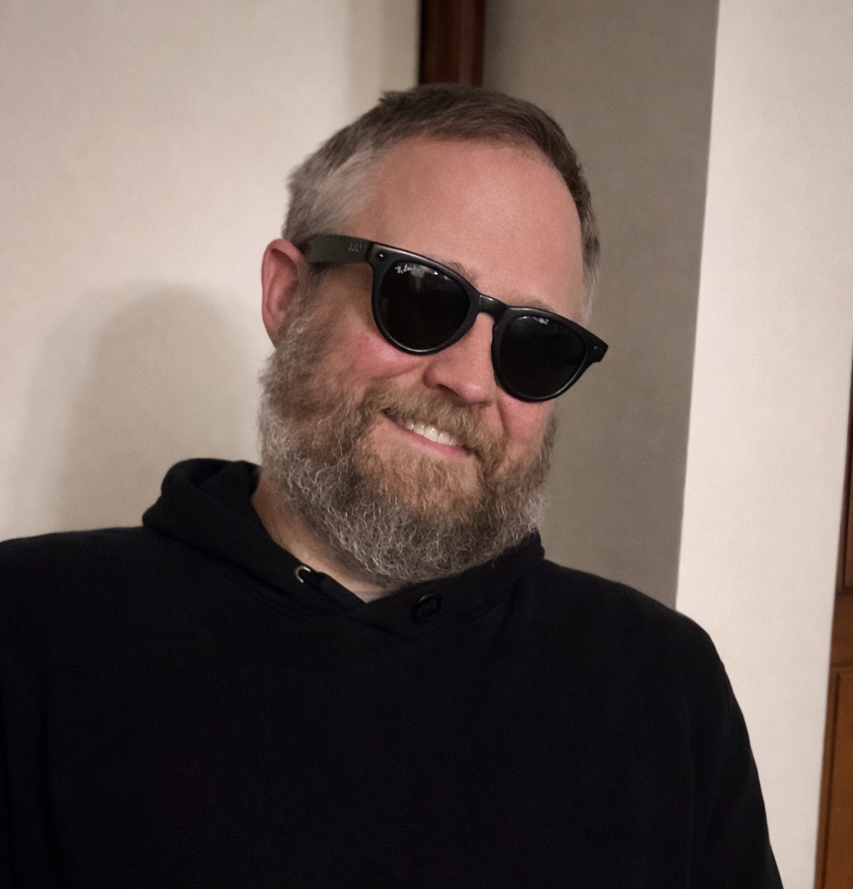
 When Caleb Bartley first noticed he was missing handshakes, he had no idea that moment would mark the beginning of a dramatic life transition. “I noticed I was missing handshakes… and I thought oh man, what is this?” he recalled. His eventual diagnosis of Retinitis Pigmentosa arrived abruptly, accompanied only by a two-page brochure and the words: “There’s nothing we can do for you.” Yet from the start, Caleb chose determination over discouragement, launching himself into a journey defined by purpose, creativity, and resilience.
As the world shut down during the pandemic, Caleb used the isolation as an opportunity to take control of his adaptation. “If I was going to adjust to blindness, then by God I was going to do it on my terms,” he said. He taught himself cane travel by watching YouTube videos, practiced navigating stairs and sidewalks, and experimented with street crossings. He dove into screen readers, learning NVDA, Narrator, VoiceOver, and later JAWS. His self-guided push laid a strong foundation long before he formally connected with anyone for support.
Caleb’s work at a CPA firm already provided him with good pay and stable employment. He decided what he needed was adjustment to blindness skills. So, Caleb connected with State Services for the Blind (SSB) to get training and supports to keep up with his rapidly changing vision. From his very first intake at SSB with Emily and Mark, Caleb felt welcomed. “Both of those intakes could not have gone better… it was just so easy.” Orientation and mobility training with SSB Community Partner Sharee Marcus validated the skills he had painstakingly built on his own and added new strategies and purpose behind each technique. “She said I had done a good job teaching myself—which was comforting—then gave me more tools and explained why things are done the way they are.”
As Caleb adjusted to new routines and new roads, technology support became essential. A tech assessment introduced him to the LyriQ, a portable text-to-speech device. Caleb had never encountered the LyriQ, but immediately realized it could be transformative for processing sensitive work documents: “I’ve recommended it to two or three people since then… it’s such a smart solution.” Even when budget freezes delayed funding, SSB staff continued advocating for him. Through the Employer Reasonable Accommodation Fund (ERAF), Caleb was then connected with Ray, who helped ensure his employer could receive reimbursement for the equipment.
Later, just as Caleb’s case was preparing to close, a new connection blossomed unexpectedly. When SSB counselor Jessica remembered an earlier recommendation for NVDA training materials, she introduced him to Callie from the new Evolve Employment Program. Caleb didn’t anticipate much—but within a week, everything he needed arrived. “I was like—holy cow.” What mattered even more was the follow-through. “Callie really took the time to circle back… it felt like there was a whole team around me.”
With each skill gained and each barrier removed, Caleb’s world began to grow again. “My world got a lot smaller—but because of the support from Emily, Mark, Jessica, Ray, and Callie, my world is no longer shrinking. In some ways, it has begun to expand.” Today, he travels independently by plane, train, bus, and white cane. He is returning to beloved outdoor passions such as rowing and water sports. He actively connects programs, people, and ideas—recommending services, sharing contacts, and championing innovations from Glide’s autonomous mobility device to OneCourt’s immersive stadium technology.
For others just beginning their own blindness journey, Caleb’s message is simple and compassionate. “Be kind to yourself… everybody goes through denial. You’ll get to where you need to be—on your terms.” He encourages people to learn early and stay curious. “Gain the knowledge now. Knowledge will never fade, even if your eyesight does.”
Today, Caleb shares his experiences openly because he believes deeply in the power of stories. “If somebody else thinks my story could help, who am I to not offer it? Every story has value.” His journey shows that life with vision loss isn’t about shrinking possibilities—it’s about rebuilding them, with the right tools, community, and support to help move forward.

