

Federal Hemp Changes
Translations of this page:
The information contained in this website is not legal advice nor is it intended to replace your obligation to thoroughly read all applicable law and rules. It is the responsibility of each applicant and license holder to maintain compliance with all applicable laws and rules.
Please note that following the signing of new federal legislation previewed below, we have updated this page to reflect the new effective date of the federal definition change, which is now Dec. 11, 2026. The rest of the message below remains the same as was sent on Aug. 31.
Download a handout summarizing the content on this page.
Changes to the federal hemp definition
In November 2025, President Trump signed a federal spending bill that changed the definition of hemp under Title 7, Section 1639o. This change to federal law—which effectively bans hemp products containing more than 0.4 milligrams (mg) of THC per package—will now take effect on Dec. 11, 2026, unless other federal action occurs.
The new federal definition clarifies what is federally legal as industrial hemp. The following products are excluded from the new definition of hemp, and therefore will become federally illegal:
- The hemp plant and plant parts (including seeds) with more than 0.3% total THC concentration, including THCA (the previous definition included only delta-9 THC).
- Intermediate hemp-derived cannabinoid products with more than 0.3% total THC.
- Final hemp-derived cannabinoid products containing more than 0.4 mg total THC per container.
This federal definition change does not change how Minnesota law defines lower-potency hemp edible (LPHE) products and LPHE retailers, manufacturers and wholesalers or the legality of those products in the state. LPHEs are defined in Minnesota Statutes, section 342.01, subdivision 50, and are allowed to be manufactured and sold under state law. Minnesota’s definitions of LPHE licenses and product types will not change after the federal definition changes on Dec. 11, 2026.
However, under the new federal definition, many products compliant under Minnesota law (e.g., packages containing more than 0.4 mg of THC) will become federally noncompliant. We recognize this will have a variety of impacts on businesses currently selling LPHE products. For example, similar to complexities currently faced in the cannabis industry, the federal change could result in:

Limited access to federally insured banking and financial services
Limitations on point-of-sale services
Restrictions on federal tax deductions
Limitations on interstate commerce*
*Through applicable endorsements, Minnesota’s licensing system authorizes the import of products qualifying as LPHEs from other jurisdictions and the export of hemp products manufactured in Minnesota to jurisdictions where the products meet the state’s regulatory requirements. These provisions of state law were enacted under the existing federal definition of hemp. Given that many existing LPHE products in Minnesota will no longer be compliant with the pending new federal definition, operators that hold these endorsements should be especially aware of the impact of the federal definition on the interstate hemp market and should consult with legal counsel to assess the implications for their business. Operators holding an LPHE importer endorsement before any federal changes go into effect should review Guidance Memo 2025-02 (Standards for Out-of-State Hemp Product Importing) and ensure that any product imported into Minnesota is compliant with Minnesota and federal law and regulation.
OCM cannot provide hemp businesses with business or legal advice, and we recommend speaking with legal counsel before making decisions. This page lays out information that may be helpful to businesses as the planned federal law change approaches.
Licensure options for LPHE businesses
As the federal definition change nears—and the first license renewal period approaches for LPHE license holders—businesses should be aware of their options for making changes to align their business plans and license status with the anticipated federal changes.
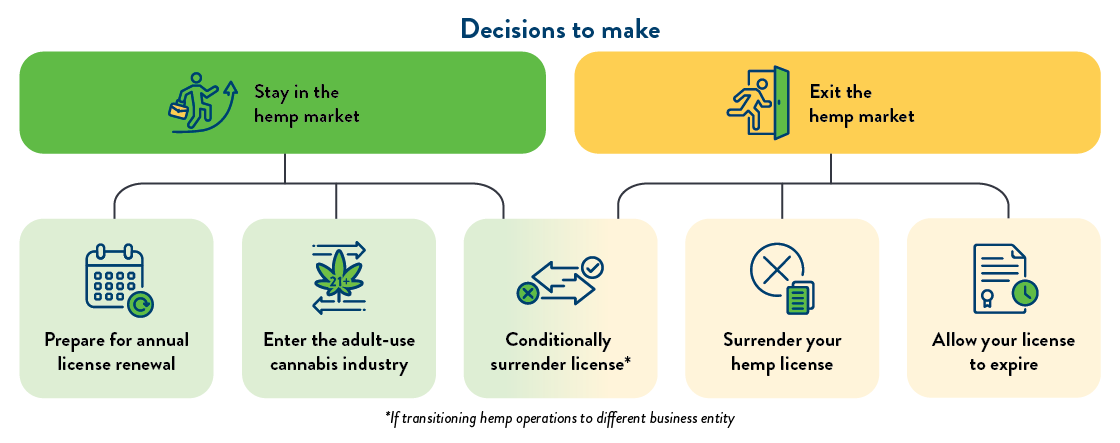
 Prepare for annual license renewal
Hemp business licenses must be renewed on an annual basis under Minnesota law. If businesses are assessing the federal changes and would like to continue operating as a licensed hemp business within Minnesota, current hemp business license holders can prepare for upcoming annual license renewal by:
- Reviewing their FPOR documents to ensure they are up to date
- Gathering any updated contact information
- Collecting any other supporting documents
OCM notifies businesses that their license is up for renewal 90 days before the license expires. If a renewal application has not been submitted after the initial notification, automated reminder notifications are sent to business contacts at 60 days and again at 30 days before the license expiration date.
 Surrender your hemp license (including a conditional surrender process)
If a business decides to cease operating as a licensed hemp business within Minnesota, they can surrender their hemp license and cease all operations of their current business. To voluntarily surrender a license, email ocm.licensing@state.mn.us. Attach the following required document:
- Completed Request to Surrender LPHE License Voluntarily form (updated 5/29/2026)
Notably, the form also includes a conditional surrender option. Per Minnesota Statues, section 342.44, a hemp business license cannot be transferred, and once a business surrenders a license, they are not able to sell or buy LPHE products. The conditional surrender process is available if a business plans to transition their hemp operations and products to a different business entity by conditioning the surrender of the existing hemp business's license to the issuance of a new license to the new entity upon successful application while minimizing business interruptions. Minnesota Statutes, section 342.44, subdivision 2, does not allow businesses to transfer a hemp license. As such, businesses need to surrender their current license, and the new business would need to apply for a new LPHE license under the new business entity.
 Allow your license to expire
Business licenses are issued for one year. Businesses may exit the hemp market by simply choosing not to renew their license and instead waiting until it expires. Please note that upon a license expiring, all LPHE business activities must end.
 Enter the adult-use cannabis industry
A hemp business can consider entering the adult-use cannabis market. This past session, the Legislature removed the prohibition on holding a cannabis business and hemp business license simultaneously. While there is not currently an open window for applications for cannabis businesses licenses, a large number of prospective cannabis businesses continue to advance through the licensing process that may be available for business partnership or investment. To learn about options that existing cannabis applicants and license holders have regarding ownership changes, visit the Making Business Changes webpage. Making business changes requires working closely with OCM to follow established processes and sometimes receiving prior approval [Minnesota Statutes, section 342.14, subd. 1(a)].
 Federal bills to watch
Following the passage of the definition change last November, there have been many discussions across the hemp industry and members of Congress about the potential for further changes before the law goes into effect. Several bills have been introduced as Congress and various federal agencies are considering additional changes to the federal status of hemp and cannabis. The introduction or consideration of bills does not mean that they will pass, and it is difficult to anticipate the likelihood of further federal action and the implications for state license holders. However, businesses may wish to monitor and engage with their federal elected officials on these current proposals:
Continuing Appropriations and Extensions Act of 2027 (continuing resolution)
- This bill extends key provisions of the ban on hemp-derived products from Nov. 12 to Dec. 11. It was passed by the U.S. Senate on Aug. 8 and passed by the U.S. House on Sept. 1. The president signed the bill on Sept. 3, enacting the new date for the federal change in definition.
Lawful Hemp Protection Act
- This bill would establish a federal regulatory framework for hemp-derived consumer products. It would limit the legal definition of hemp to 1% THC; establish cannabinoid limits; prohibit synthetic cannabinoids; restrict under-21 sales; establish packaging, labeling, and testing requirements; establish a distribution system for hemp beverages similar to alcohol; and impose a tax on products. It has not received a vote in either chamber.
Beverage Regulatory Parity Act
- This bill exempts hemp beverages from the federal definition change—it would establish cannabinoid limits; prohibit synthetic cannabinoids; restrict under-21 sales; establish packaging, labeling, and testing requirements; establish a distribution system for hemp beverages similar to alcohol; and impose a tax on products. It has not received a vote in either chamber.
 Upcoming hemp industry forum
OCM is convening a discussion forum in late September to provide space for industry to share the impact of federal changes on businesses and share information around the options available through the current regulatory framework.
 Resources
For more information on allowable product types, THC limits, and packaging and labeling requirements, review the following documents:
- Hemp Businesses in Minnesota: A guide for lower-potency hemp edible licensed businesses
- Packaging and Labeling Guide for Cannabis and Hemp Products
- Lower-Potency Hemp Edible (LPHE) Product Compliance Packaging and Labeling Quick Guide
General business support resources
Department of Employment and Economic Development:
- Small Business Digital Toolbox
- Get Connected / Do Business in Minnesota
- Start & Grow Your Small Business / Do Business in Minnesota
- Cannabis Industry Navigation Program (CanNavigate)
- Cannabis Industry Startup Financing (CanStartup)
- List of Minnesota Investors
- Minnesota Business First Stop Assistance Form
Apprenticeship and dual training resources for cannabis workers
Department of Labor and Industry:
Pollution prevention and environmental regulations resources
Pollution Control Agency:
Department of Labor and Industry:
Industrial Hemp Development Act (chapter 18K)
Minnesota Department of Agriculture:
Tax Inquiries
Minnesota Department of Revenue: