

2026 Legislative Session Recap
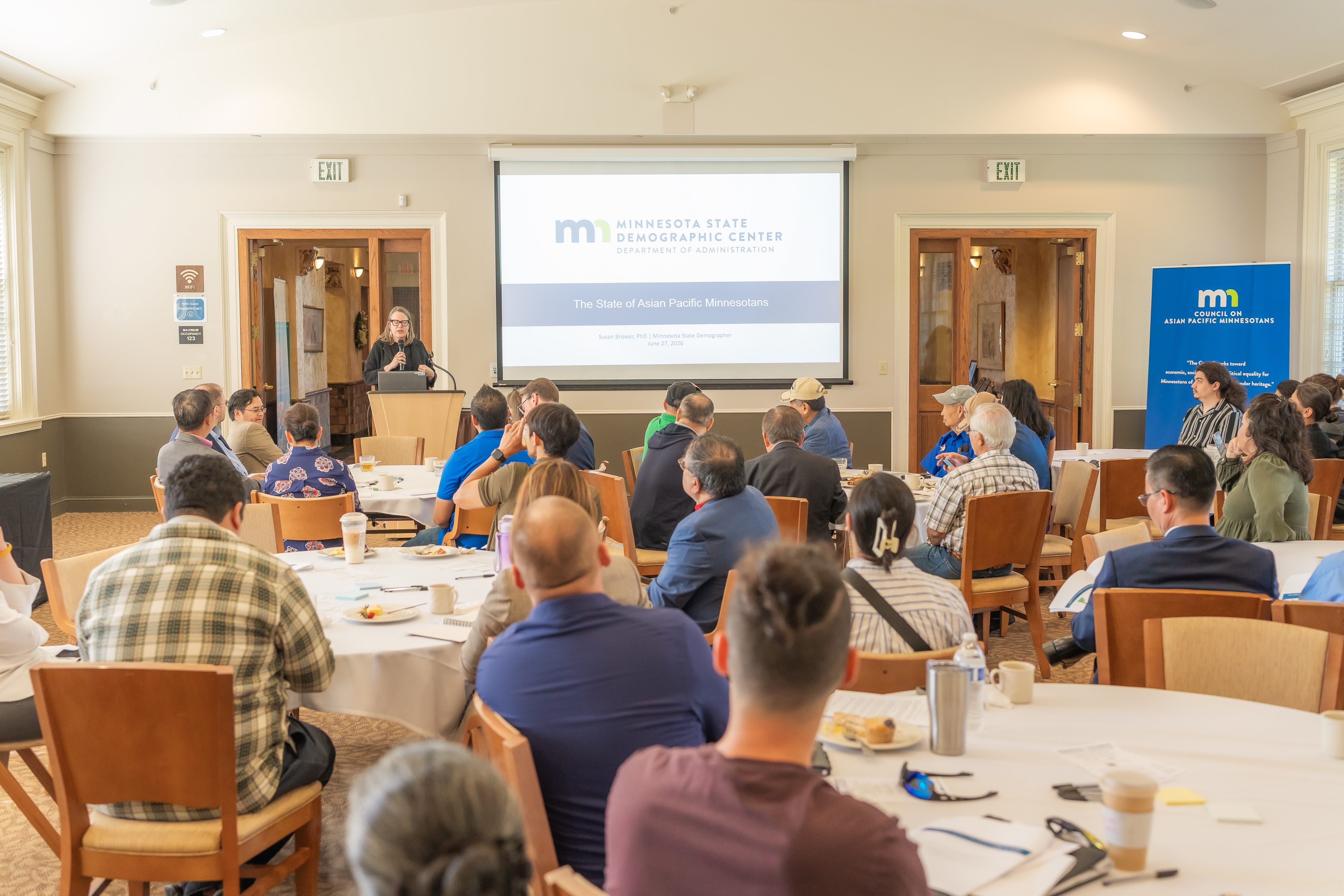 The 2026 legislative session saw many bills passed, discussed, and tabled. On June 27, 2026, the Council hosted a well-attended Session Recap Event in partnership with the Minnesota Humanities Center.
2026 Legislative Session Comes to a Close with Bipartisan Agreements, but Some Major Bills Left Undone
At midnight on Sunday, May 18, the Minnesota State Legislature concluded its work for the 2026 legislative session. With an evenly split House of Representatives (67-67) and a slim Democratic-majority in the Senate (34 Democrat senators – 33 Republican senators) during a midterm election year, bipartisan collaboration was essential in addressing our state’s most pressing issues.
There were bipartisan victories for healthcare, housing, public infrastructure, and accountability initiatives including:
- The creation of a statewide Office of Inspector General to address and prevent potentially fraudulent activity and misuse of taxpayer money;
- A pathway to stabilize Hennepin County Medical Center (HCMC);
- A $1.24 billion bonding bill to invest in public infrastructure projects;
- $125 million in property tax relief;
- $40 million in emergency rental assistance funding for those in urgent need (especially community members impacted by Operation Metro Surge); and
- A constitutional amendment coming to the 2026 ballot to increase the distribution from the permanent school fund without raising taxes, among many other items.
The Council is now preparing for our 2026 Legislative Session Recap Event. The Recap is a great opportunity to connect with other community members and leaders, learn more about this legislative session, and speak directly with lawmakers and the Council about what priorities you would like us to focus on during the 2027 legislative session. Event details will be announced soon—we hope you will join us.
Additionally, the Council will be hosting its next Check-in with the Council on Friday, June 5. These public community conversations are an opportunity to meet with Council staff and other members of the community to discuss what issues are important to you and to share what you are seeing in our communities. Please visit the Council’s website for information on how to join. We look forward to seeing you there.
In the meantime, below is a detailed summary of key initiatives that did and did not pass in the 2026 session.
Initiatives that Passed
Healthcare & Public Health Support - Stabilizing HCMC & Rural Hospitals
Hennepin County Medical Center (HCMC) is a cornerstone of our local and regional healthcare system. It is the state’s busiest trauma hospital, serving more uninsured and low-income residents than any other facility in Minnesota. Approximately 6,500 to 7,000 people work at HCMC, making it the largest employer in downtown Minneapolis. HCMC is a lifeline for maintaining quality public health for workers and their families’ livelihoods, and for patients in need, especially for urgent and life-saving treatment for Asian Pacific Minnesotan communities.
Earlier this year, HCMC announced that it was facing a $50 million budget deficit and was expected to incur $1.7 billion in losses over the next 10 years due to rising uninsured rates, increasing uncompensated care costs, and changes to federal health policy, including $1 trillion in cuts to Medicaid in the next decade after Congress passed H.R. 1 (also known as the “One Big Beautiful Bill Act”).
With this crisis looming, Democratic and Republican state lawmakers came to a bipartisan agreement to direct $205 million from the General Fundstabilize HCMC for the next year and allocate $500 million from the state’s budget reserve over five years for healthcare systems and hospitals at risk of closure. An additional $30 million will be set aside for distressed hospitals across Minnesota. With this funding, our most vulnerable community members can continue to access the medical care that every person deserves.
Housing Investments
The state legislature passed a $165 million housing package that includes:
- $100 million in Housing Infrastructure Bonds (HIBs);
- $40 million for Family Housing Prevention and Assistance Program (FHPAP);
- $40 million in emergency rental assistance funding;
- $14.275 million in workforce housing development program;
- $4 million for supportive housing;
- $425,000 for investments in statewide tenant hotlines services to build greater capacity for renters in need of resources and support; and
- $150,000 for homeownership education and counseling.
These bipartisan investments translate to more neighbors being housed with dignity and safety as state lawmakers continue to navigate the impact of federal funding cuts in housing on our communities.
Benefits for Veterans of the Secret War in Laos
In 2025, the state Legislature passed a bill to grant state veteran recognition and limited benefits to veterans of the Secret War in Laos. This bill established a task force to make recommendations on eligibility and the process for veterans to claim benefits. The task force met throughout 2025 and produced a report outlining its recommendations to the Legislature for consideration during the 2026 legislative session.
This year, the Legislature completed the work of this task force, passing legislation to formalize eligibility requirements and application procedures for these veterans. With the bill now signed into law, the Minnesota Department of Veterans Affairs will now implement this program, which includes recognition on state driver’s licenses, preferential employment consideration, access to military burials, and outreach to ensure as many eligible veterans as possible receive this justly earned recognition.
Public Infrastructure Funding
The $1.24 billion bonding bill passed in the closing hours of the 2026 legislative session will improve the day-to-day lives of Minnesotans through investments in infrastructure across the state that includes (but are not limited to):
- $47 million for local road improvements;
- $30 million for grants to improve drinking water infrastructure;
- $26 million for grants to improve clean water infrastructure;
- $25 million for the local bridge replacement;
- $17.5 million for public housing rehabilitation;
- $15 million for lead service line replacement;
- $10 million for grants for emergency shelter; and
- $9 for flood hazard mitigation.
Initiatives that Did Not Pass:
Unfortunately, Democratic and Republican lawmakers could not come to an agreement on a few critical pieces of legislation, including the following:
Economic Relief & Response to Immigration Enforcement
During the session, legislators considered options to provide relief to businesses impacted by federal immigration enforcement activities, either through partially forgivable loans or as grants. A bill for a $100 million business relief forgivable loan program for businesses impacted by Operation Metro Surge did not pass into law after previously being approved by the Senate. If passed, this legislation would have provided urgent relief to Asian Pacific Minnesotans and other immigrant communities that were severely financially impacted by Operation Metro Surge.
Several bills that would have limited federal immigration officers’ access to sensitive locations (such as schools, courthouses, hospitals, and daycares), from masking during law enforcement activity, and to restrict civil immigration enforcement actions were not passed into law.
Gun Violence Prevention
Legislation that included a ban on assault weapons and large-capacity magazines, investments in school safety and Extreme Risk Protection Order (ERPO) implementation, and measures to crack down on ghost guns and binary triggers did not pass into law.