

2025 Legislative Session Recap
The 94th Minnesota Legislature convened on January 14, 2025, and the 2025 legislative session adjourned on May 19, 2025. The Council has compiled the below overviews and infographics breaking down the 2025 Minnesota legislative session into easy-to-understand pieces. Read on to learn more.
Budget
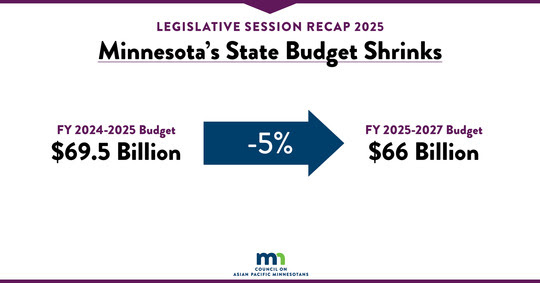 After a tumultuous 2025 session, with numerous vacancies and extended debate over power sharing in a newly tied state House or Representative, the state Legislature completed the new two-year budget in a special session on June 9. The new two-year budget will spend about $66 billion, down from nearly $70 billion from the last biennium, setting a more modest direction for state government in the coming years.
After working with a record-high budget surplus of $17 billion in the previous biennium, legislators returned to the Capitol in January to a significantly changed fiscal picture. In contrast to the surpluses from the last two biennia, legislators had to address a looming budget deficit of about $6 billion beginning in 2027-2028. While legislators were able to close this gap by approximately 50%, more work and careful monitoring of the state’s long-term outlook will be needed, particularly with uncertain changes in federal funding and future economic conditions.
 Access to Healthcare
Access to healthcare was identified by Asian Pacific Minnesotans as the number one priority issue in the Council’s 2024 Community Priorities Survey. This has been a longstanding priority issue for community members, with areas of concern including affordability, language access, provider availability, and understanding of culturally specific needs.
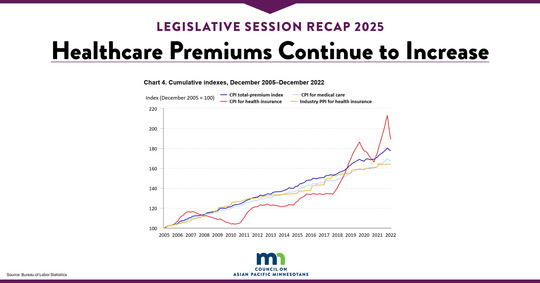
Over time, healthcare costs have increased significantly relative to inflation both in Minnesota and across the country. This has been particularly true as the state’s population has aged and needed more care, even as the working age population shrinks. This is projected to be a driving cause for budget pressure both on the state government as well as on family budgets in the coming years. At the same time, these rising costs are paired with a reduction in federal health insurance subsidies, resulting in rate hike proposals in 2026 of between 7– 26% for the average Minnesotan, far outpacing the overall rise in cost of living.
 As costs have risen and needs have grown, it will become increasingly challenging for state lawmakers to provide the services Minnesotans need while passing a balanced budget. The state’s budget has been reduced by approximately 5% since the last biennial budget, largely to control growing expenses in long-term care and special education needs. However, even with this significant reduction, Minnesota will still need to address a remaining deficit of nearly $3 billion in the next budget year in 2027, even before accounting for the potential impact of recent federal changes, such as cuts to Medicare or changes in healthcare premium subsidies. This is why understanding the needs of Minnesotans and our diverse communities is so crucial to long-term health of our state’s residents and budget.
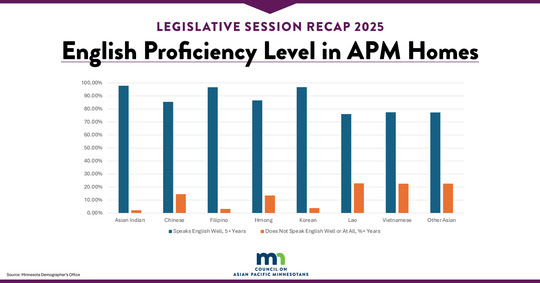
Access to healthcare and expected health outcomes can range broadly between Asian Pacific Minnesotan communities. This is due, in part, to increased challenges facing refugee-experienced communities and others with limited English proficiency as well as significant differences in economic security, educational attainment, and underlying health concerns. These considerations make it clear that simply removing financial challenges from certain Asian Pacific Minnesotan communities would not alone ensure accessibility to healthcare; change requires adopting policies that address cultural and linguistic hurdles as well.
 One important area of change in the 2025 session was the establishment of a Spoken Language Medical Interpreting Working Group to consider and recommend improvements to medical interpretation services in Minnesota. This working group will help improve outcomes for elderly, newly arrived, and other vulnerable groups while improving the standard of service provided by medical interpreters. The Council supported this legislation and has previously championed legislation to improve medical interpreting standards, and believes the establishment of this working group will improve health outcomes for the approximately 100,000 Asian Pacific Minnesotans with limited English proficiency.
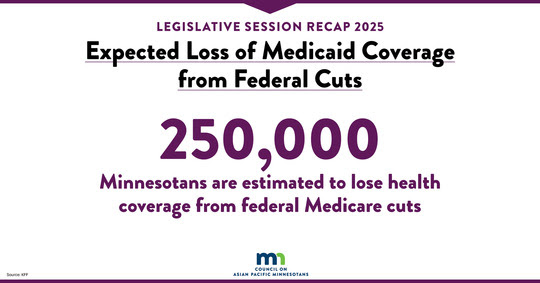
One of the largest, and still most uncertain, areas of concern is how recent federal changes may impact the availability and affordability of healthcare, particularly for lower-income and older Minnesotans. One estimate by state government suggests up to 250,000 Minnesotans could lose access to Medicare. This could be due to a combination of direct changes, such as to qualifications, as well as indirect changes such as the requirement for additional paperwork. This is in addition to an estimated 62,000 Minnesotans who could lose access to healthcare insurance in the private market. However, as it will take time for the impact of federal changes to be fully felt, these estimates may be higher or lower depending on other factors, such as the overall health of the state and national economy.
The impact of these and other federal changes on Minnesotans will undoubtedly be a major focus during the 2026 session, as state legislators attempt to balance the budget while maintaining access to services.
 Arts, Culture, and Legacy
Since the Council was established in 1985, the population of Asian Pacific Minnesotans has grown by nearly 10 times, from around 35,000 in the mid-80s to over 300,000 today. As Minnesota as a whole has become more diverse, our population has become increasingly interested in preserving their histories, traditions, and cultures in our state.
A key component of supporting the preservation of cultural heritage has been the Minnesota Legacy Amendment. Originally passed by a state constitutional referendum in 2008, the Legacy Amendment creates a dedicated revenue stream to preserve Minnesota’s history and cultural heritage through a sales tax of 0.125%. For Asian Pacific Minnesotans, this has resulted in funding that has supported cultural events and festivals, museum exhibits, language preservation, artistic displays, and much more.
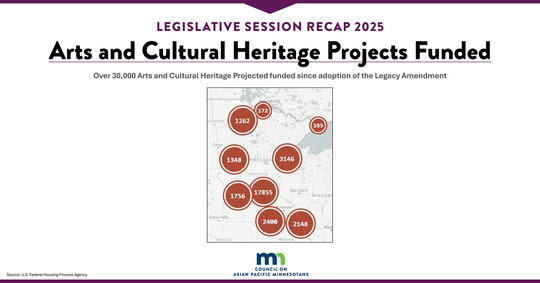 One of the major changes to Legacy funds in the 2025 session was a shift away from direct funding of projects to larger pools of competitive funds managed by organizations such as the Minnesota Humanities Center and the Minnesota Historical Society. This change was part of a broader shift in the Capitol to combat fraud and waste by moving away from providing direct appropriations in favor of competitive projects, which require a higher level of reporting and scrutiny. While there are some drawbacks and concerns to this approach, including the potential for smaller and less-established communities to be at a competitive disadvantage in the grant writing process, there are benefits, such as a higher degree of accountability and stewardship of state resources.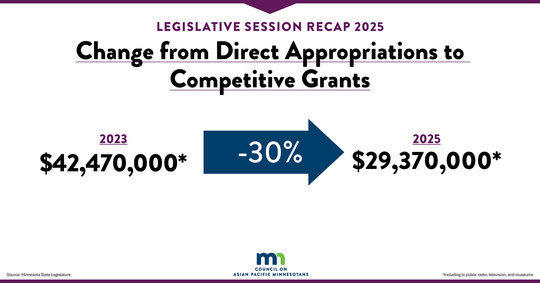
Housing
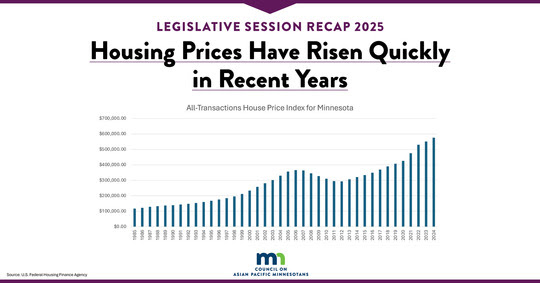 Since the COVID-19 pandemic began in 2020, the cost of housing has increased significantly across the country and state as affordability and accessibility have not kept up with demand. During the 2025 session, the Legislature considered several proposals to address the rising cost of housing across the state and improve affordability and accessibility to stable housing.
While bipartisan initiatives to increase new construction were not approved during the 2025 session, the state did continue to reduce barriers for first-time homebuyers. Initiatives included $3.8 million for the Homeownership Assistance Fund designed to close disparity gaps between different groups of Minnesotans, $2 million for the Community-based First-generation Homebuyers Down Payment Assistance Program, and other policies and programs meant to improve access to stable, affordable housing.
These investments come as housing costs have risen quickly in recent years. Today, one of the most significant challenges to securing stable housing has been a rapid and sustained increase in both the average cost of homes and the cost of rental housing. According to MLS data, the median home price in Minnesota has risen significantly over the past 5 years, from $290,000 in July 2020 to $375,000 in July 2025.
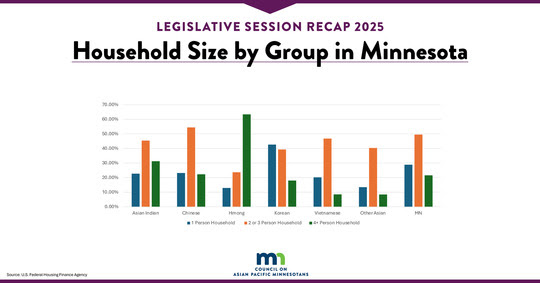 Because of the broad diversity within the APM community, API Minnesotans experience vastly different housing challenges depending on their personal and community situations. As an example, it is much more common for APM households to include at least one child, ranging as high as in 63% of all Hmong households in 2023. This contributes to APM households consisting of larger household sizes, with four or more people per household being much more common than the population as a whole.
As housing costs continue to rise and affordable housing, including construction of starter homes, become increasingly difficult to secure, Minnesotans may face growing challenges in finding stable homes. The Council encourages legislators and state government to take a holistic approach to ensure all Minnesotans, no matter their means or background, have access to safe, affordable, and stable housing.
Employment and Income
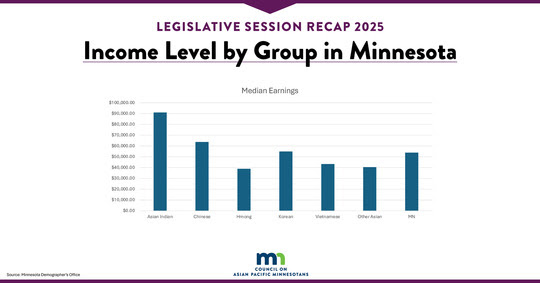 As the cost of living and inflation increased during the last few years, income and wages has become one of the top concerns for Asian Pacific Minnesotans. As APMs are made up of an incredibly diverse range of communities from all kinds of backgrounds and experiences, identifying employment and income needs for Asian Pacific Minnesotans can be a challenge, particularly when comparing between our immigrant and refugee experienced populations.
However, as the job market shows some signs of slowing down while inflation remains stubbornly high, it will be a crucial area of concern for Minnesotans well into the future. These concerns have continued to gain attention at the Legislature as the Legislature appropriated more funds for job training and unemployment assistance and implement policies to ensure programs are effectively implemented. These include policy provisions to increase the penalty for intentional misrepresentation with regard to unemployment benefits, require a task force to examine the workforce development system, including funding systems and metrics, and create a uniform outcome report card and allow the department to withhold grants if the grantee hasn’t provided up-to-date information.
 Household income levels are an area of great divergence between Asian Pacific communities in Minnesota, particularly between our immigrant and refugee communities. While immigrant communities such as the Asian Indian, Chinese, and Japanese frequently exceed the state’s median income level, refugee-experienced communities often lag behind. This is due to a number of factors, including education levels, language proficiency, lack of access to transportation, and other factors.
While Minnesota continues to have a strong labor market, with a 3.6% unemployment rate as of August 2025, disparities persist among certain groups. While many APM groups match or are below the overall unemployment rate, refugee-experienced Minnesotans, such as those from Southeast Asia, continue to experience higher levels of unemployment. Data from 2023 showed that Hmong Minnesotans experience a 6% unemployment rate, Vietnamese Minnesotans a 5% rate, and a 4% overall rate. These differences in communities make it important to ensure the culturally relevant outreach is available through APM-focused community-based organizations in order to most effectively provide employment support to those who need it.
The Council encourages DEED and the state Legislature to continue to work with community leaders and community-based nonprofit organizations to ensure APMs and all Minnesotans have access to employment training and assistance programs. Similarly to Legacy Amendment grants, during the 2025 session the state Legislature reviewed its practice of making direct grants to organizations compared to providing larger, competitive pools of funding for employment assistance programs, with the state opting for less direct appropriations to specific organizations in favor of higher funding for competitive grant pools. No matter the future path chosen by legislators, the Council urges careful consideration of statutory language and eligibility requirements to ensure that culturally specific considerations are included in these funding opportunities to ensure the needs of all Minnesotans are met.