
EMS Providers in Minnesota
Whether you’re beginning your EMS journey or an experienced provider transferring your National Registry of Emergency Medical Technicians (NREMT) certification, Minnesota offers a great place to practice.
Why Choose Minnesota for EMS?
Minnesota is home to some of the most innovative and progressive EMS agencies in the country. With strong Medical Director support, advanced protocols, and a diverse mix of urban and rural EMS systems, providers here can practice at the top of their scope and make a real impact in their communities.
If you’re passionate about helping others, responding to emergencies, and making a difference in critical moments, consider a career in EMS today!
Questions? Contact info.OEMS@state.mn.us
Get Started with EMS in Minnesota
Use the links below to explore opportunities, apply for certification, and learn why Minnesota is a great place to live and work.
Certification & Registration Requirements
All EMS certification and registration applications must be submitted through the Minnesota eLicense Portal.
EMS Levels in Minnesota
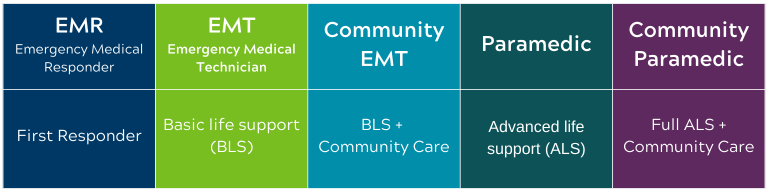
Minnesota has several EMS registration and certification levels, each with specific training, responsibilities, and skillsets. The table and descriptions below provide a general overview of each level, but they don’t include all possible skills. The service medical director determines which skills are allowed at each level. If you're considering a career in EMS, check the patient care protocols of the service you're interested in to understand how these roles work in practice.
Emergency Medical Responder (EMR)
The First Line of Emergency Care
EMRs are often first on the scene, providing immediate life-saving interventions before an ambulance arrives. They are commonly firefighters, law enforcement officers, or workplace responders.
Requirements:
- Complete an Emergency Medical Responder Initial Course (approved by OEMS).
- Submit an EMR Initial Registration application.
Skills & Responsibilities:
- Perform CPR and use an AED.
- Control bleeding and shock.
- Assist in basic airway management (oral/nasal airways, BVM).
- Provide spinal motion restriction and splinting.
- Communicate with EMS teams for patient transfer.
Perfect for: Those looking to start in emergency care or add EMS skills to another profession (firefighting, law enforcement, security, workplace safety).
Emergency Medical Technician (EMT)
Basic Life Support (BLS)
EMTs provide pre-hospital emergency care, transport patients, and assist paramedics. They are the backbone of EMS response teams.
Requirements:
- Complete an NREMT-approved EMT course.
- Obtain National Certification (NREMT).
- Submit an Initial EMT Certification application.
Skills & Responsibilities:
- Assess and stabilize patients in medical and trauma emergencies.
- Administer oxygen, CPR, naloxone (Narcan), and epinephrine (EpiPen).
- Perform non-invasive airway management (CPAP, suctioning).
- Splint fractures and manage spinal injuries.
- Transport patients to hospitals for further care.
Perfect for: Those looking for a fast-paced, hands-on emergency medical career. Many EMTs continue to become paramedics, nurses, or other healthcare professionals.
Community EMT (CEMT)
Basic Life Support (BLS) + Community Care
Community EMTs (CEMTs) provide essential follow-up care within the first 24–48 hours after a patient is discharged from a hospital or nursing home. They also conduct safe home checks for patients who frequently call 911, helping reduce preventable emergencies and supporting long-term wellness.
Requirements:
- Be currently certified as an EMT or AEMT.
- Have at least two years of service as an EMT or AEMT.
- Successfully complete an approved education program, including training in culturally appropriate care.
- Submit a Community EMT application to the OEMS.
Perfect for: Experienced EMTs or AEMTs who want to expand their role in community-based, preventive healthcare for Minnesota Health Care Programs (MHCP) members.
Paramedic
Full Advanced Life Support (ALS) Provider
Paramedics provide the highest level of pre-hospital care, performing advanced procedures and administering life-saving medications.
Requirements:
- Complete an NREMT-approved Paramedic course.
- Obtain National Certification (NREMT).
- Submit a Paramedic Certification application.
Skills & Responsibilities:
- Perform advanced airway techniques (intubation, surgical airways).
- Administer IV medications, including pain management and sedation.
- Read and interpret 12-lead EKGs and provide cardiac care.
- Manage medical and trauma emergencies at an advanced level.
Perfect for: Those passionate about high-acuity emergency medicine, working on ambulances, helicopters, or in hospital emergency departments.
Community Paramedic
Expanding EMS Beyond Emergencies
Community Paramedics focus on preventative care, chronic disease management, and reducing unnecessary ER visits.
Requirements:
- Hold a valid Paramedic Certification.
- Complete a Community Paramedic Initial Course (approved by OEMS).
- Submit a Community Paramedic Certification application.
Skills & Responsibilities:
- Manage chronic conditions (diabetes, CHF, COPD).
- Provide wound care and post-hospital follow-ups.
- Assist with medication reconciliation and patient education.
- Work with hospitals, clinics, and public health agencies.
Perfect for: Experienced paramedics who want to expand their role beyond emergency response and focus on long-term patient care.
RN & PA Pathway to EMS
- Pre-Hospital RN (PHRN): This designation is for RNs that have a current Minnesota nursing license AND have either a Certified Flight Registered Nurse (CFRN) certification OR a Certified Emergency Nurse (CEN) certification. RNs with the Pre-Hospital RN designation can provide advanced level care when working for an Advanced Life Support licensed service. The PHRN designation expires when the nursing license expires or the CEN/CFRN certification expires, whichever expires soonest.
- Advanced RN-EMT: An RN without a CEN or CFRN credential is still able to provide advanced level care with the following requirements. They must currently have a valid EMT/AEMT certification from the Office of EMS, be currently practicing as a nurse, and have approval from the ambulance service medical director. The Advanced RN-EMT credential expires with the candidate EMT certification.
- Advanced Physician Assistants (PA): EMT: Similar to RN-EMTs, PAs can function provide advanced level care by meeting the following requirements: have a valid EMT/AEMT certification, be currently practicing as a physician assistant, and have approval from the ambulance service medical director. The Advanced PA-EMT credential will expire with the provider’s EMT certification.
Join Minnesota EMS Today!
If you're driven by a passion for helping others in critical moments, EMS is a rewarding and impactful career. Whether you're just starting or advancing your skills, Minnesota provides the training, support, and opportunities you need.
Ready to Apply? Visit the Minnesota eLicense Portal to begin your EMS journey!
Have questions? Contact info.OEMS@state.mn.us